
You are in a packed stadium. Your phone shows 5G, and a video loads in a second. Thousands of people around you are doing the same thing, and the network keeps up.
Later, in a concrete car park under the same stadium, the same phone shows the same 5G symbol — but the video stalls. Same phone, same symbol, very different result. The difference is invisible: the length of the radio waves carrying your data.
Quick answers
- What is 5G wavelength?: The physical length of one 5G radio wave, measured from one crest to the next. It ranges from about 50 centimetres on low-band 5G down to a few millimetres on the highest 5G frequencies. [1][2]
- Why does wavelength matter?: Because it decides what a signal can do. Longer wavelengths travel farther and pass through walls more easily. Shorter wavelengths carry far more data, but only over short distances. [1][3]
- Is there one 5G wavelength?: No. 5G uses many frequency bands at once, so the wavelength changes with the band your phone is using at that moment. [1][4]
5G is often sold as one thing: faster internet. In reality it is a set of radio technologies working across a wide range of frequencies, from under 1 gigahertz to above 50 gigahertz. [4][6] Each of those frequencies carries its own wavelength, and the wavelength shapes what the signal can do.
Every radio signal is a wave, and every wave has a length. That length is set by the frequency. It decides how far the signal travels, how much data it carries, and how big the antenna must be. This article works through the idea step by step: what a wavelength is, how it links to frequency, which wavelengths 5G uses, and why the shortest ones are both the fastest and the most fragile.
What Is a Wavelength?
To understand 5G, start with the wave itself. A radio wave is a travelling pattern of electric and magnetic fields. The wavelength is the distance between two matching points on that wave, such as one crest and the next.
Radio waves belong to the electromagnetic spectrum, the same family as visible light, X-rays and the waves inside a microwave oven. The only difference between them is frequency — and therefore wavelength. [1] A magnet’s field and a radio wave are different effects of the same underlying physics.
Think of waves on water. Long, slow rollers travel far and pass around obstacles. Short, rapid ripples carry more energy in a small space but fade quickly. Radio waves behave in a similar way, and that comparison runs through the whole story of 5G.
How Are Frequency and Wavelength Connected?
Frequency and wavelength are two ways of describing the same wave. Frequency counts how many wave crests pass a point each second, measured in hertz. Wavelength measures the distance between crests. The two are linked by the speed of the wave.
Radio waves travel at the speed of light, about 300,000 kilometres per second in air. So the wavelength equals the speed of light divided by the frequency. Double the frequency, and the wavelength halves. [2] Radio signals travel at nearly the speed of light, which is also the fact that lets GPS measure distance from signal timing.
A few everyday numbers make the link concrete. An FM radio station at 100 megahertz has a wavelength of about 3 metres. A Wi-Fi router at 2.4 gigahertz has a wavelength of about 12.5 centimetres. A 5G signal at 28 gigahertz has a wavelength of about 1 centimetre. [2] Same physics, very different lengths — and those lengths decide what each signal can do.
Because the speed never changes, frequency and wavelength always move in opposite directions. That is why engineers talk about frequency when they mean wavelength, and the other way round: naming the frequency names the wavelength too.
What Wavelengths Does 5G Use?
With that link in mind, the 5G picture falls into three bands. 5G is not one frequency. The standard, called 5G New Radio, works across two ranges: Frequency Range 1, the sub-6 GHz range, and Frequency Range 2, from 24.25 GHz to 52.6 GHz, with a newer extension reaching 71 GHz. [4][6] The full system is explained in How Does 5G Work?
Low-band 5G uses frequencies from 600 to 900 megahertz, giving wavelengths of about 50 to 33 centimetres. These are the longest 5G waves, and they are used for wide coverage — reaching across kilometres and into buildings. [2]
Mid-band 5G uses frequencies from 3.3 to 4.2 gigahertz, giving wavelengths of about 9 to 7 centimetres. The mid-band around 3.5 GHz is often called the sweet spot of 5G: a useful balance of speed and range. [1][2]
High-band 5G, also called millimetre wave or mmWave, uses frequencies from 24 to 52.6 gigahertz, giving wavelengths of about 12 to 6 millimetres. [2][6] The name is literal: these waves are measured in millimetres, not centimetres or metres. In the United States, the first high-band 5G auctions covered the 24 GHz and 28 GHz bands, and concluded in 2019. [5]
Why Do Shorter Wavelengths Carry More Data but Travel Less Far?
The three bands above are not equal — and the reason is the wavelength itself. A shorter wavelength means a higher frequency, and higher frequencies offer wider channels. Wider channels carry more data at once.
That is why mmWave can reach multi-gigabit speeds, while low-band 5G typically delivers 100 to 900 megabits per second. [3] The 5G standard was designed with a peak download target of up to 20 gigabits per second. [4] The shortest waves carry the most data.
There is a second reason higher frequencies carry more. The high bands also offer far more empty room. Sub-6 GHz channels reach about 200 megahertz wide, while mmWave channels can reach 2 gigahertz wide — ten times as much. [1] That extra width is what the shortest wavelengths unlock.
But the same short waves fade faster. A mmWave cell reaches only about 100 metres before the signal drops off, while a low-band cell can cover several kilometres. [3] So operators mix the bands: long waves for coverage, short waves for capacity in busy places. Your phone moves between them without telling you.
Why Does Wavelength Decide Antenna Size?
There is one more thing wavelength decides, and it is visible on every base station: the size of the antenna. An antenna works best when its size relates to the wavelength it handles. [1] Smaller waves need smaller antennas.
A low-band antenna must be fairly large, because its waves are tens of centimetres long. A mmWave antenna element can be only a few millimetres across, because its waves are only a few millimetres long. [1] That size difference changes what engineers can build.
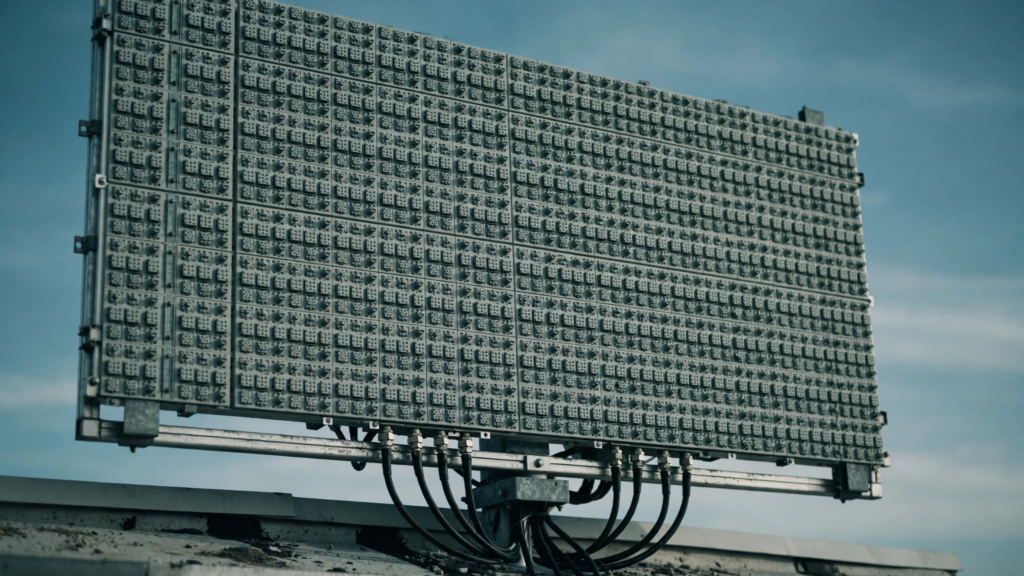
Because each element is so small, many of them fit into a single flat panel. These arrays of antennas, known as massive MIMO, work together to focus the signal toward each phone, improving range and capacity. [7] The short wavelength is what makes that dense packing possible.
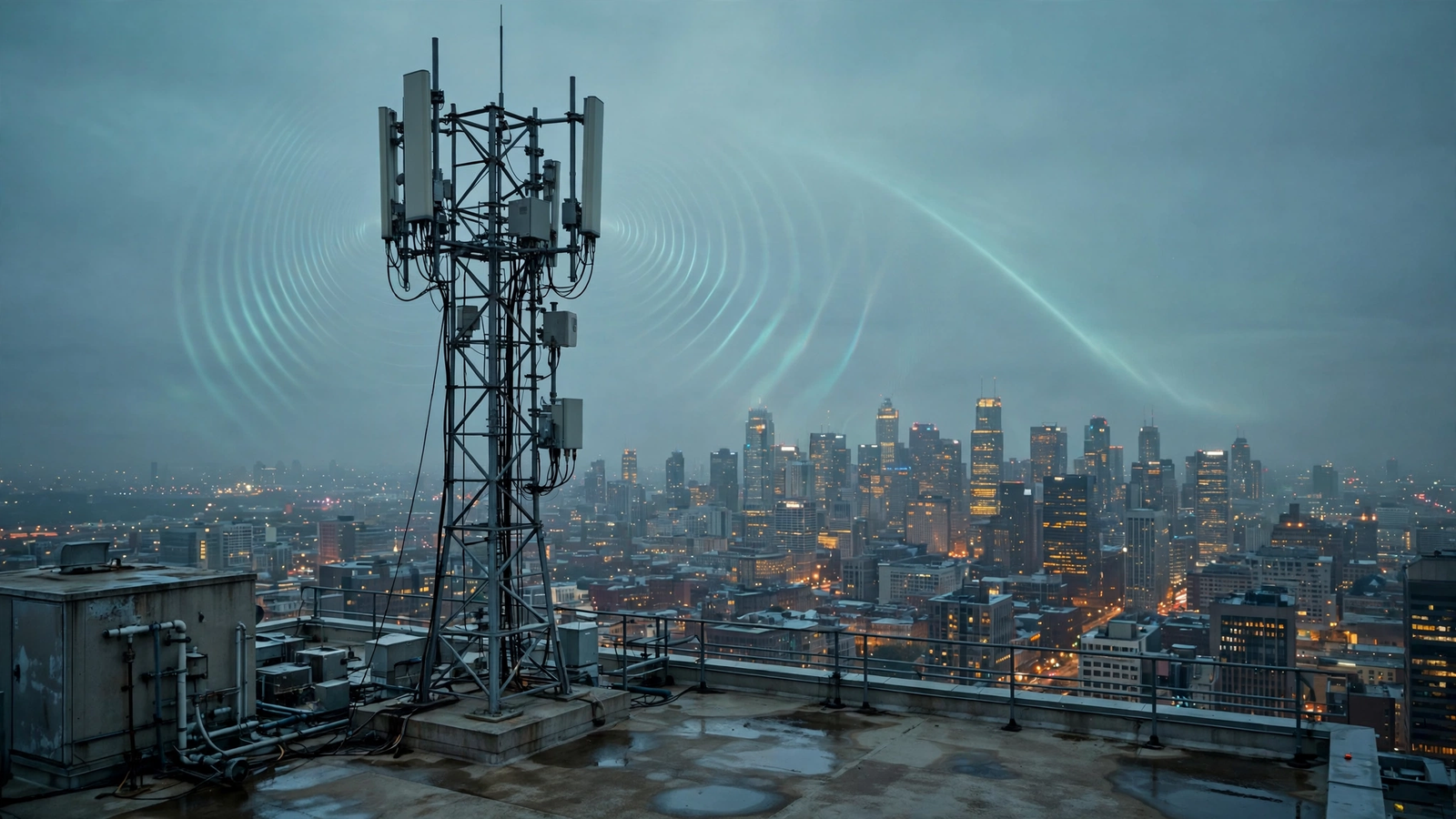
You can see this on a real tower. The long panel antennas handle the long low-band waves, while the small square panels handle the short mmWave signals. [1][7] The size of the hardware gives away the size of the wave.
What Happens When a 5G Signal Meets a Wall?
Short waves are fast, but they are also fragile — and nowhere is that clearer than indoors. Long waves bend around obstacles and pass through many materials. Short waves are more easily reflected, scattered and absorbed.
A mmWave signal can be weakened by walls, trees and rain, and even by the human body itself. [1][3] That is why indoor 5G often runs on low- or mid-band signals, even when mmWave is available outside. [1][3] The building itself filters the bands.

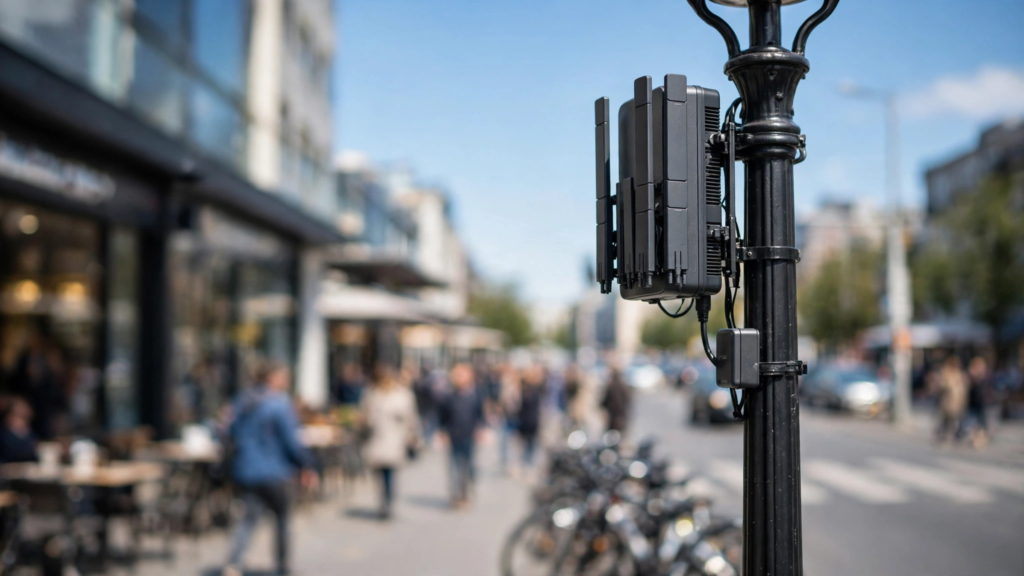
The fix is to bring the transmitter closer. Small cells mounted on lampposts, walls and rooftops serve short-range mmWave in busy areas, so the signal does not have far to travel. [4][7] Instead of one large tower covering kilometres, many small cells each cover a street or a square.
How Can You Tell Which Wavelength Your Phone Is Using?
If wavelength decides so much, it would help to know which one you are on — but your phone does not say. The 5G symbol on your screen does not name the band. Two phones can both show 5G while using very different wavelengths, and getting very different speeds.
The clues are in the experience. Extremely fast downloads in a stadium, an airport or a dense city centre often mean mmWave. [3] Steady, moderate speeds over a wide area usually mean low- or mid-band 5G. The fastest 5G you ever see is almost always a short wave, working over a short distance.
Part of the confusion is what the icon means. The 5G symbol only says your phone is connected to a fifth-generation network. It says nothing about the band, the wavelength or the speed you should expect.
The practical test is simple. If your 5G is extremely fast but disappears when you step indoors, you were probably on a short wavelength. [3] If it follows you everywhere at a moderate speed, you were probably on a long one.
Key Takeaways
- A wavelength is the physical length of one complete radio wave, measured from one crest to the next.
- Wavelength and frequency are linked by the speed of light: double the frequency, and the wavelength halves.
- 5G uses wavelengths from about 50 centimetres on low-band frequencies down to a few millimetres on mmWave frequencies.
- Shorter wavelengths carry far more data, but they travel less far and are blocked more easily.
- Longer wavelengths travel farther and pass through obstacles better, but carry less data.
- Wavelength also decides antenna size, which is why mmWave base stations can pack many tiny antennas into one panel.
Conclusion
The 5G symbol on your phone hides a whole range of physics. The same symbol can mean a wave half a metre long reaching across kilometres, or a wave a few millimetres long serving a single city block at enormous speed. Once you know the wavelength, the trade-offs of 5G — speed against range, capacity against coverage — start to make sense.
The same idea reaches beyond phones. Every wireless technology, from FM radio to Wi-Fi to GPS, lives somewhere on the same spectrum, and its wavelength decides what it can do.
Explore more evidence-based explanations in CAVELYRA’s Science Explained collection.
References
- TelecomTrainer. Understanding the 5G Spectrum: From 300 MHz to 100 GHz. https://www.telecomtrainer.com/understanding-the-5g-spectrum-from-300-mhz-to-100-ghz/
- UMA Technology. What Type of Wavelengths Do Cellphones Use? https://umatechnology.org/what-type-of-wavelengths-do-cellphones-use/
- Science Insights. What Is mmWave 5G? Speed, Range, and How It Works. https://scienceinsights.org/what-is-mmwave-5g-speed-range-and-how-it-works/
- Arunruangsirilert, K., Wongprasert, P., & Katto, J. Performance Analysis of 5G FR2 (mmWave) Downlink 256QAM on Commercial 5G Networks. arXiv. https://arxiv.org/html/2502.03416v1
- TelecomTV. FCC concludes first high-band 5G airwaves auctions. https://www.telecomtv.com/content/5g/fcc-concludes-first-high-band-5g-airwaves-auctions-35306/amp/
- IPLook. 5G mmWave Spectrum. https://www.iplook.com/info/5g-mmwave-spectrum-i00291i1.html
- Dingli Telecom. 5G Small Cells Explained: What You Need to Know. https://telecom.dingli.com/a-guide-to-understanding-5g-small-cell-technology/