
On a dark night far from city lights, the Milky Way looks like a faint band of light across the sky. That band is the light of billions of stars, seen edge-on from inside our own galaxy. But the light is only a small part of the story.
A galaxy is far more than its stars. Between the stars lie gas and dust. At the centre sits a black hole millions of times heavier than the Sun. And around it all stretches a halo of dark matter that outweighs everything we can see. This article takes the galaxy apart, piece by piece, and weighs each part.
Quick answers
- What are galaxies made of?: Stars, gas and dust, a supermassive black hole at the centre, and a vast halo of dark matter — which outweighs everything visible. In the Milky Way, dark matter is roughly 85 to 90 percent of the total mass. [2][3]
- Do all galaxies have the same recipe?: No. Spiral galaxies like the Milky Way hold plenty of gas and keep forming stars, ellipticals are mostly old stars with little gas, and irregular galaxies can be up to 90 percent gas by mass. [4]
- How do astronomers know, if most of it is invisible?: From light and motion: different kinds of light reveal stars, gas and dust, while the speeds of stars and the bending of light reveal the dark matter. What dark matter actually is remains unknown. [7][9]
A galaxy is a huge collection of stars, gas, dust and dark matter, held together by gravity. Our own galaxy, the Milky Way, is the one we can measure best, so most of the numbers in this article come from it. The same ingredients appear in other galaxies, but in different proportions.
How galaxies came to be this way is a different story, told in How Do Galaxies Form? This article answers a simpler question: what is a galaxy made of, right now? It works through the five ingredients one by one, then shows how the recipe changes between galaxy types, and how astronomers weigh things they cannot see.
What Are the Five Ingredients of a Galaxy?
Every galaxy is made of the same five ingredients: stars, gas, dust, dark matter, and a supermassive black hole at the centre. The stars are the part we see. The gas and dust fill the space between them. The dark matter forms a vast halo around everything. The black hole sits at the centre, heavy but small.
In the Milky Way, the proportions are lopsided. One published breakdown puts dark matter at 85 to 90 percent of the total mass, and stars at 5 to 10 percent. Molecular hydrogen gas is 1 to 5 percent, dust is about 0.1 percent, and other material such as hot ionised gas is 1 to 5 percent. [2] These are ranges, not exact figures, because the total mass of the galaxy is still uncertain.
A 2019 measurement that combined data from the Hubble and Gaia space telescopes put the Milky Way’s total mass at 1.5 trillion times the mass of the Sun, with dark matter at about 84 percent of that total. [3] The stars added up to only about 60 billion solar masses, or around 4 percent. [3] The exact numbers differ between studies, but every estimate agrees on the same point: most of a galaxy is dark matter.
How Many Stars Does a Galaxy Hold?
The Milky Way holds about 200 to 400 billion stars. [2] The Sun is one ordinary star among them, sitting in a disk about 100,000 light-years across. [4] It takes the Sun about 225 million years to complete one orbit around the galactic centre. [1]
The stars are not spread evenly. The thin disk holds young and old stars mixed with gas and dust. The central bulge is a dense crowd of mostly old stars. Around both stretches the halo, a thin scattering of very old stars and globular clusters, tight balls of old stars that orbit far from the disk. [1]
Starlight also tells us the age of a galaxy’s stars. Young, hot stars shine blue, and they cluster in the spiral arms where new stars are forming. Old stars shine red, and they dominate the bulge and the halo. [4] How stars are born from gas and dust is explained in How Are Stars Born?
What Is the Gas and Dust Between the Stars?
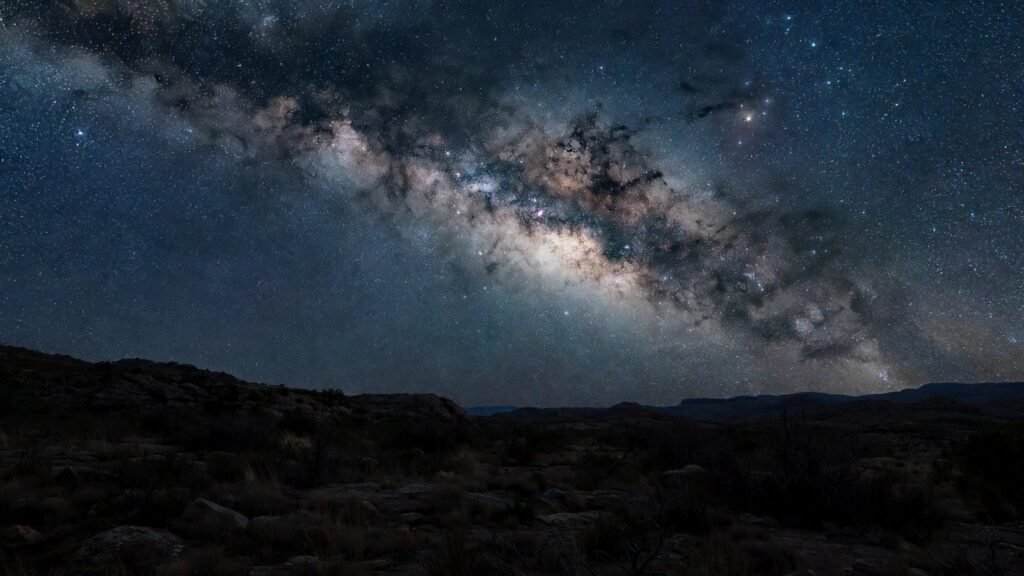
The space between stars is not empty. It holds the interstellar medium, a thin mixture of gas and dust that makes up 10 to 15 percent of the Milky Way’s visible mass. [8] By mass, 99 percent of it is gas and 1 percent is dust. [8] The gas is about 70 percent hydrogen, 28 percent helium, and about 1.5 percent heavier elements. [8]
The gas comes in different forms. Cold, dense molecular clouds are the places where new stars form. Warmer, thinner gas fills much of the disk. Very hot, ionised gas glows around young stars and fills the spaces between clouds. The dust is made of tiny grains of carbon and silicates, each far smaller than a grain of sand, yet it blocks visible light across huge distances. [8]
That blocking effect is why astronomers look at galaxies in more than one kind of light. Dust hides stars in visible light, but it glows in infrared. Cold hydrogen gas gives off a radio signal at a wavelength of 21 centimetres, which lets telescopes map it across the whole galaxy. [7] The heavier elements in the gas were made inside stars and spread by supernovae, as explained in How Do Supernovae Work?
What Is Dark Matter, and How Much of a Galaxy Is It?
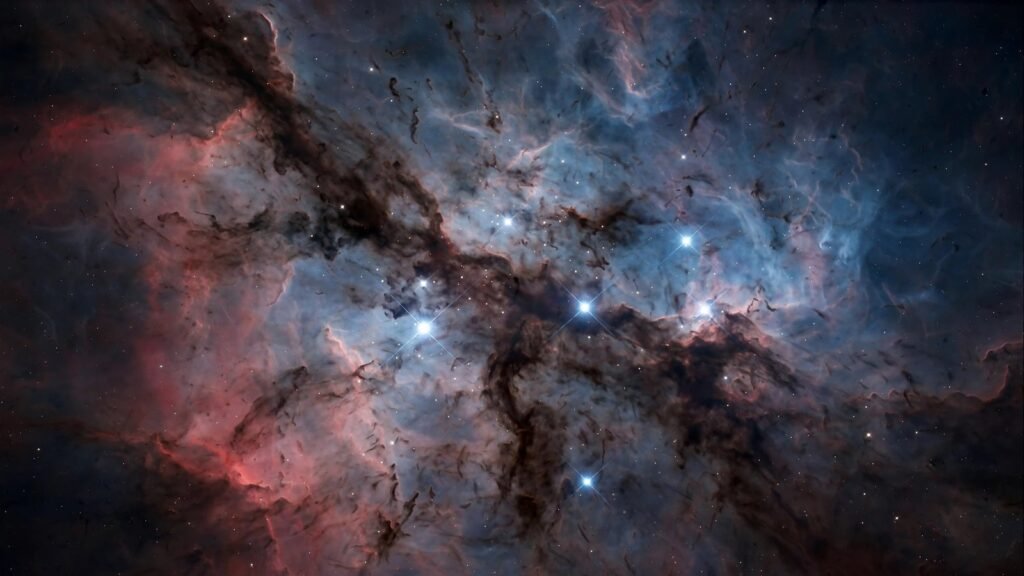
Dark matter is the largest ingredient in a galaxy, and the strangest. It does not emit, absorb or reflect light, so no telescope can see it directly. Astronomers know it is there only because of its gravity. [5] Across the whole universe, dark matter makes up about 85 percent of all matter. Ordinary matter — everything made of atoms — is only about 5 percent of the universe’s total energy, with dark matter at 27 percent and dark energy at 68 percent. [5]
In the Milky Way, dark matter forms an enormous halo that reaches far beyond the visible disk of stars. The 2019 measurement traced the galaxy’s mass out to about 129,000 light-years from the centre. [3] The visible parts of the galaxy sit inside this halo like a small bright centre inside a huge dark cloud. Without the halo’s gravity, the galaxy’s stars would not stay together at the speeds they move. [9]
What dark matter actually is remains unknown. One leading idea is a particle called a WIMP, a weakly interacting massive particle, but no experiment has yet found one. [5] Until a detection is made, dark matter is a name for a gravitational effect, not a known substance.
What Sits at the Centre of a Galaxy?
Many large galaxies have a supermassive black hole at their centre, and the Milky Way is one of them. [6] Ours is called Sagittarius A*, and it weighs 4.297 million times as much as the Sun. [6] Its mass was measured by tracking the star S2, which takes 16 years to complete one orbit around it, passing within 17 light-hours at its closest approach. [6]
That sounds enormous, but it is a tiny share of the galaxy. Four million solar masses next to a total of 1.5 trillion is far less than one percent. [3][6] The black hole rules the stars near the centre, but it does not hold the galaxy together. The dark matter halo does that. [5]
The proof that Sagittarius A* is a black hole earned Reinhard Genzel and Andrea Ghez a share of the 2020 Nobel Prize in Physics. [6] Their teams tracked stars orbiting the galactic centre for decades, and the orbits ruled out every alternative to a supermassive black hole. [6]
How Does the Recipe Change Between Galaxy Types?
Not every galaxy has the Milky Way’s recipe. Astronomers sort bright galaxies into three broad types: spiral, elliptical and irregular. Among bright galaxies, about three in four are spirals, about one in five are ellipticals, and about one in twenty are irregulars. [4]
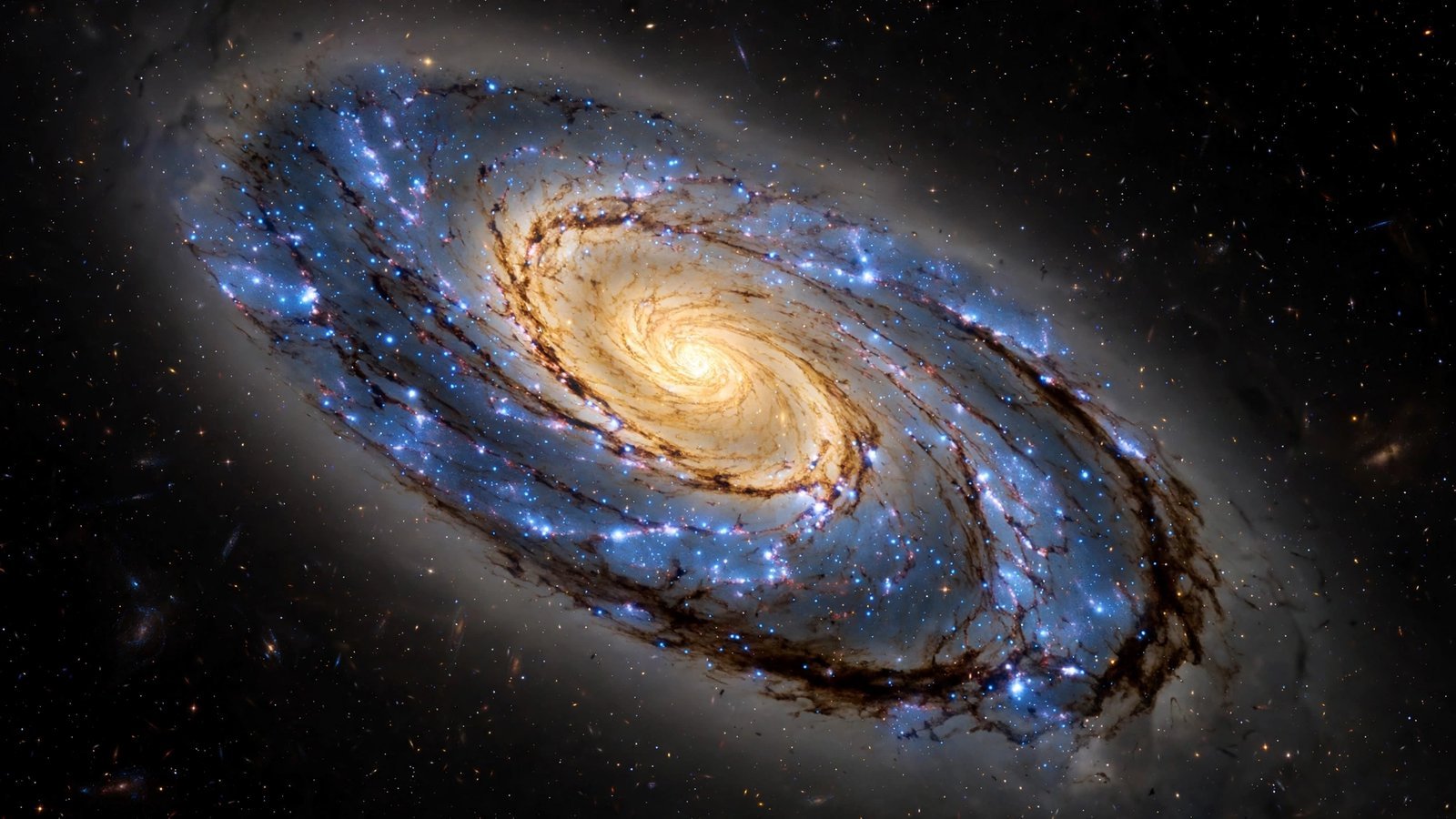
Spiral galaxies have a rotating disk of stars, gas and dust, with spiral arms where new stars form. Their disks hold roughly 10 to 20 percent gas, and star formation is still going on. [4] The Milky Way is a spiral. [1] Most bright galaxies are spirals too. [4]
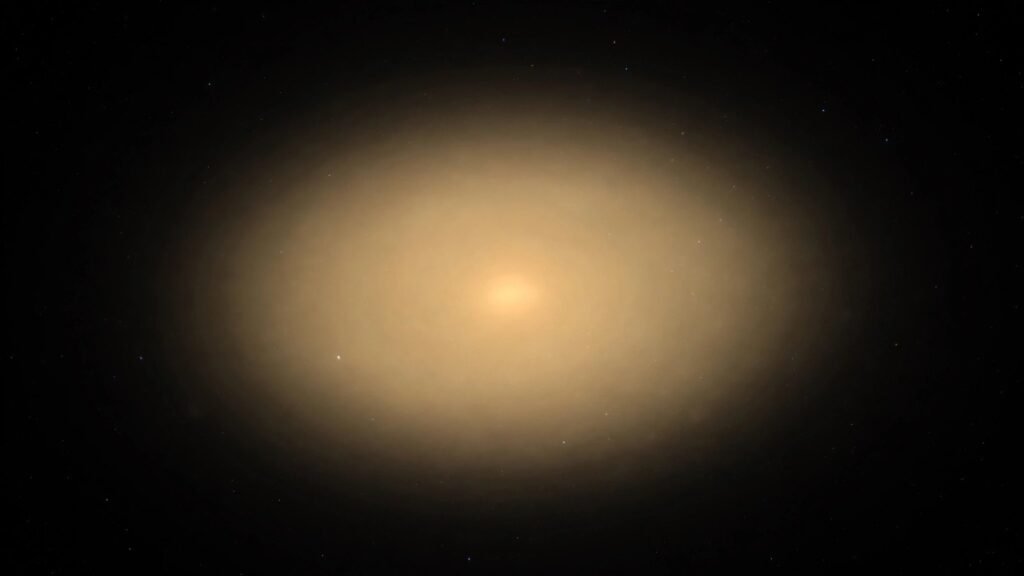
Elliptical galaxies are smooth, rounded crowds of mostly old stars, with very little gas or dust. They have had little star formation in the last 10 billion years. [4] Irregular galaxies are the opposite in one way: they can be up to 90 percent gas, and they form stars vigorously. [4] The same five ingredients appear in all three types, but the amounts are very different.
How Do Astronomers Know What Galaxies Are Made Of?
No one can visit a galaxy, so astronomers read its light. Different kinds of light reveal different ingredients. Visible light shows the stars. Infrared shows dust warmed by starlight. Radio waves trace cold hydrogen gas. X-rays show very hot gas and matter falling into the central black hole. [7]
Dark matter is weighed by motion. In the 1970s, Vera Rubin and Kent Ford measured how fast stars and gas orbit in spiral galaxies. The speeds stay roughly flat far from the centre, at about 200 kilometres per second, even where the starlight has faded. [9] If only the visible matter were there, the outer stars would move more slowly and drift away. The flat speeds mean a large halo of unseen mass surrounds the disk.
The bending of light gives a second check. A galaxy’s gravity bends the light of objects behind it, an effect called gravitational lensing. When the bending is stronger than the visible matter can explain, extra mass must be present. [5] A third line of evidence comes from clusters of galaxies: Fritz Zwicky found that the galaxies in the Coma cluster move too fast to be held together by their visible mass alone. [10]
What Is Still Unknown?
The biggest unknown is dark matter itself. Astronomers can map where it is and weigh how much there is, but no one knows what it is made of. Underground detectors have searched for WIMP particles for decades without an unambiguous detection. [5]
Even the total mass of the Milky Way is uncertain. Estimates have ranged from 500 billion to 2 or 3 trillion solar masses, depending on the method and on how far out the halo is counted. [3] The 1.5 trillion figure is the most precise measurement so far, but it is still an estimate, not a final answer.
The proportions also vary from galaxy to galaxy, and many galaxies are too faint or too far away to weigh well. Each new measurement sharpens the picture, but the full inventory of galaxies is still being written.
Key Takeaways
- A galaxy is made of five ingredients: stars, gas, dust, a supermassive black hole at the centre, and a halo of dark matter.
- Dark matter is the largest share: roughly 85 to 90 percent of the Milky Way’s total mass, and about 85 percent of all matter in the universe.
- Stars are only a small share of the mass: the Milky Way’s 200 to 400 billion stars add up to about 60 billion solar masses, around 4 percent of the total.
- The gas between stars is mostly hydrogen (about 70 percent by mass) with helium (about 28 percent); dust is only about 1 percent of the gas and dust, yet it blocks visible light.
- The recipe differs by galaxy type: spirals are gas-rich and still forming stars, ellipticals are mostly old stars with little gas, and irregulars can be up to 90 percent gas.
- Astronomers weigh galaxies with light and motion: different wavelengths reveal each ingredient, and flat rotation curves and gravitational lensing reveal the dark matter. What dark matter is remains unknown.
Conclusion
A galaxy looks like a collection of stars, but the stars are the minority. Most of a galaxy’s mass is dark matter we cannot see, wrapped around a smaller amount of gas and dust and a modest number of stars, with a supermassive black hole at the centre. The Milky Way’s numbers are the best measured, but the same five ingredients appear in every galaxy, mixed in different proportions.
The picture is still incomplete. Dark matter’s identity is unknown, and the total mass of even our own galaxy is an estimate with a wide range. What astronomers have learned is how to weigh the invisible: by watching how stars move, how light bends, and how each kind of light reveals a different ingredient.
Explore more evidence-based explanations in CAVELYRA’s Science Explained collection.
References
- OpenStax Astronomy (LibreTexts). Chapter 13: Galaxies. https://phys.libretexts.org/Courses/Grossmont_College/ASTR_110:_Astronomy_(Fitzgerald)/13:_Galaxies
- Astronomical Society (BAS). The Milky Way Galaxy (information sheet, PDF). https://bas.asn.au/wp-content/uploads/Milky-Way-Galaxy-Information.pdf
- Gizmodo. How Heavy Is the Milky Way? https://gizmodo.com/how-heavy-is-the-milky-way-1833131376
- Ohio State University, Astronomy 162. Lecture 27: Types of Galaxies. https://www.astronomy.ohio-state.edu/pogge.1/Ast162/Unit4/types.html
- University College London. Dark Matter. https://www.ucl.ac.uk/mathematical-physical-sciences/physics-astronomy/research/research-groups/high-energy-physics/research-high-energy-physics-group/dark-matter-searches/dark-matter
- European Southern Observatory. The story of our quest for Sagittarius A*. https://www.eso.org/public/unitedkingdom/blog/our-quest-for-sagittarius-a/
- NASA, Imagine the Universe. Multiwavelength Milky Way. https://imagine.gsfc.nasa.gov/science/objects/milkyway2.html
- Highline College. Interstellar Medium. https://people.highline.edu/iglozman/classes/astronotes/interstellar.htm
- AA Masterclass. Dark matter and how astronomers know it is there. https://aamasterclass.org/blog/dark-matter-and-how-astronomers-know-it-is-there
- sci.astro FAQ. Evidence for dark matter. http://www.faqs.org/faqs/astronomy/faq/part8/section-8.html