
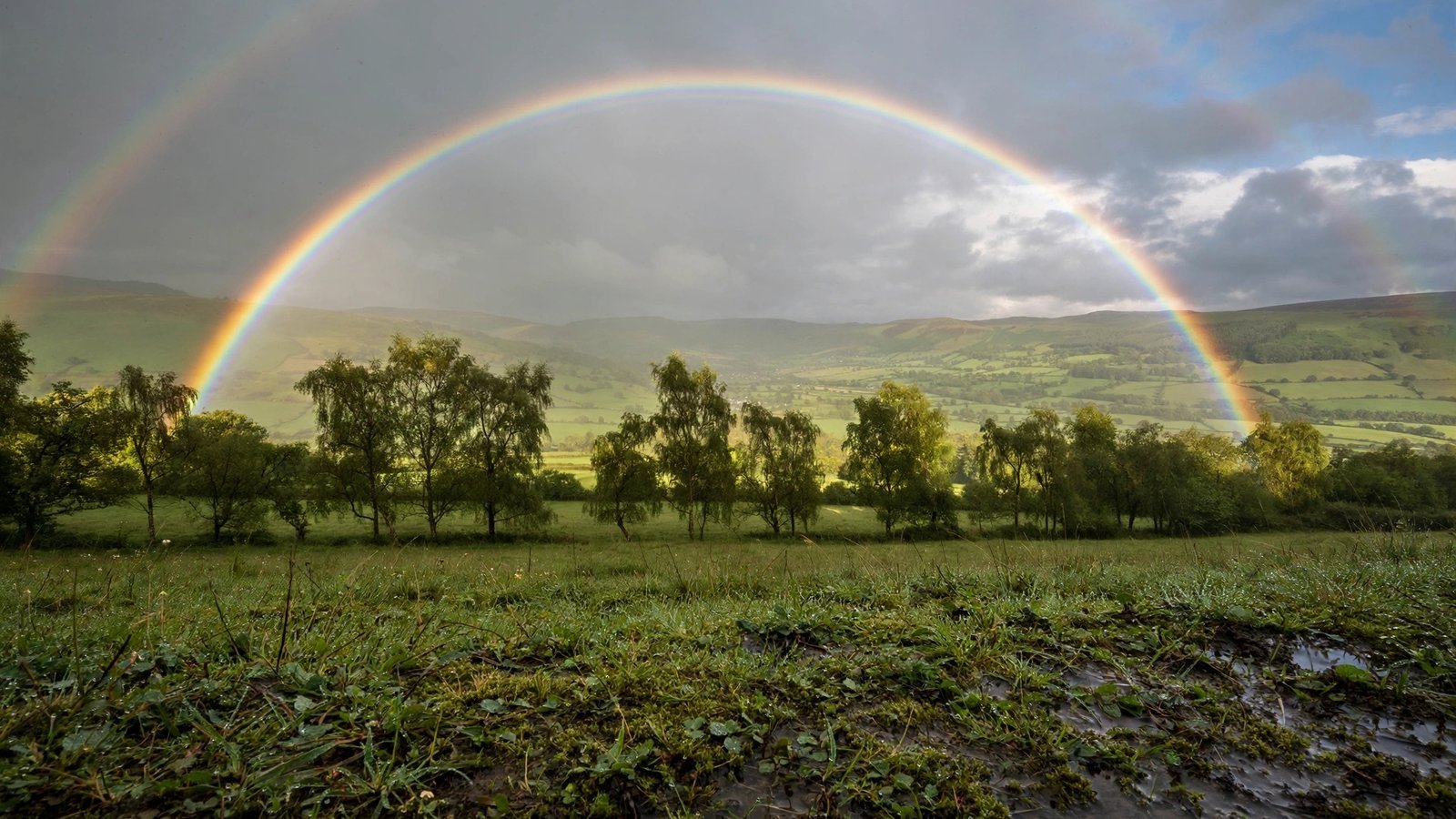
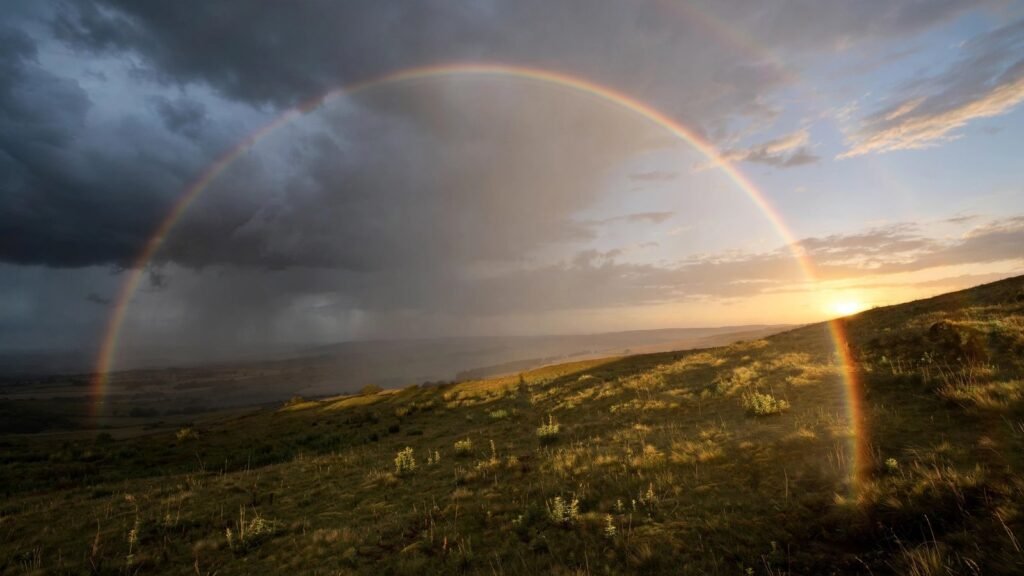
After a summer shower, a rainbow stands over the valley. Its colours look solid enough to touch, and one end seems to land on the far hill, right beside a line of trees. It is hard not to imagine walking over there and standing exactly where the colours meet the ground.
People have tried. Children run toward it across fields, and drivers follow it down country roads. The end always stays ahead, in the next field or over the next hill. This article explains why no one can ever arrive there — and what the rainbow really is, once you stop chasing it.
Quick answers
- Why can't you reach the end of a rainbow?: Because it has no fixed place. A rainbow is a circle of light centred on a point opposite the Sun from your own eyes, so it moves when you move. The "end" is only where that circle meets the ground in your view. [1][2]
- Does everyone see the same rainbow?: No. Each person sees light from a different set of raindrops, because each person's viewing point is different. Two people standing a few metres apart are looking at two different rainbows. [5]
- Is a rainbow really a circle?: Yes. The colours form a complete ring around the antisolar point, and the ground hides the lower half. From an airplane, the full circle can sometimes be seen. [1][3]
The short version of how a rainbow forms is this. Sunlight enters a raindrop, bends, reflects once inside the drop, and bends again as it leaves. Each colour leaves at a slightly different angle, which spreads white sunlight into a spectrum. The full story is told in How Does a Rainbow Form? This article takes that as given and asks a different question: why can you never reach the end of it?
The answer has little to do with rainbows and a lot to do with you. A rainbow is not an object hanging in the sky. It is a pattern of light that only exists for one pair of eyes at a time, in one place at a time. Change the place, and the pattern changes with it. To see why, start with the point the whole circle hangs from.
Why Does the End of a Rainbow Always Move Away?
Stand still and look at a rainbow. Its lower end appears to touch the ground at a definite spot — a field, a wood, a rooftop. That spot looks as real as any place on a map. But it is not a place at all. It is the point where the circle of coloured light, seen from where you stand, dips below the horizon. [1]
Walk toward it, and the geometry changes with every step. The Sun, the rain and your eyes form a new arrangement, and a different set of raindrops starts sending coloured light toward you. The old drops fall out of the pattern, and new ones take their place. The end you were walking toward was built from the old arrangement, so it is gone before you get there. [5]
The chase has a natural limit. If you keep walking into the rain itself, the rainbow fades and vanishes. Once the drops surround you, there is no longer a wall of rain in front of you at the right angle, and the pattern falls apart. You are left standing in ordinary rain, with wet clothes and no colours at all. The rainbow was never ahead of you. It was always arranged around you. [1]
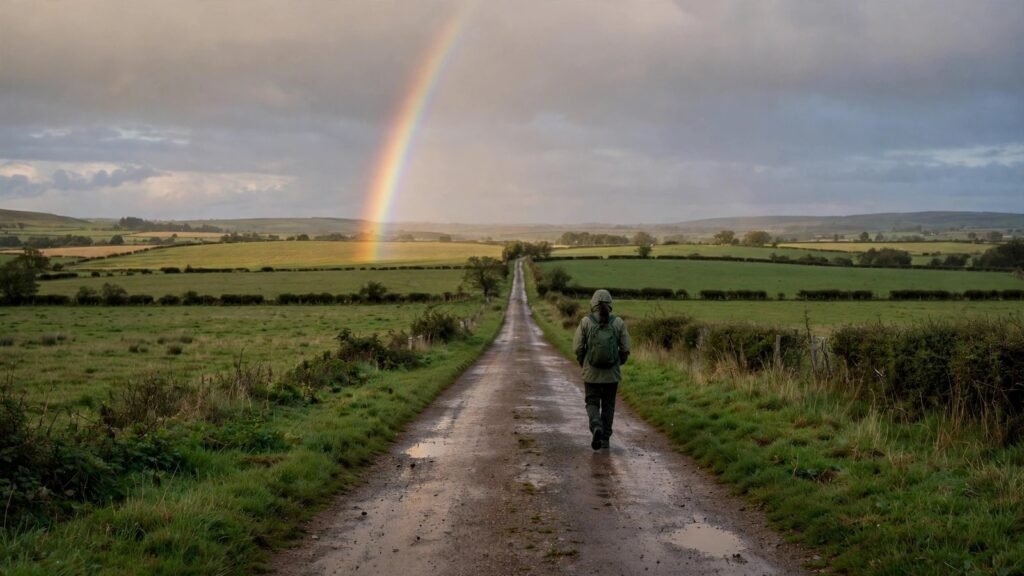
It helps to think of your shadow. You can never walk to the end of your own shadow either, because it moves when you do. A rainbow works the same way, except that the pattern is made of light from the sky instead of darkness on the ground. Chasing either one is chasing your own position.
What Is the Antisolar Point?
Every rainbow has a centre, and that centre is you — or rather, a point in the sky directly opposite the Sun from you. It is called the antisolar point. Draw an imaginary line from the Sun, through your head, and out the other side. Where that line meets the sky is the centre of your rainbow. [2][4]
You can find it without any instruments. Stand with your back to the Sun and look at your shadow. The shadow of your head marks the antisolar point on the ground. The rainbow forms as a circle around that point, with red light reaching your eyes from about 42 degrees away from it and violet from about 40 degrees. [2]
The key point is that the antisolar point belongs to one observer. Step a few metres to the side, and the line from the Sun through your head points somewhere else. Your rainbow’s centre has moved, and so has the whole circle. Nothing in the sky has changed. Only your place in the geometry has changed. [4][5]
Why Does Everyone See a Different Rainbow?
This is the part most people find hardest to believe. Two friends standing side by side, looking at the same rainbow, are not seeing the same rainbow. Each of them is receiving coloured light from a different collection of raindrops. The arcs overlap so closely that the difference is invisible, but the light reaching each pair of eyes has travelled a different path. [5]
Think of it as a private showing. Millions of raindrops are scattering light in all directions, and only the drops at the right angle for your eyes send you the colours. Your friend’s eyes sit in a different place, so a different set of drops lines up for them. Move a few steps, and your own rainbow quietly rebuilds itself from new drops, moment by moment. [5]
Photographs can make the illusion look stronger. A photographer can stand where the rainbow’s end lines up with a lighthouse or a tree, so the picture seems to show the rainbow touching that object. But the camera is not at the end. It is simply standing where the geometry lines up that way. Someone standing at the lighthouse would see the rainbow somewhere else entirely. [5]
The same logic explains why two people can never reach the end together. Each of them is chasing a different pattern, built for different eyes. They may walk side by side toward the same hill. But the end each of them sees is their own, and it will retreat from each of them in turn.
Why Is a Rainbow Really a Full Circle?
From the ground, a rainbow looks like an arch. But the arch is only the part you can see. The coloured light reaches your eyes from every direction at about 42 degrees from the antisolar point — above it, below it, and to both sides. Directions at a fixed angle from a fixed point form a circle, so the full rainbow is a complete ring. [4]
The proof comes from above. From an airplane, with rain or cloud droplets below and the Sun behind the plane, passengers can sometimes see the whole ring. The shadow of the aircraft often sits near its centre. The geometry has not changed. The observer has simply moved to a place where the lower half of the circle is no longer hidden. [3][6]
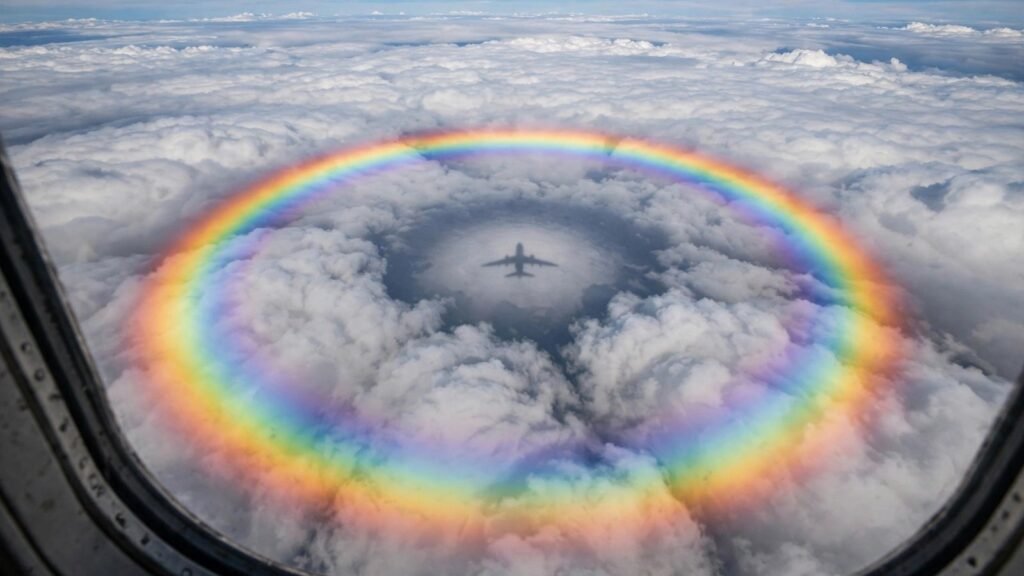
You do not need an airplane to see more of the circle. A garden hose on a sunny day can make a small rainbow in the spray. If you move the spray below your eye level, the ring can close into a full circle right in front of you. The colours shift if you move your head even slightly. That is the same lesson on a smaller scale: the ring belongs to your viewpoint, not to the water. [6]
The largest arc ever seen from flat ground is about half the circle, at sunrise or sunset, when the Sun sits on the horizon. Even then, the lower half is missing — not because it does not exist, but because there is no ground below the horizon for it to appear against. [1][6]
Why Does the Ground Cut the Circle Into an Arc?
The ground is the reason every rainbow looks like a bow. The antisolar point sits below the horizon whenever the Sun is above it, so the centre of the circle is underground from your point of view. The lower half of the ring would need raindrops below the horizon to form, and there are none in sight. The Earth itself blocks the view. [1]
The height of the Sun decides how much of the circle you see. When the Sun is low, the antisolar point is high, and a large part of the ring rises above the horizon. At sunset, the Sun is on the horizon and the antisolar point is on the opposite horizon. You can see a full semicircle, with the top of the arch 42 degrees above the horizon. [1]
When the Sun climbs, the arch shrinks. The higher the Sun, the lower the antisolar point sinks, and the smaller the visible arc becomes. Once the Sun rises above 42 degrees, the whole circle sits below the horizon, and no rainbow can be seen from flat ground at all. That is why rainbows are morning and late-afternoon sights, and why you will not find one at midday. [1][3]
Climbing helps for the same reason. From a mountain top or a tall building, the horizon drops away, and more of the lower half comes into view. The clouds that supply the rain sit below you as well as ahead of you. More of the circle has drops to shine through, so more of it becomes visible. The circle was always complete. You have only just moved to where you can see it. [3]
Where Did the Pot of Gold Story Come From?
If the end of a rainbow cannot be reached, why does the story say treasure is buried there? The tale is old. The National Weather Service notes that as far back as the 17th century, people in Ireland had a saying about this. They said a person was as likely to find a pot of gold as to find the end of a rainbow. The saying later changed into the story we know today. [1]
Part of the story has a real root in the ground. In central Europe, farmers ploughing fields after heavy rain sometimes turned up small curved gold coins, minted centuries earlier by Celtic peoples. The coins had a dish-like shape, and German folk tradition called them Regenbogenschüsselchen — rainbow cups — because people assumed the rainbow had left them behind. Rain had simply washed the soil off buried metal. [7]
The leprechaun came later, and from a different story. In old Irish tales, the leprechaun was a solitary fairy craftsman who guarded buried wealth, with no rainbow attached to him at all. The rainbow, the gold and the leprechaun were joined together much later, in popular retellings. The joke at the heart of the legend is simple. The treasure is hidden in the one place no one can ever reach, because the end of the rainbow moves with whoever looks for it. [7]
Key Takeaways
- A rainbow has no fixed place. It is a circle of light centred on your own antisolar point, so it moves when you move.
- The “end” is only where that circle meets the ground in your view. Walk toward it, and new raindrops rebuild the pattern ahead of you.
- Each person sees a different rainbow, made from a different set of raindrops.
- The full rainbow is a complete circle. The ground hides the lower half, which is why it looks like an arch.
- The higher the Sun climbs, the smaller the visible arc becomes. Above 42 degrees, no rainbow is visible from flat ground.
- The pot of gold is an old saying, not a place. The treasure was hidden at the end of the rainbow precisely because no one can reach it.
Conclusion
A rainbow looks like a bridge to somewhere, but it is really a mirror of where you stand. Its centre is the shadow of your own head, and its circle is drawn around your eyes. Its end is a trick of geometry that retreats with every step you take toward it. The colours are real — the light is really there — but the place they seem to mark is not.
That is why the old stories were right in their own way. The end of the rainbow is the perfect hiding place, because it is the one place that does not exist. The next time a rainbow appears after rain, you can enjoy it without chasing it. Stand still, watch the light, and remember that the whole circle is there, even the half the ground hides from you.
Explore more evidence-based explanations in CAVELYRA’s Science Explained collection.
References
- National Weather Service, Flagstaff. How Do Rainbows Form? https://www.weather.gov/fgz/Rainbow
- American Meteorological Society. Primary rainbow. Glossary of Meteorology. https://glossary.ametsoc.org/wiki/primary-rainbow/
- Nave, R. Primary and Secondary Rainbows. HyperPhysics, Georgia State University. https://hyperphysics.gsu.edu/hbase/atmos/rbowpri.html
- Sinclair, B. Rainbows. University of St Andrews. https://www.st-andrews.ac.uk/~bds2/optics/rainbow.html
- How Everything Works. Why Can’t Two People See the Same Rainbow? https://howeverythingworks.com/why-cant-two-people-see-same-rainbow/
- Physics Optics. Full Circle Rainbow: 5 Surprising Secrets You Never Knew. https://www.physicsoptics.com/blog/rainbows/full-circle-rainbow/
- ConnollyCove. Pots of Gold at the End of the Rainbow: The Real Origin. https://www.connollycove.com/tales-of-rainbows-and-pots-of-gold/