

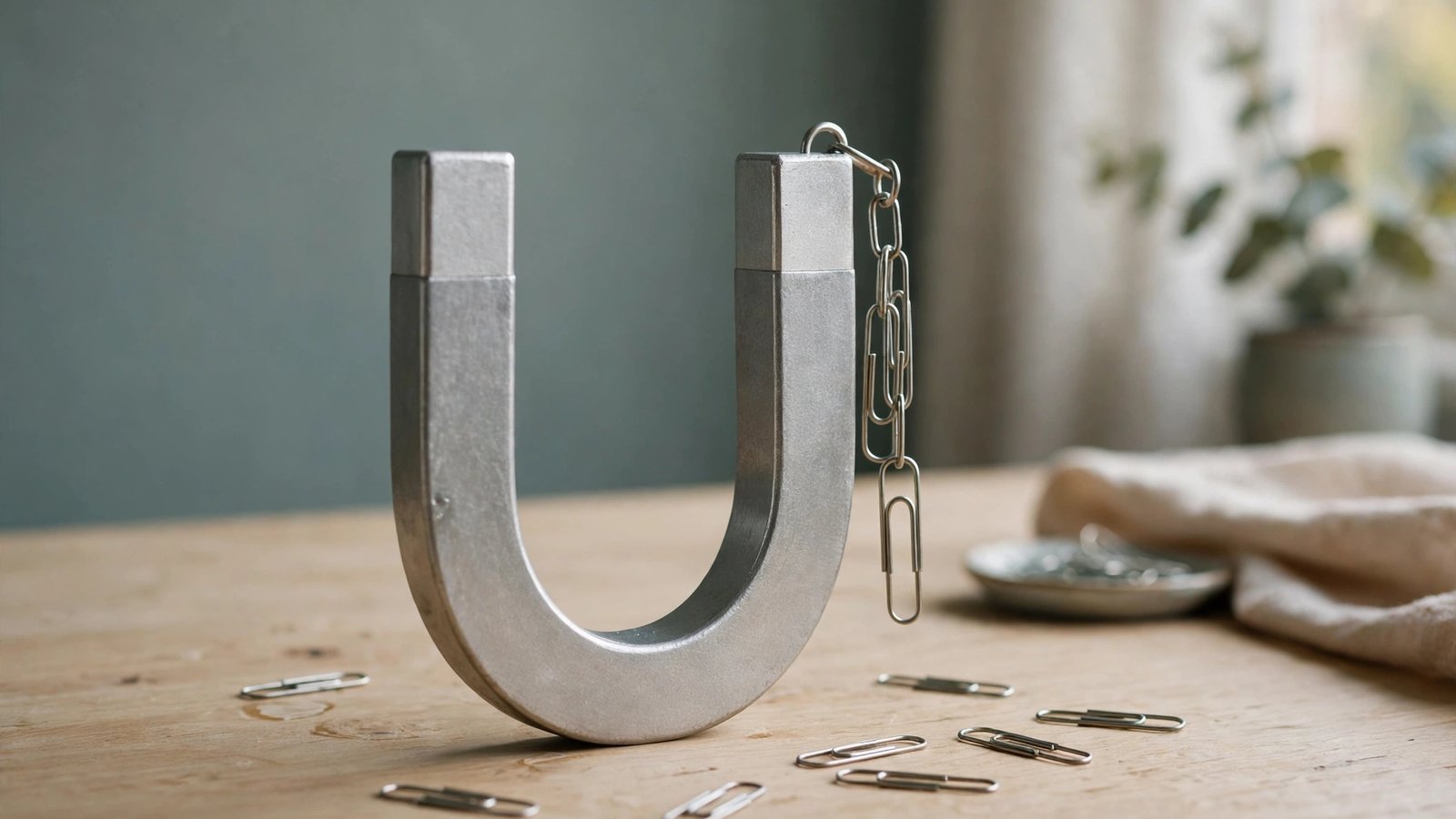
A fridge magnet holds a shopping list for years. It never needs charging, and it never runs down. It just keeps pulling, day after day, with no power source at all. So how do permanent magnets work?
That staying power is what makes a permanent magnet different from an ordinary piece of iron. A paper clip will stick to a magnet, but take the magnet away and the clip goes back to normal. A permanent magnet keeps its field after the magnetising force is gone. This article explains how that happens, how such magnets are made, and what can weaken them.
Quick answers
- What makes a magnet permanent?: Its magnetic domains are aligned by a strong field and then locked in place by the material's structure, so the field stays after the external field is removed. [1][2]
- Are all permanent magnets the same?: No. There are four main families — ferrite, alnico, neodymium and samarium-cobalt — and they differ greatly in strength, heat tolerance and cost. Neodymium is the strongest type available today. [2][5]
- Can a permanent magnet lose its magnetism?: Yes. Heat above its Curie temperature, a strong opposing field, hard shocks and corrosion can all weaken it, and the risk depends on the material. [3][7]
The question is simple: how do permanent magnets work? A permanent magnet is a material that produces its own magnetic field and keeps it without any power supply. [1] The general ideas behind magnetism — magnetic fields, domains and poles — are explained in How Do Magnets Work? This article goes further into one kind of magnet only: the permanent kind. It does not repeat the general article. It answers what “permanent” means, how these magnets are made, why they stay magnetic, and what the four types are for.
The short version is that permanence is a property of the material, not a trick of the shape. Some materials hold their domain alignment easily. Others lose it at the first knock. That difference decides where each magnet is used — from a fridge door to an electric car motor.
What Makes a Magnet Permanent?
Inside a ferromagnetic material, atomic magnetic moments line up in small regions called magnetic domains. In an unmagnetised piece, the domains point in random directions, so their effects cancel out. [1] A magnetising field forces the domains to line up. In most materials, they drift back when the field is removed. In a permanent magnet, they stay.
Two numbers describe that staying power. Remanence is the magnetism left after the external field is removed. Coercivity is the strength of an opposing field needed to wipe it out. [1] A good permanent magnet has high values of both: it keeps a strong field, and it resists being undone.
Materials with high coercivity are called magnetically hard. Materials with low coercivity are called magnetically soft. [1] Soft iron makes a good temporary magnet — a paper clip or a nail — because its domains move easily. But that same ease makes it a poor permanent magnet. Hard materials resist change, so they hold their alignment for years.
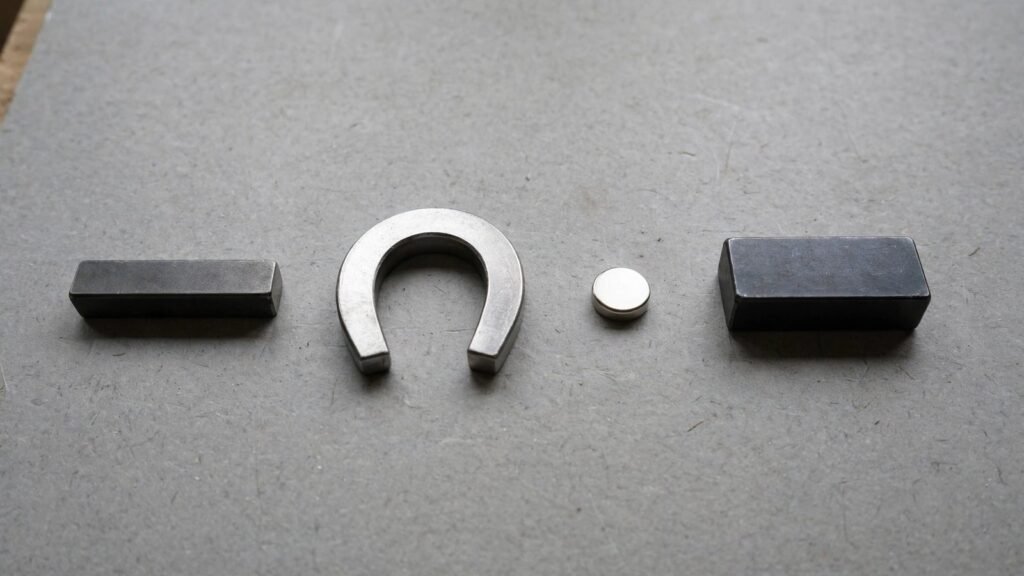
Shape matters less than material. A permanent magnet can be a bar, a disc, a ring or a horseshoe. [2] What matters is the alloy or ceramic inside, and how it was treated. The next section looks at that treatment.
How Is a Permanent Magnet Made?
A permanent magnet is not born magnetic. It is built, shaped and then switched on. The steps are similar for the main types, and they were worked out over decades of magnet making. [2][6]
First, the raw materials are mixed into an alloy or a ceramic powder. For a neodymium magnet, the alloy is neodymium, iron and boron, melted together and then ground into a fine powder. [2] The powder is pressed into a mould, often under a magnetic field that lines the particles up before they are fixed in place. Heat then fuses the particles together, a step called sintering. [2][6]
Alnico magnets are made differently: they are usually cast from molten metal, then heat-treated, or pressed and sintered like the others. [6] Ferrite magnets start as iron oxide mixed with barium or strontium carbonate, pressed and sintered. [8] The details vary, but the goal is the same: a solid piece whose crystal structure will resist change.
The last step is magnetisation. The finished piece is placed inside a coil, and a huge pulse of current runs through the coil for a tiny fraction of a second — about a thousandth of a second. [2] The pulse creates a field strong enough to force the domains into line. Before this step, the piece would stick to a magnet but could not pick up a paper clip on its own. [2] After it, the piece is a permanent magnet.
Some magnets get a coating first. Neodymium magnets are plated with a thin film of nickel, sometimes gold or zinc, because the bare alloy rusts easily. [2] Ferrite and alnico need no such coating, since they resist corrosion far better. [1]

Why Does a Permanent Magnet Stay Magnetic?
The answer is in the material’s crystal structure. Once the domains are aligned, the structure makes it hard for them to turn back. [1] The alignment is locked in, so the field goes on without any power. A permanent magnet is, in effect, an energy store that does not discharge through normal use. [1]
Holding things up costs the magnet nothing. A fridge magnet holding a note does not spend its magnetism the way a battery spends charge. [1] The field is simply there, as long as the alignment holds. That is why a well-made magnet can work for decades with no visible loss of strength.
The lock is strong, but it is not unbreakable. Heat, a strong opposing field, a hard knock or rust can all break it. How much each matters depends on the material — which is why the four families behave so differently. The next section meets the four families, and the section after that covers what breaks the lock.
This also explains why an ordinary nail cannot be a permanent magnet. Its domains move freely, so it is magnetised only while it sits in a strong field. [2] Take the field away, and the domains scatter again. The difference between the nail and the magnet on your fridge is not the iron in them. It is how firmly the material holds its alignment.
What Are the Four Types of Permanent Magnets?
Nearly every permanent magnet made today belongs to one of four families. Each is a trade-off between strength, heat tolerance, rust resistance and cost. [1] The figures below are typical values — exact figures vary by grade — and they come from one comparison table, so the four types are measured on the same scale. [2]
Ferrite magnets, also called ceramic magnets, are the most common type. [2] They are made from iron oxide with barium or strontium carbonate, and they are cheap, hard and rust-proof. [8] Their strength is modest — an energy product of about 3.5 million gauss-oersteds — but they work well up to about 300°C. [2] You will find them in fridge magnets, loudspeakers, small motors and toys. [8]
Alnico magnets are an alloy of aluminium, nickel and cobalt, with iron. [2] They date back to the 1930s, when the Japanese metallurgist Tokushichi Mishima discovered the first alloy of the family. [6] Alnico is the least affected by temperature: it keeps working above 500°C, and its Curie temperature is about 860°C. [2] But its coercivity is low, so it is easily demagnetised by other magnets or by a hard knock. [2] It is still used in guitar pickups, microphones, loudspeakers, sensors and motors. [6]
Neodymium magnets, or NdFeB, are the strongest permanent magnets available today. [5] They were developed independently in 1984 by General Motors and Sumitomo Special Metals. [5] A typical grade has an energy product of about 40 million gauss-oersteds — roughly ten times a ferrite magnet. [1][2] That strength allows smaller, lighter motors, which is why they are used in electric vehicles, cordless tools, hard disk drives and wind turbine generators. [5]
Their weakness is heat: a standard grade should not run above about 150°C, and its Curie temperature is only about 310°C. [2]
Samarium-cobalt magnets are the second rare-earth family. [2] They are slightly weaker than neodymium, with an energy product of about 26 million gauss-oersteds, but they handle heat far better. [2] They work up to about 300°C and stay magnetic up to a Curie temperature near 750°C. [2] They also resist corrosion without a coating, which suits them to hot, harsh places such as aircraft engines and industrial sensors. [1][8]
The pattern is clear. If the job needs the most strength in the smallest space, neodymium wins. If it needs heat and stability, samarium-cobalt or alnico wins. If it needs low cost and rust resistance, ferrite wins. No single type is best at everything.
What Weakens or Demagnetises a Permanent Magnet?
Heat is the most common cause. [3] As a magnet gets hotter, its atoms vibrate more, and the ordered domains start to break up. [7] Every material has two limits: the maximum operating temperature, above which it loses strength while hot but recovers when it cools, and the Curie temperature, above which it loses its magnetism for good. [2]
The Curie temperature is named after Pierre Curie, who showed that magnetism is lost at a critical temperature. [4] For iron it is about 770°C. [4] For the four families it is roughly 310°C for neodymium, 460°C for ferrite, 750°C for samarium-cobalt and 860°C for alnico. [2] A magnet heated past its Curie point cools down demagnetised, and it must be magnetised again to work. [3]
Heat is not only about the Curie point. A standard neodymium magnet starts to struggle above about 80°C, well below its limit. [7] And cold can hurt too: below about minus 40°C, a neodymium magnet’s resistance to demagnetisation falls sharply. [7] The safe range for a magnet is always narrower than its Curie temperature suggests.
A strong opposing field is the second cause. A field pushing the other way can force the domains to turn, reducing or reversing the magnetisation. [3] The field must be stronger than the magnet’s coercivity. [3] Alnico, with its low coercivity, is the most exposed; neodymium and samarium-cobalt resist far stronger fields. [2] This is also how demagnetisers work on purpose: a controlled opposing field wipes a magnet clean.
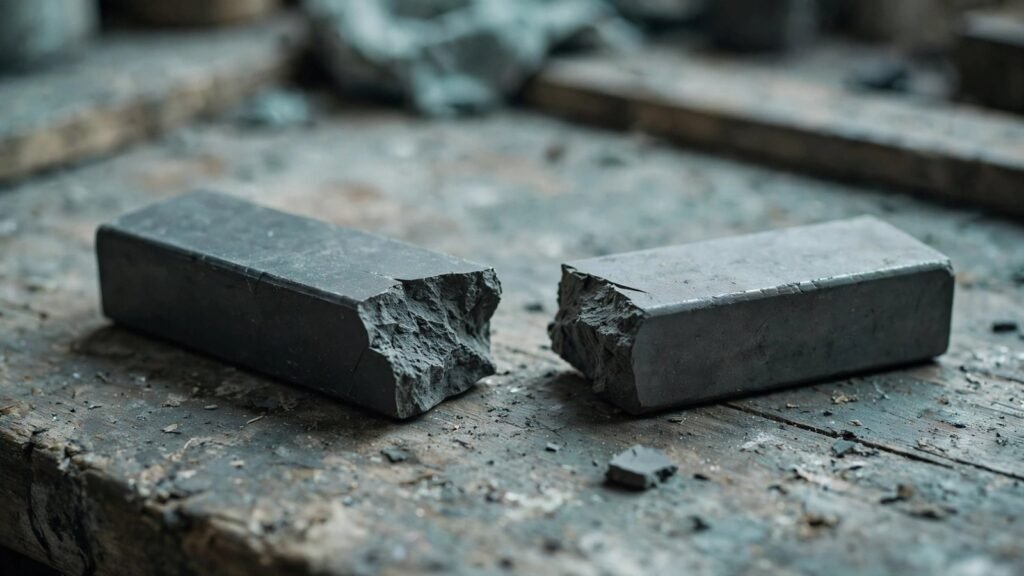
Physical shock is the third cause, but it mostly affects older materials. Dropping or hammering a magnet can shake its domains out of line. [3] Modern materials such as neodymium and samarium-cobalt do not suffer this problem in normal use; it mainly applies to magnetic steels and alnico. [3] A hard knock can still crack a brittle magnet, though, and a cracked magnet is a weaker one. [7]
Corrosion is the fourth cause. Rust eats into the material and breaks up the domain structure. [7] Neodymium is the most at risk, which is why it is plated with nickel. [2] Ferrite and samarium-cobalt resist corrosion on their own. [1] A damaged coating on a neodymium magnet is worth fixing, because rust spreads under it.
Where Are Permanent Magnets Used?
The strongest magnets do the heaviest work. Neodymium magnets drive the motors of electric and hybrid vehicles — each Toyota Prius uses about one kilogram of neodymium in its motors. [5] They also sit in the generators of some wind turbines and in the motors of cordless tools. [5] How those motors turn magnetism into motion is explained in How Do Driverless Cars Work?
Smaller neodymium magnets are everywhere in electronics. They are in hard disk drives, headphones, phone speakers and magnetic fasteners. [5] Their strength is what makes small devices possible: a weaker magnet would need to be much bigger to do the same job. [5]
Ferrite magnets do the everyday jobs. They hold notes on fridge doors, drive loudspeakers and small motors, and sit inside toys and magnetic strips. [8] Alnico magnets still serve where heat or stability matters: guitar pickups, microphones, sensors and measuring instruments. [6] Samarium-cobalt magnets work in the hottest places, such as aircraft and industrial equipment. [1]
The same four materials, then, cover almost everything — from a child’s fridge magnet to a wind turbine. What changes is not the physics. It is the trade-off: strength against heat, cost against corrosion, size against stability.
Key Takeaways
- A permanent magnet keeps its field because its magnetic domains are aligned and then locked in place by the material’s structure.
- Remanence is the magnetism that remains after the magnetising field is removed; coercivity is how hard it is to undo.
- Magnets are made by shaping an alloy or ceramic powder, then switching it on with a brief, powerful magnetic pulse.
- The four families are ferrite, alnico, neodymium and samarium-cobalt; neodymium is the strongest, ferrite the cheapest, alnico the most heat-tolerant.
- Heat above the Curie temperature, strong opposing fields, hard shocks and corrosion can weaken a magnet; the risk depends on the material.
- Neodymium drives electric vehicle motors and wind turbines; ferrite does everyday jobs; alnico and samarium-cobalt serve hot and sensitive instruments.
Conclusion
A permanent magnet is not magic. It is a material whose tiny magnetic regions were lined up once and then held in line by the structure around them. That locked alignment is the whole trick — and it explains both the strength and the limits.
Choose the right family and the magnet will work for decades. Heat it past its limit, hit it hard, or let it rust, and the alignment breaks down. The physics is the same in a fridge magnet and an electric car motor. Only the trade-offs change.
Explore more evidence-based explanations in CAVELYRA’s Science Explained collection.
References
- Radial Magnet. Magnets 101 — The Complete Guide to Magnetics. https://radialmagnet.com/magnets-101/
- CoolMagnetMan. What types of magnets are there? https://www.coolmagnetman.com/magtypes.htm
- PhysLink. Do magnets ever lose their magnetism? https://www.physlink.com/education/askexperts/ae472.cfm
- Wikipedia. Curie temperature. https://en.wikipedia.org/wiki/Curie_temperature
- Wikipedia. Neodymium magnet. https://en.wikipedia.org/wiki/Neodymium_magnet
- Ormerod, J. et al. Manufacturing Processes for Permanent Magnets: Part I — Sintering and Casting. JOM, 2022. https://link.springer.com/article/10.1007/s11837-022-05156-9
- Stanford Magnets. What Factors Cause Demagnetization of Permanent Magnets? 5 Key Reasons. https://www.stanfordmagnets.com/what-factors-cause-demagnetization-of-permanent-magnets.html
- Neodymium Magnets Wholesale. Different Types of Permanent Magnets. https://www.neodymiummagnetswholesale.com/2024/09/11/different-types-of-permanent-magnets/