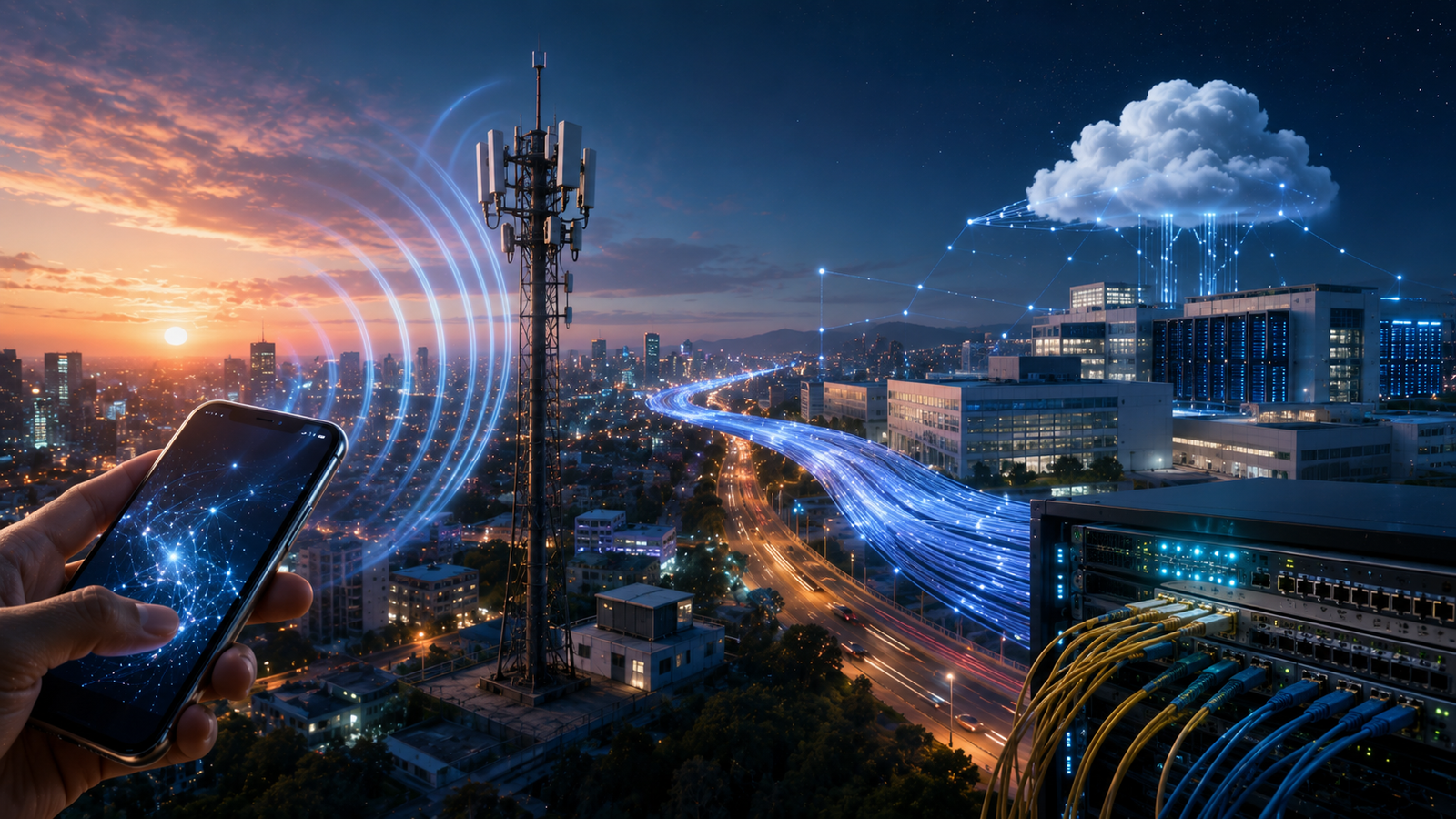
Your phone’s 5G connection begins with radio waves, but the complete system extends through antennas, cellular networks, fiber links, routers, servers, and sophisticated software.
Quick answers
- How 5G works: Your phone sends and receives data as radio signals through a nearby cellular base station, which connects it to the operator’s wider network.
- What makes 5G different: It combines different radio-frequency bands, advanced antennas, signal processing, and network architecture to support capacity, speed, and connected devices.
- Why speeds vary: Your connection depends on spectrum, signal conditions, network congestion, your device, and the capacity of the network beyond the tower.
You open a video on your phone and it begins playing almost immediately. You make a video call, upload a photograph, check a website, or send a message without a cable connecting your phone to the nearest cellular network.
So what is happening behind the screen?
Your phone converts digital information into radio signals. Those signals travel through the air to a nearby cellular base station. From there, the information enters a much larger network containing radio equipment, computers, fiber connections, routers, servers, and other infrastructure.
5G is therefore more than faster mobile internet. It is an evolution of cellular technology that combines radio spectrum, antennas, signal processing, software, and network infrastructure to connect large numbers of devices.
How Does Your Phone Connect to 5G?
A smartphone contains radio hardware and antennas that communicate with cellular networks. When you send information, the phone converts digital data into a radio signal and transmits it toward a nearby base station.
The base station receives the signal and passes the information into the operator’s network. From there, the data can travel through high-capacity networks toward the internet or another destination.
When information comes back, the process happens in reverse. The network sends the data toward a base station, the base station transmits the radio signal, and your phone converts it back into digital information that appears as a webpage, video, message, or call.
Why Is It Called a Cellular Network?
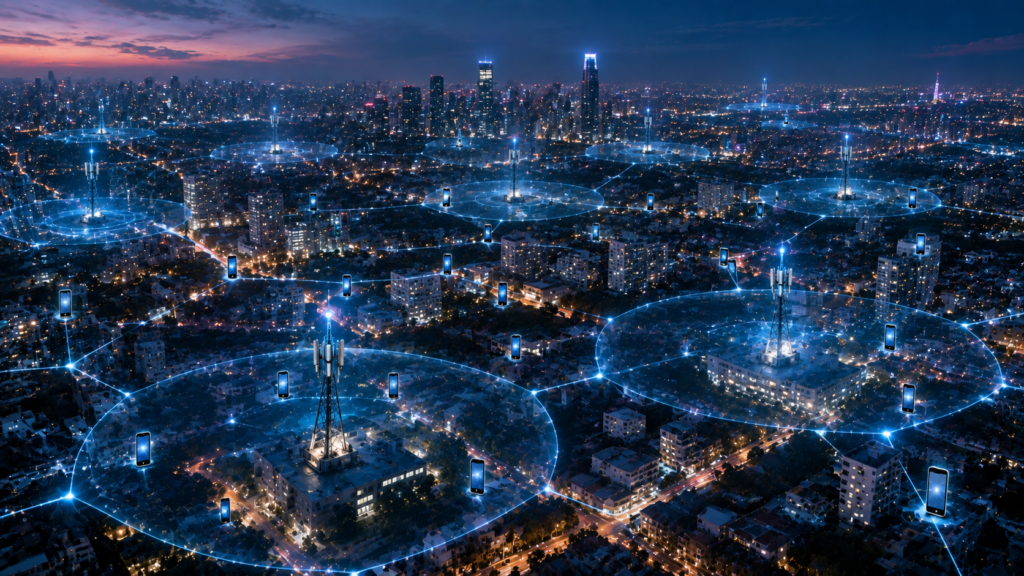
Radio spectrum is limited. Billions of wireless devices cannot transmit randomly on the same frequencies without interfering with one another.
Cellular networks solve this problem by dividing geographic areas into cells. Each cell is served by one or more base stations, and the same spectrum can potentially be reused in different geographic areas where sufficient separation exists.
As you move, your phone can connect to different cells. This allows a network to serve large numbers of users across a wide geographic area.
How Do Radio Waves Carry Data?
Cellular networks use specific portions of the electromagnetic spectrum. Different frequencies have different physical characteristics, which affects how far signals travel, how well they penetrate obstacles, and how much capacity they can provide.
Lower frequencies generally travel farther and can penetrate some obstacles more effectively. Higher frequencies can provide more available bandwidth, but they generally have shorter effective ranges and can be more affected by physical blockage.
This creates an important engineering tradeoff between coverage and capacity.
Is 5G One Frequency?
No. There is no single 5G frequency.
5G can operate across low-band, mid-band, and much higher-frequency spectrum, including millimeter-wave frequencies.
Low-band spectrum can provide broad coverage. Mid-band spectrum can offer a useful balance between coverage and capacity. Millimeter-wave spectrum can provide very high bandwidth, but it generally has shorter effective ranges and can be strongly affected by physical obstacles.
This is why two phones can both show a 5G symbol while experiencing very different speeds and coverage.
Why Is 5G Sometimes So Fast?
5G can provide very high data rates under suitable conditions, but the 5G symbol does not guarantee a specific speed.
Performance depends on available spectrum, signal conditions, network congestion, distance from the base station, device capability, antenna configuration, channel bandwidth, network deployment, and backhaul capacity.
A strong 5G signal can still produce disappointing performance if many users are sharing the same resources. Signal strength is only one part of the equation.
How Do Massive MIMO and Beamforming Help?
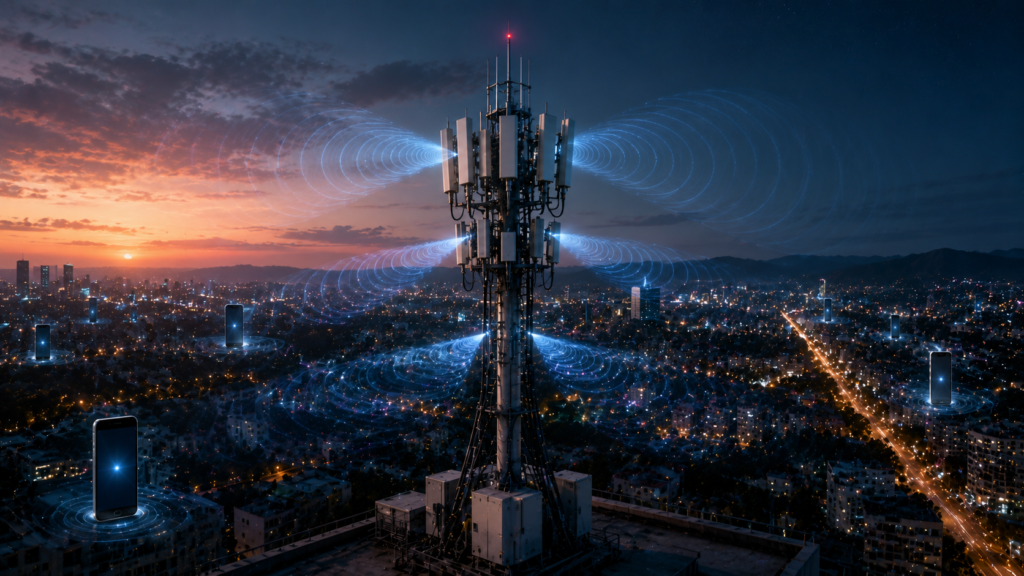
Massive MIMO uses many antenna elements at a base station rather than relying on a single antenna. This allows the network to transmit and receive multiple streams of information while taking advantage of the spatial characteristics of the radio environment.
Beamforming uses multiple antennas and signal processing to control how radio waves combine. It can create stronger signal conditions in desired directions and improve communication with particular devices.
These technologies help modern cellular networks use available spectrum more efficiently.
How Does Your Phone Stay Connected While You Move?
Your phone continuously evaluates radio conditions as you move.
You may start near one base station and gradually move into an area where another cell provides a more suitable connection. The network can transfer your connection from one cell to another through a process called handover or handoff.
This can happen while you are watching a video, making a call, or using navigation. The network manages these transitions automatically.
How Can Thousands of Users Share One Cell?
A crowded cell may contain thousands of connected devices competing for limited radio resources.
The network organizes access by assigning time and frequency resources, adjusting transmission parameters, and scheduling different devices.
Sophisticated algorithms determine which devices transmit, when they transmit, and which resources they use. This allows many users to share the available spectrum in a controlled way.
Why Does 5G Latency Matter?
Speed and latency are different.
A connection can have high bandwidth while still experiencing noticeable delay. Latency matters for applications such as video calls, online gaming, remote control, industrial systems, and augmented reality.
5G was designed with lower-latency capabilities in mind. However, actual latency depends on the entire network path. The radio link is only one part of that path. Processing, routing, application architecture, and physical distance also contribute to total delay.
What Is the 5G Core Network?
Your phone communicates first with the radio access network. The base station then connects into the operator’s core network.
The core network handles functions such as authentication, mobility management, session management, traffic routing, policy enforcement, and connections to external networks.
The radio access network connects your device to the cellular system. The core network turns that connection into a complete communications service.
How Does Your Phone Authenticate With the Network?
When your phone connects to a cellular network, the network needs to determine whether the device and subscriber are authorized.
Your SIM or eSIM contains credentials associated with your mobile subscription. The network uses authentication procedures to establish a trusted relationship between the device, subscriber identity, and network.
This happens automatically as your phone connects and moves between cells.
How Is 5G Communication Secured?
Modern cellular networks use security mechanisms to protect communications over the radio interface and within network systems.
Cryptographic mechanisms help protect communication, while network architecture provides additional security controls.
The exact implementation varies between generations and deployments, but security is an integral part of modern cellular communication.
Why Does 5G Affect Battery Life?
Wireless communication consumes energy. Your phone’s cellular radio must monitor signals, transmit and receive data, measure neighboring cells, change configurations, and perform security operations.
Modern cellular systems use power-saving mechanisms that allow devices to enter lower-power states when active communication is not required.
Your phone can therefore maintain necessary connectivity without continuously operating every component at maximum activity.
What Can 5G Connect?
5G can connect much more than smartphones.
Cellular networks can support sensors, vehicles, industrial equipment, cameras, meters, machines, and other connected devices. Different applications may require different combinations of bandwidth, reliability, device density, and latency.
This is why 5G is better understood as a broad connectivity platform rather than simply a faster phone connection.
What Is Network Slicing?
Network slicing uses software-defined architecture to create logically separated network environments for different applications.
Different slices can have different performance or policy characteristics. One service could prioritize capacity, another reliability, while another could support large numbers of low-data-rate devices.
The exact implementation depends on the network, but the underlying idea is to make network resources more flexible through software.
What Happens to a Radio Signal Between Your Phone and the Tower?
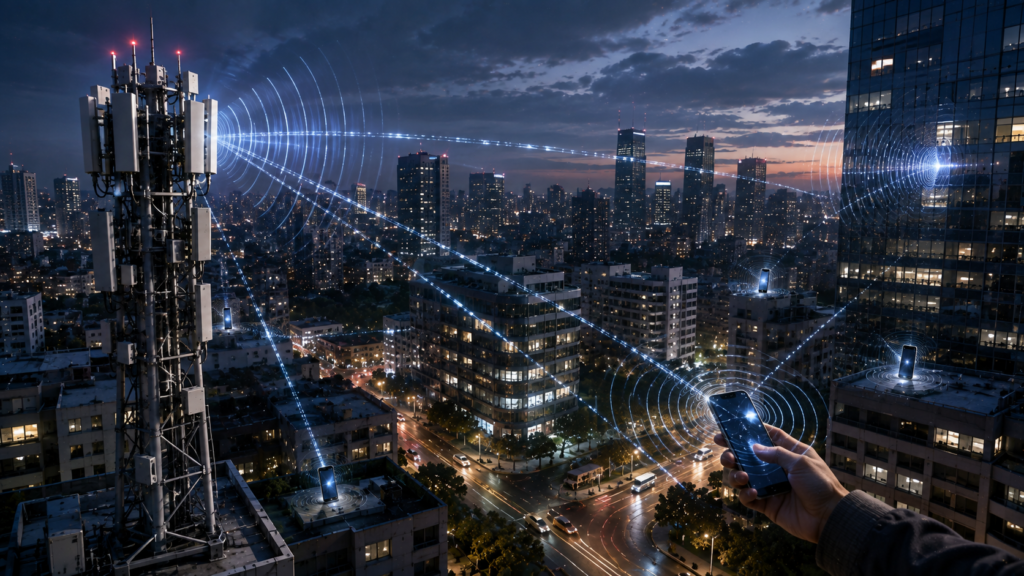
The space between your phone and the base station is called the wireless channel.
The signal can reflect from buildings, scatter from surfaces, bend around obstacles, and arrive through multiple paths. These effects can cause constructive or destructive interference.
As a result, the received signal can change when you move only a short distance. Modern receivers use signal processing to deal with these changing conditions.
Why Does Strong Signal Not Guarantee High Speed?
A strong signal does not necessarily mean a fast connection.
You can have a strong signal in a congested cell where many users are competing for available resources. Conversely, a weaker signal can sometimes provide good performance when the network is lightly loaded and radio conditions are favorable.
Network performance depends on much more than signal strength.
What Is Backhaul?
The radio link connects your phone to the base station. Backhaul connects the base station to the rest of the network.
Many cellular sites use fiber-optic links for backhaul. A fast wireless connection is therefore dependent on high-capacity infrastructure behind the tower.
5G may be wireless between your phone and the base station, but much of the network beyond that point can still depend on wired connections.
How Does Your Data Reach the Internet?
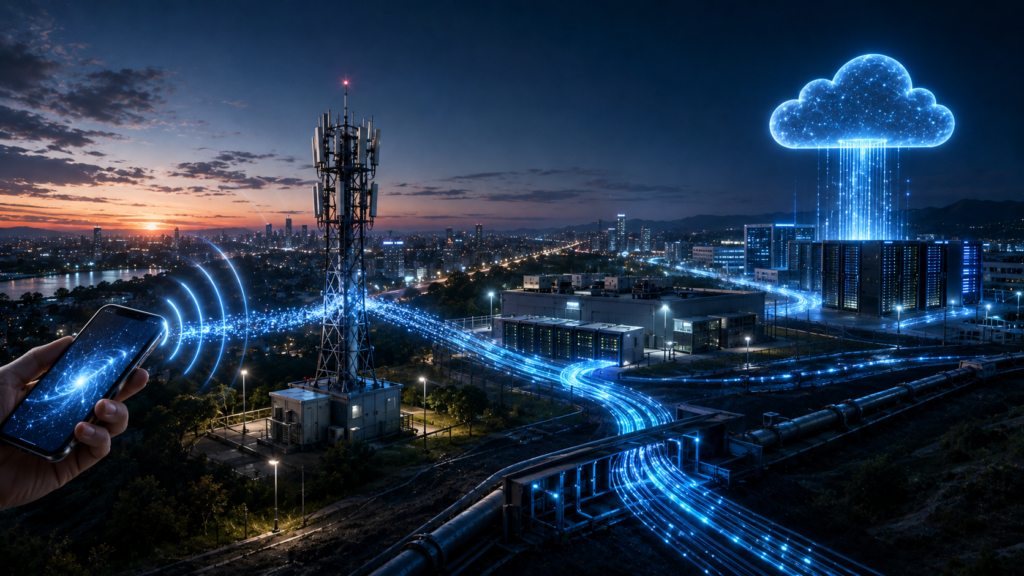
Imagine downloading a video.
The data travels from a server through the internet and enters the operator’s network. It then moves toward a base station and crosses the wireless link to your phone.
The response travels back through the same interconnected system.
Your actual experience depends on every major part of this path. A congested network, limited backhaul, distant server, or other bottleneck can affect performance even when the radio connection itself is strong.
Why Does Fiber Matter to 5G?
Once data leaves the base station, it can travel through high-speed fiber and other network infrastructure.
Packets may cross multiple routers before reaching a cloud data center or another destination. This means the wireless connection between your phone and the base station is only one part of the complete journey.
This is also why edge computing can matter for applications where response time is important. Processing resources can sometimes be placed closer to users.
Why Does Your Phone Switch Between 4G and 5G?
Your device continuously evaluates available networks.
It considers signal quality, network configuration, spectrum availability, device support, operator policies, and other conditions.
If 5G provides a suitable connection, the phone can use it. If conditions change, it may use LTE instead.
The goal is reliable connectivity, not remaining on 5G at all times.
Why Are 5G Coverage Maps Not Perfect?
A coverage map provides an approximation.
Real-world performance can differ because buildings, terrain, trees, weather, network load, indoor construction, device orientation, and other factors affect radio propagation.
A map may show coverage in an area where the signal is weak inside a particular building.
Wireless propagation is physical, so software cannot completely eliminate the effects of the environment.
What Are Small Cells?
A small cell is a compact cellular base station designed to serve a relatively small area.
Instead of relying on one large tower, networks can use many smaller cells to increase capacity and improve coverage in dense environments.
Small cells can be useful in places such as shopping centers, stadiums, airports, and business districts.
Network design changes according to population density, terrain, demand, and available spectrum.
How Does 5G Work in Rural Areas?
A large rural area with relatively few users can be served efficiently using lower-frequency spectrum and tall infrastructure. A single cell can cover a relatively large area.
Dense cities require a different approach. Cells can be smaller, and many antennas or small cells may be needed to handle concentrated demand.
Cellular planning therefore changes according to population density, terrain, demand, and spectrum availability.
5G Compared With Wi-Fi
Wi-Fi is typically used within homes, offices, campuses, and other local environments. A router or access point provides the wireless connection.
Cellular networks use geographically distributed base stations and operator infrastructure. Your phone can move between cells while maintaining connectivity.
Both technologies provide wireless access to digital networks, but they use different architectures and service models. They solve different connectivity problems.
5G Is More Than Faster Internet
Imagine a modern city filled with smartphones, connected vehicles, cameras, sensors, industrial machines, and cloud services.
All of these systems compete for network resources.
5G is part of the infrastructure designed to manage this growing demand. Its importance therefore extends beyond speed to capacity, efficiency, mobility, reliability, connectivity, and flexibility.
The Complete Journey of a 5G Message
Return to your phone and open a website.
Your phone converts the request into a radio signal. The signal travels through the air to a nearby base station, where it is received and processed.
The base station forwards the information into the operator’s network. Routers move the packets toward their destination, and a server sends the response back.
The response travels through the network to the base station. The base station transmits it, your phone receives it, and the radio hardware converts it back into digital information.
Your browser displays the page.
Behind that simple experience are radio physics, antennas, signal processing, scheduling, authentication, security, cellular architecture, fiber, routers, servers, and global internet infrastructure.
What Does the 5G Symbol Really Mean?
When your phone displays 5G, the symbol represents a radio link between your device and a cellular network.
It represents antennas communicating through electromagnetic waves, carefully managed radio spectrum, signal processing, scheduling, coding, authentication, and base stations connected to high-capacity networks.
It also represents a path from your phone to servers and services around the world.
The signal is invisible, but the system behind it is very real.
Your phone is connected through physics, telecommunications engineering, computer networking, software, and a vast physical infrastructure.
References and Further Reading
- 3GPP: 5G System Overview — standards background on 5G system architecture and capabilities.
- 3GPP: 5G New Radio (NR) — technical context for the radio interface used by 5G.
- ETSI: 5G Mobile Technologies — overview of 5G standards and technical features.
These sources describe the standards and engineering behind 5G. Actual speeds, coverage, latency, and available features depend on the operator, spectrum, device, and deployment.
Related Reading
Key Takeaways
- 5G is a generation of cellular wireless technology.
- 5G operates across multiple frequency ranges.
- Low-band, mid-band, and millimeter-wave spectrum provide different combinations of coverage and capacity.
- Cellular networks divide geographic areas into cells.
- Massive MIMO and beamforming help manage radio signals and network capacity.
- Handover allows phones to move between cells while maintaining connectivity.
- Signal strength alone does not determine network speed.
- Congestion, spectrum, device capability, interference, backhaul, and network configuration affect performance.
- The radio link connects your phone to the base station, while backhaul connects the base station to the wider network.
- The core network manages authentication, mobility, sessions, routing, and other functions.
- 5G can support smartphones, vehicles, sensors, industrial systems, and other connected devices.
- Edge computing can place processing resources closer to users.
- 5G is an evolution of radio technology, network architecture, software, and connectivity.
Conclusion
The next time your phone shows a 5G connection, that small symbol represents a much larger system.
Your phone converts digital information into radio signals. Antennas transmit and receive those signals, while cellular base stations connect the wireless link to the operator’s network.
From there, the data can travel through fiber, routers, core-network systems, cloud infrastructure, and servers before the response makes its way back to your phone.
The experience depends on more than the radio signal. Spectrum, antennas, signal processing, network congestion, backhaul, routing, device capability, and the physical environment all influence how well the connection performs.
5G also extends beyond smartphones. The same underlying network can support connected vehicles, sensors, industrial equipment, cameras, machines, and other devices with different connectivity requirements.
That is why 5G is more than a faster version of mobile internet.
It is a coordinated system of electromagnetic waves, antennas, spectrum, software, computers, fiber infrastructure, and network architecture.
The radio signal may be invisible.
The engineering behind it is everywhere.
That is how 5G and modern wireless connectivity work.
Explore more evidence-based explanations of technology, science, and modern connectivity in CAVELYRA’s Science Explained collection.