
Look at a star in the night sky.
It may appear calm, stable, and almost permanent. But a star is a dynamic system, held together by a delicate balance between gravity and the energy produced by nuclear reactions in its interior.
For some massive stars, that balance eventually fails.
The star has spent millions of years producing energy and building heavier elements inside its core. Then its nuclear processes reach a critical stage. The core collapses under gravity, and the outer layers can be violently expelled into space.
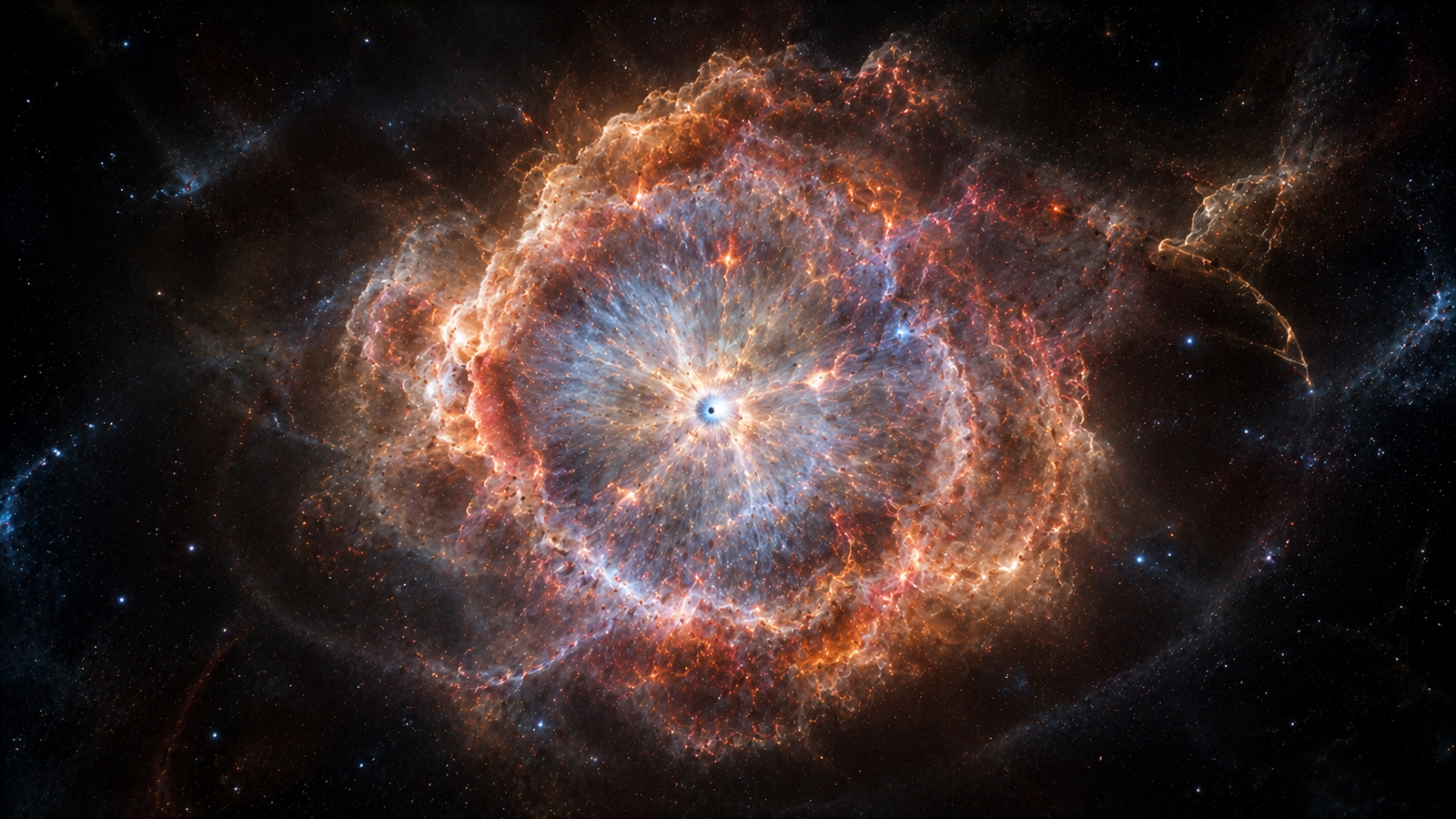
The result is a supernova.
But a supernova is more than a spectacular explosion. It is the final stage of a complex chain of stellar evolution, extreme physics, nuclear reactions, and gravitational collapse.
So how does a supernova actually happen? What causes a massive star to collapse? What remains afterward? And how can the death of one star contribute to the formation of future stars and planets?
To understand the explosion, we first need to understand the star that produces it.
How Does a Massive Star Reach Its Final Stage?
A massive star begins when gravity pulls together a dense region of gas and dust. As the material becomes compressed, temperatures and pressures rise until nuclear fusion begins in the core.
For much of its life, the star converts hydrogen into helium. The energy released by this process helps support the star against the inward pull of gravity.
Eventually, the hydrogen in the core becomes depleted. The core contracts and heats up, allowing further stages of nuclear burning to begin.
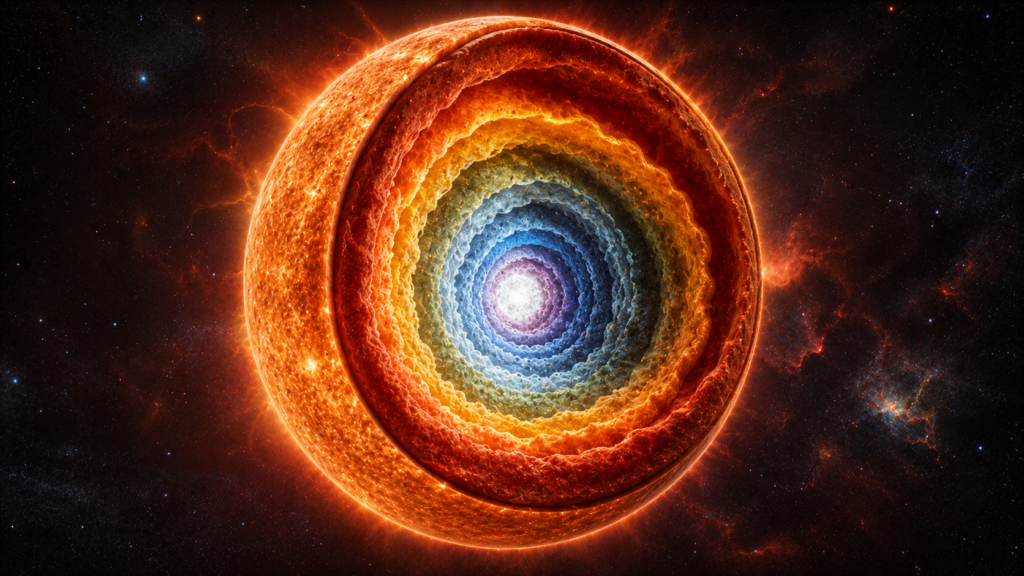
In sufficiently massive stars, these stages can produce progressively heavier elements. Carbon, oxygen, neon, magnesium, and silicon can participate in successive fusion processes as the star evolves.
The star develops increasingly complex layers, with different regions undergoing different nuclear reactions.
Eventually, an iron-rich core forms.
Why Is Iron So Important?
Iron marks a critical point in the life of a massive star.
Earlier stages of nuclear fusion can release energy that helps support the star against gravity. Fusion involving iron does not provide the same energy advantage.
As the iron-rich core grows, the star can no longer rely on further fusion to provide enough support against gravitational collapse.
The balance begins to fail.
Gravity takes over.
The core then collapses extremely rapidly. A process that follows millions of years of stellar evolution can unfold in a remarkably short period.
What Happens When the Core Collapses?
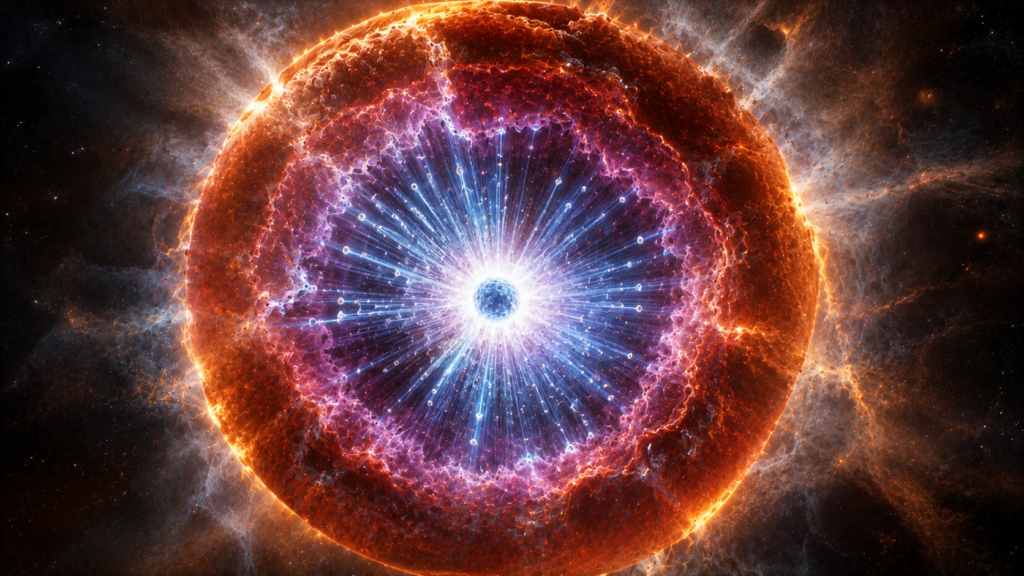
The collapsing core reaches extraordinary densities.
Under these extreme conditions, electrons and protons interact, producing neutrons and enormous numbers of neutrinos. Matter becomes compressed into an incredibly dense region, and the behavior of the collapsing material changes dramatically.
A shock wave develops.
This is a crucial part of the supernova process, but the shock does not simply race outward and automatically produce an explosion. As it moves through the collapsing star, it can lose energy.
Neutrinos also carry enormous amounts of energy away from the core.
Scientists believe that interactions involving neutrinos play an important role in helping revive the stalled shock in core collapse supernovae. The precise details of this process remain an active area of research.
If the explosion develops successfully, the outer layers of the star are expelled into space.
The result is a core collapse supernova.
Why Is a Supernova So Powerful?
A massive star contains an enormous amount of material.
When its core collapses, the surrounding layers can be violently accelerated outward. Shock waves move through the stellar material, heating it to extreme temperatures.
The explosion can become extraordinarily bright.
At the same time, nuclear reactions can occur within the expanding material. Elements produced during the star’s life can be redistributed, while additional elements can form through explosive nuclear processes.
The supernova therefore does two things at once. It releases an enormous amount of energy, and it changes the chemical environment around the star.
The material that once belonged to a single star begins spreading into interstellar space.
What Is Left After a Massive Star Explodes?
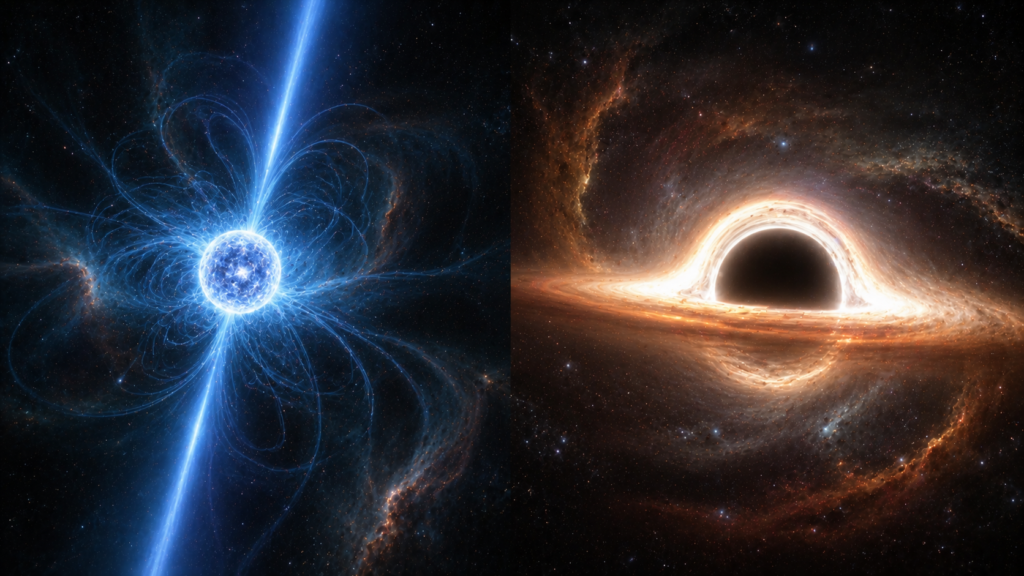
The fate of the collapsed core depends on the conditions inside the star.
In some cases, it becomes a neutron star.
In others, the collapse continues and a black hole forms.
Neutron Stars
A neutron star is an extraordinarily compact object. A large amount of stellar mass is compressed into a sphere roughly the size of a city.
The resulting density is extreme. So are its gravitational and magnetic properties.
Some neutron stars rotate very rapidly. If beams of radiation from a rotating neutron star sweep across Earth at regular intervals, astronomers detect a repeating signal. These objects are called pulsars.
Some neutron stars have exceptionally powerful magnetic fields. These are known as magnetars.
A neutron star therefore represents one possible endpoint of massive stellar collapse.
Black Holes
If the collapsing core is sufficiently massive, the forces resisting further compression may not be enough to stop gravity.
The collapse can continue until a black hole forms.
A black hole has an event horizon, a boundary beyond which light cannot escape.
It is important to distinguish the black hole from the supernova explosion itself. The black hole does not simply swallow the entire star and cause the explosion. The explosion and the compact remnant are consequences of the complex physical processes occurring during and after stellar collapse.
Do All Supernovae Come From Massive Stars?
No.
This is an important distinction because the word supernova describes more than one physical process.
Core collapse supernovae occur when massive stars undergo catastrophic gravitational collapse.
Type Ia supernovae have a different origin.
They involve white dwarfs, the dense remnants of stars that have exhausted their nuclear fuel. Under particular conditions, a white dwarf can undergo a runaway thermonuclear reaction and become disrupted.
Different binary-star configurations can produce the conditions required for these explosions, and the precise pathways remain an active area of research.
So when astronomers observe a supernova, they cannot simply assume that a massive star has collapsed. They need to determine which physical mechanism produced the event.
How Do Astronomers Know What Happened?
A supernova sends information about its physical conditions across space in the form of light.
Astronomers study how its brightness changes over time. This changing pattern is called a light curve.
They also examine the spectrum of the explosion.
Different elements leave characteristic signatures in light. By studying these spectral features, astronomers can determine which elements are present and learn about the temperature, composition, and velocity of the expanding material.
This allows scientists to reconstruct important aspects of an explosion that occurred at an enormous distance.
A supernova becomes a natural laboratory.
Astronomers do not need to travel to the star. They can study the information carried to Earth by its light.
What Do Neutrinos Tell Us About a Supernova?
Neutrinos are particularly important in core collapse.
These particles interact very weakly with ordinary matter. Large numbers can therefore escape from the collapsing core and carry energy and information outward.
Supernova 1987A provided an important example.
Astronomers detected neutrinos associated with the explosion in the Large Magellanic Cloud. The observation provided valuable information about the extreme processes occurring inside a collapsing star.
Neutrinos are especially useful because they can escape from regions that would otherwise be hidden beneath enormous amounts of stellar material.
Where Do the Elements From a Supernova Go?
A supernova does not simply destroy a star and leave nothing behind.
It returns stellar material to space.
Some of the elements in that material were produced during the star’s earlier stages of nuclear burning. Others can form through nuclear reactions associated with the explosion.
The expanding material eventually mixes with the surrounding interstellar medium.
Over cosmic time, that enriched material can become part of new stars, planets, and other structures.
This is one reason stellar evolution is closely connected to the chemical evolution of galaxies.
Elements such as carbon, oxygen, calcium, and iron have histories that extend far beyond the Solar System. Supernovae are important contributors to this history, although they are not responsible for producing every heavy element in the universe.
Different elements can form through different nuclear processes and in different astrophysical environments.
Supernovae are one important part of a much larger cosmic story.
What Happens to a Supernova Remnant?
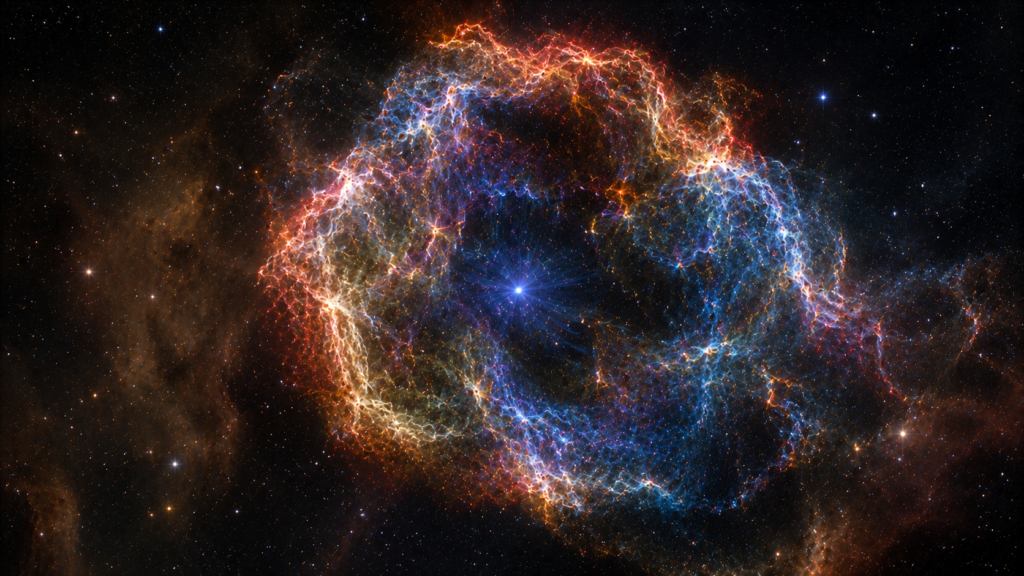
The visible explosion eventually fades, but the event does not simply end.
The expelled material continues expanding through space.
It interacts with surrounding interstellar gas. Shock waves move outward. Magnetic fields and charged particles participate in the evolving structure.
Over time, the expanding debris develops into a supernova remnant.
Some remnants remain visible for thousands of years.
The Crab Nebula is one of the best-known examples. A pulsar sits at its center, surrounded by material associated with the explosion.
Cassiopeia A is another important supernova remnant in the Milky Way. Its expanding debris allows astronomers to study material produced and redistributed during the stellar explosion.
These remnants provide long-lasting evidence of stellar death and valuable laboratories for studying plasma, magnetic fields, and high-energy processes.
Can Supernovae Change Their Galaxies?
The influence of a supernova extends beyond the original star.
Its shock waves can interact with surrounding interstellar gas. Depending on the environment, this interaction can compress gas and potentially contribute to new episodes of star formation.
In other situations, the energy released by the explosion can disrupt surrounding clouds.
Supernova remnants can also accelerate charged particles to very high energies and contribute to the population of cosmic rays.
Supernovae therefore influence the physical environment of galaxies as well as the evolution of individual stars.
Why Are Supernovae Part of Cosmic Recycling?
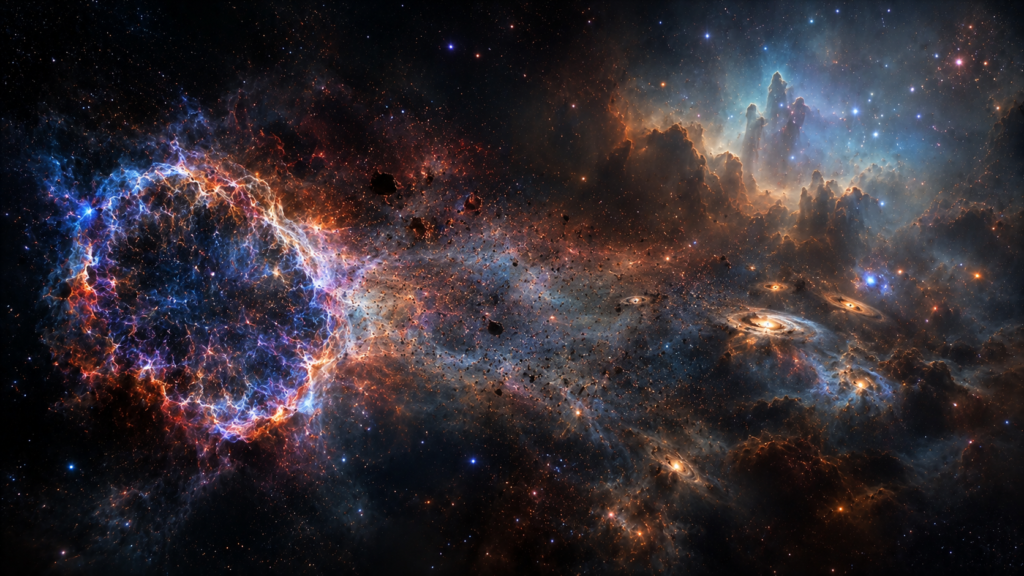
Think about the process on a much larger scale.
A cloud of gas forms a star.
The star lives for millions of years.
Nuclear reactions transform matter inside it.
The star eventually dies.
Its material returns to space.
That material mixes with surrounding gas and can later become part of another generation of stars.
The cycle continues.
The early universe contained mostly hydrogen and helium, while later generations of stars formed from material that had been increasingly processed by previous generations of stars.
The Sun formed from material that had already experienced this cosmic history.
The planets formed from the same enriched environment.
That is why the simple phrase “we are made of stardust” captures a real scientific idea. Many of the elements that make up Earth and living organisms were produced or transformed through earlier generations of stellar processes.
Supernovae are part of that history.
Why Are Type Ia Supernovae Important to Cosmology?
Type Ia supernovae have another important role.
After calibration, their observed brightness can provide useful information about cosmic distances. Astronomers can use these events to study very distant galaxies.
Observations of distant Type Ia supernovae played an important role in the discovery that the expansion of the universe is accelerating.
That discovery led to the concept of dark energy.
A stellar explosion therefore became a tool for investigating the behavior of the universe on its largest scales.
This is one of the remarkable features of supernova research. The same event can tell astronomers about nuclear physics, stellar evolution, galactic environments, and cosmology.
Could a Supernova Affect Earth?
A sufficiently nearby supernova could expose Earth to harmful radiation and affect the atmosphere.
Distance matters enormously, however. Most supernovae observed from Earth are far enough away to be spectacular astronomical events rather than immediate threats.
There is another important point about what we see.
Light takes time to travel.
If a supernova occurs millions of light-years away, its light can take millions of years to reach Earth.
When astronomers observe such an event, they are seeing the distant past.
The explosion may have happened millions of years ago, even though its light has only now reached our telescopes.
How Does a Supernova Work From Beginning to End?
For a core collapse supernova, the sequence begins with a massive star.
The star spends millions of years producing energy through nuclear fusion. As it evolves, it produces progressively heavier elements.
Eventually, an iron-rich core develops.
Fusion can no longer provide enough support against gravity.
The core collapses.
Neutrinos are produced in enormous numbers. A shock wave develops. Under the appropriate conditions, the shock can be revived and the outer layers are expelled.
The collapsed core becomes a neutron star or black hole, depending on the final conditions.
The explosion also sends stellar material and elements into the surrounding galaxy.
A Type Ia supernova follows a different pathway. A white dwarf undergoes a runaway thermonuclear explosion under specific conditions and is disrupted.
Two different physical mechanisms can therefore produce the phenomenon we call a supernova.
A Star Dies, But Its Story Continues
A supernova may look like destruction.
On a cosmic scale, it is also transformation.
The original star changes beyond recognition. Its core may become a neutron star or black hole. Its outer layers spread through space. Elements produced during its life and death enter the surrounding interstellar environment.
That material can eventually become part of new stars and planets.
The explosion can influence surrounding gas, accelerate particles, and contribute to the chemical evolution of its galaxy.
So a supernova is more than a spectacular stellar explosion.
It is a consequence of stellar evolution.
It is a laboratory for extreme physics.
It is a mechanism for redistributing matter.
And it is one part of the long cosmic cycle through which stars transform and recycle material.
A star that once appeared as a tiny point of light can eventually influence an enormous region of space.
Long after its explosion has faded, the material it released can continue participating in the evolution of the universe.
Key Takeaways
- Massive stars can end their lives through catastrophic core collapse when their internal support can no longer withstand gravity.
- An iron-rich core marks a critical stage because further fusion cannot provide the same energy support against gravitational collapse.
- Core collapse produces extreme densities, enormous numbers of neutrinos, and conditions that can lead to a powerful shock wave and explosion.
- The collapsed core can become a neutron star or, under sufficiently extreme conditions, a black hole.
- Some neutron stars become pulsars or magnetars because of their rapid rotation or exceptionally strong magnetic fields.
- Not every supernova comes from a massive star. Type Ia supernovae involve the thermonuclear disruption of white dwarfs.
- Supernovae produce and redistribute elements, returning stellar material to interstellar space.
- Supernova remnants can remain visible for thousands of years and allow astronomers to study the aftermath of stellar explosions.
- Supernovae can influence surrounding gas, cosmic rays, star formation, and the chemical evolution of galaxies.
- Material released by dying stars can eventually become part of new stars, planets, and other cosmic structures.
Conclusion
A supernova is the dramatic endpoint of a long stellar process.
For a massive star, that process begins with nuclear fusion and progresses through increasingly advanced stages of stellar burning. Eventually, an iron-rich core forms, the balance against gravity fails, and the core collapses.
The result can be a powerful explosion, an enormous burst of neutrinos, an expanding cloud of stellar debris, and a compact remnant in the form of a neutron star or black hole.
Type Ia supernovae follow a different path through the thermonuclear disruption of a white dwarf.
In both cases, the consequences extend far beyond the original event. Supernovae redistribute elements, reshape their surroundings, create compact remnants, and provide astronomers with information about some of the most extreme conditions in the universe.
A star can therefore die without its story ending.
Its material can travel through space for millions or billions of years and eventually become part of something new.
That is the deeper significance of a supernova. It is not simply the destruction of a star. It is one stage in the continual transformation and recycling of matter across the universe.
Explore more evidence-based explanations of science, astronomy, and the universe in CAVELYRA’s Science collection.