Introduction
Look up at the night sky.
You see points of light scattered across the darkness. Some stars are relatively close, while others are thousands or even millions of light-years away.
Some are ancient. Others are young.
And somewhere in the galaxy, new stars are forming right now.
Stars do not simply appear in space. They begin inside enormous clouds of gas and dust.
Gravity gathers material into increasingly dense regions. Those regions collapse, a protostar develops, and material continues falling inward.
Eventually, the temperature and pressure in the center can become high enough for sustained hydrogen fusion.
A star enters the main sequence.
But how does a cold cloud become an object hot enough to shine across interstellar space?
To understand star formation, we need to begin with the space between the stars.
The Birthplace of Stars
Interstellar space is not completely empty. It contains gas, dust, radiation, magnetic fields, and extremely low-density plasma.
Most of the ordinary matter between stars is hydrogen. There is also helium and smaller amounts of heavier elements.
In some regions, this material becomes concentrated into enormous clouds called molecular clouds.
These clouds can extend across many light-years. Some contain enough material to produce thousands or even millions of stars.
They are among the main stellar nurseries of the galaxy.
Why Are Molecular Clouds Important?
Molecular clouds are cold compared with stars, but they are not inactive.
Inside them, gravity competes with gas pressure, turbulence, magnetic fields, radiation, and other physical processes.
Sometimes, a region becomes dense enough for gravity to gain the advantage.
Star formation begins.
Gravitational Collapse Begins
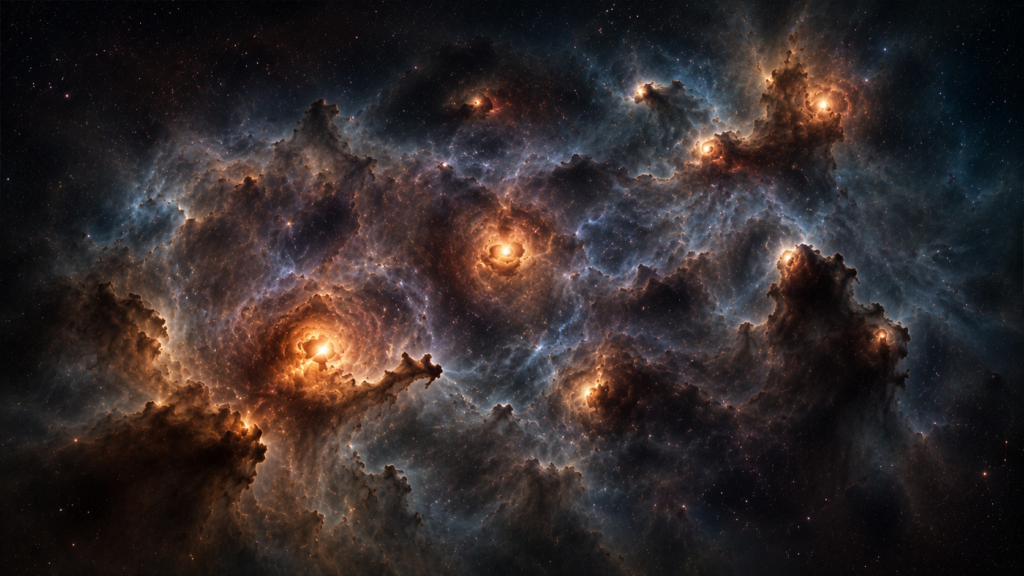
A molecular cloud does not necessarily collapse as one enormous object.
Different regions can become denser. A dense region attracts more material, increasing its density and strengthening its gravitational influence.
The collapse can then accelerate. As material falls inward, the gas becomes compressed. Compression raises its temperature, converting gravitational potential energy into thermal energy.
Eventually, a dense central object forms. This is a protostar.
What Is a Protostar?
A protostar is not yet a fully developed hydrogen-burning star.
It does not primarily shine because sustained hydrogen fusion has begun in its core. Instead, much of its energy comes from gravitational contraction as material falls inward.
This distinction matters because the birth of a star begins before nuclear fusion.
The protostar must continue accumulating material and heating internally before it reaches the conditions required for sustained hydrogen fusion.
Gravity builds the protostar first.
Why Does a Disk Form Around a Young Star?
A collapsing cloud is rarely perfectly motionless. It has some rotation.
As the material collapses, conservation of angular momentum causes rotation to become increasingly important.
A useful comparison is a figure skater pulling their arms inward. As the collapsing material moves closer to the center, its rotation becomes faster.
The gas therefore does not simply fall directly into the protostar. Much of it forms a rotating disk around the young star. This is called an accretion disk.
What Does an Accretion Disk Do?
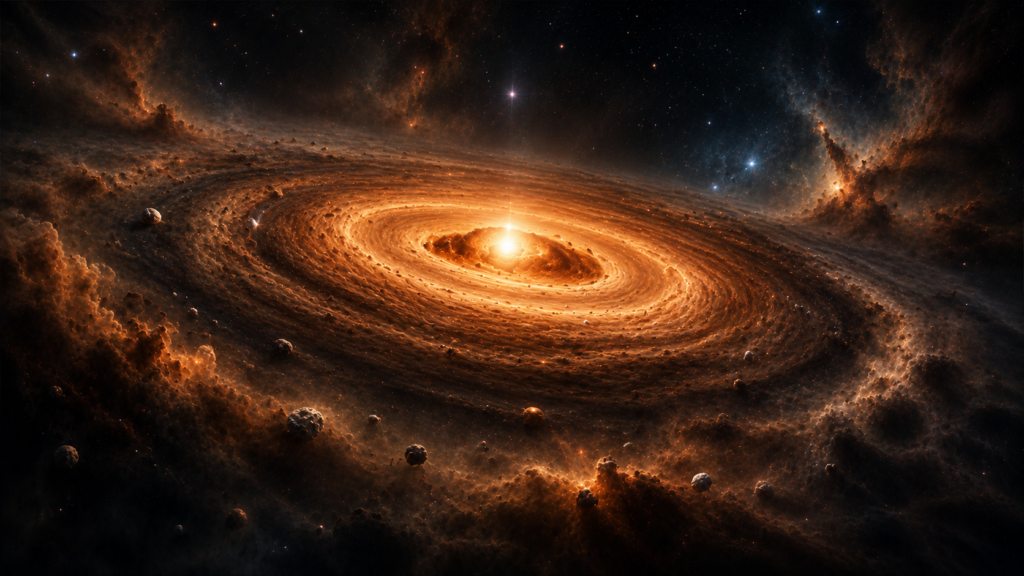
An accretion disk contains gas and dust. Material within the disk gradually moves inward, and some of that material eventually becomes part of the growing star.
But the disk has another important role. It can become the birthplace of planets.
The same material that forms a star can also provide the raw material for a planetary system.
Jets and Outflows From Young Stars
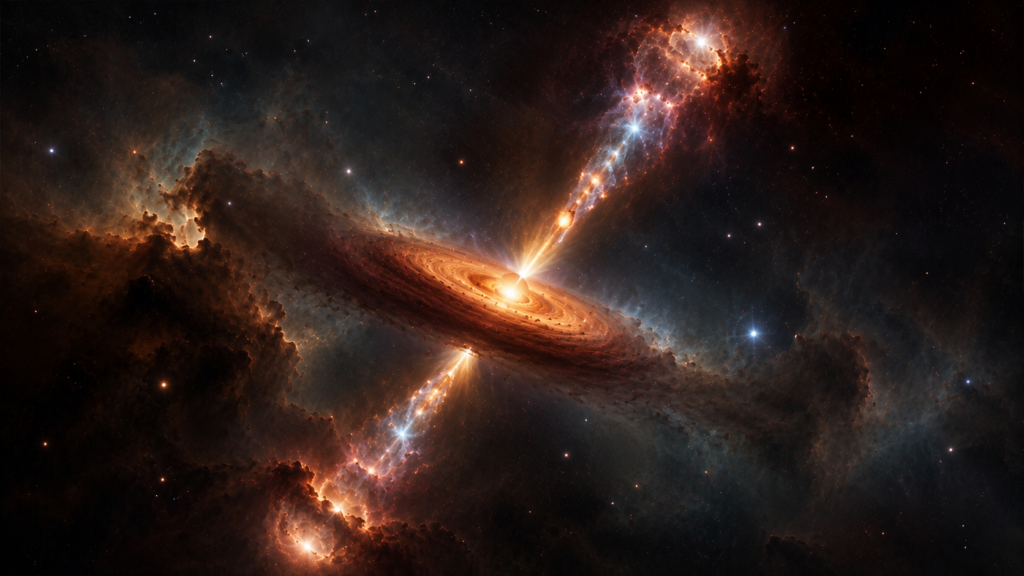
A young protostar is surrounded by an active environment.
Magnetic fields become important, and gas can be accelerated along magnetic field structures.
Some young stars produce narrow bipolar jets that can extend far beyond the immediate stellar environment.
These jets carry material and energy away from the young system.
When they collide with surrounding gas, they can produce bright regions called Herbig-Haro objects.
These structures provide visible evidence of active star formation.
Gravity Does Not Work Alone
Gravity is essential because it brings material together, but several processes oppose or influence collapse.
Gas pressure pushes outward. Turbulent motion can support parts of the cloud. Magnetic fields can influence how material moves, while radiation can affect surrounding gas.
The balance between these processes helps determine whether a region collapses.
Star formation is therefore a competition between gravity and several physical processes.
Why Does Cooling Matter?
Cold molecular clouds provide favorable conditions for gravitational collapse.
Lower temperatures mean lower thermal pressure. Gas pressure tends to resist gravitational compression, so cooling can make continued collapse easier.
Molecules and dust can radiate energy away, allowing dense regions to continue collapsing.
The exact details depend on the chemical composition and physical conditions of the cloud.
What Is the Jeans Criterion?
A region does not collapse simply because it contains a large amount of gas.
The density and distribution of the material matter.
The Jeans criterion provides a useful framework for understanding gravitational instability. Under suitable conditions, if gravity overcomes the ability of pressure to support a region, the region can become gravitationally unstable.
It begins to collapse.
Why Do Stars Often Form in Groups?
As a cloud collapses, it can fragment. One cloud can therefore produce multiple dense cores, and those cores can form multiple stars.
This is one reason stars are often born in groups. A stellar nursery can contain hundreds or thousands of young stars at different stages of development.
The Sun may also have formed in a stellar cluster billions of years ago. Its original stellar siblings could now be scattered throughout the galaxy.
From Protostar to Star
As a protostar grows, material continues falling toward it. The protostar becomes more massive, while its central temperature, density, and pressure increase.
Eventually, conditions approach those required for sustained hydrogen fusion.
This is the critical transition.
A normal hydrogen-burning star is powered primarily by sustained nuclear fusion in its core. For a Sun-like star, hydrogen nuclei combine through a chain of nuclear reactions, producing helium.
A small amount of mass is converted into energy. That energy eventually leaves the star as radiation and other forms of energy, allowing the star to shine for millions or billions of years.
What Is Hydrostatic Equilibrium?
Inside a newborn star, gravity pulls inward while the pressure produced by hot plasma pushes outward.
Fusion generates energy that supports the star’s internal structure. The star can reach a new balance called hydrostatic equilibrium.
The star is then stable enough to enter the main sequence phase of its life. For a star like the Sun, this phase lasts billions of years.
Why Does Stellar Mass Matter?
Not every star follows exactly the same path. Mass is one of the most important factors influencing a star’s temperature, luminosity, lifetime, color, fusion processes, and eventual fate.
Low-mass and massive stars differ in important details. But the basic birth process remains rooted in gravitational collapse.
How Do Massive Stars Form?
Massive stars can form inside dense stellar nurseries. Their stronger gravity allows them to gather large amounts of material.
But massive star formation presents a challenge. As a massive protostar grows, it becomes extremely luminous. Radiation pressure can push against incoming material.
Yet massive stars still form.
Their formation involves complex interactions between gravity, radiation, magnetic fields, disks, and outflows.
Exactly how the most massive stars acquire their enormous masses remains an active area of research.
How Do Planets Form Around New Stars?
The accretion disk around a young star is an active physical system.
Gas moves. Dust grains collide. Particles can stick together. Temperature varies with distance from the star, while radiation and magnetic fields affect the disk.
Over time, small solid particles can grow into larger bodies. Pebbles can form, planetesimals can develop, and eventually planetary bodies can emerge.
This connects star formation directly with planetary formation.
How Did Our Solar System Begin?
The Sun formed from a collapsing region of a molecular cloud.
Around the young Sun, a rotating disk of gas and dust developed. Material within that disk eventually formed the planets.
The rocky planets formed closer to the Sun, while the gas and ice giants formed farther away.
Asteroids, comets, moons, and countless smaller objects also developed.
The solar system therefore carries evidence of the same star formation process that created the Sun.
What Happens to the Stellar Nursery?
Young stars do not simply remain inside their birth clouds. They interact with them.
Their radiation heats surrounding gas. Stellar winds push material outward, while jets carry material away.
Massive stars can also produce powerful ultraviolet radiation. Eventually, some of the remaining cloud material is dispersed.
The stellar nursery changes. Some stars remain gravitationally associated, while others drift away.
Over millions of years, the original cloud can disappear.
Why Are Nebulae So Important?
Some regions of gas emit light after being energized by nearby stars. Other regions reflect starlight.
Some appear dark because dense dust blocks visible light. The structures we call nebulae can therefore contain active stellar nurseries.
They are not simply beautiful clouds in space. They can be laboratories where stars are being formed.
The Orion Nebula
The Orion Nebula is one of the best-known stellar nurseries visible from Earth.
It contains large amounts of gas and dust, along with many young stars.
Some are surrounded by disks, while others remain deeply embedded in their birth environments.
The region provides a nearby laboratory for studying star formation.
The Eagle Nebula
The Eagle Nebula contains enormous pillars of gas and dust. Some dense structures contain regions where new stars are forming.
Radiation and stellar winds from nearby young stars reshape the surrounding cloud.
The result is a constantly changing environment.
How Do Astronomers Study Star Formation?
Astronomers cannot watch one star form from beginning to end. The process takes millions of years.
Instead, they observe many star-forming regions at different stages.
They look for dense molecular gas, infrared emission, radio emission, rotating disks, jets, outflows, and young stellar objects.
Different wavelengths reveal different parts of the process.
Why Is Infrared Astronomy Important?
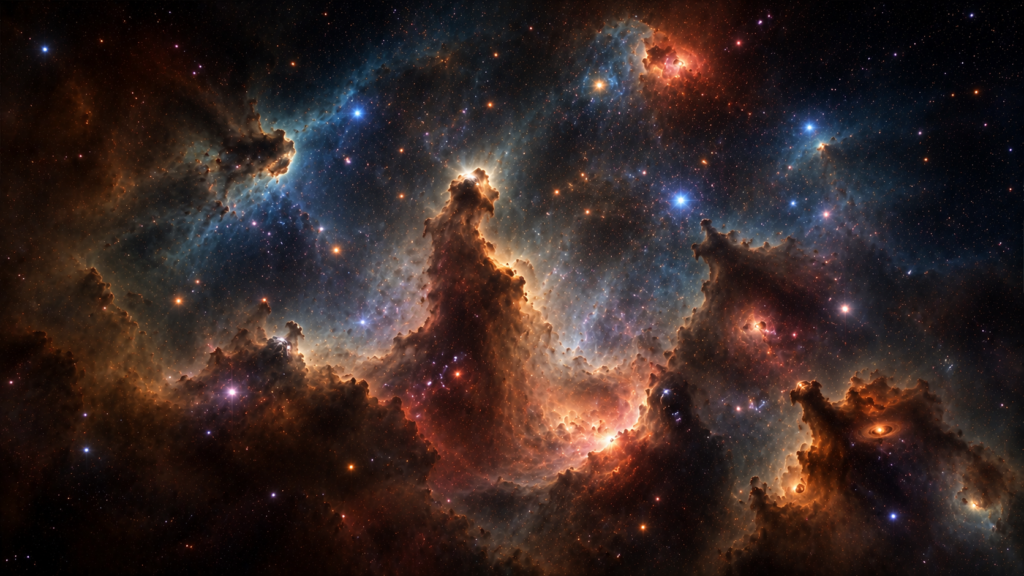
Visible light can be blocked by the dust surrounding newborn stars.
Infrared radiation can pass through much of that dust more effectively.
This makes infrared observations especially useful for studying young stars and their environments.
The James Webb Space Telescope’s infrared capabilities allow scientists to study regions of star formation in extraordinary detail.
Other Important Observatories
The James Webb Space Telescope is one important tool.
The Atacama Large Millimeter/submillimeter Array can observe cold molecular material.
The Hubble Space Telescope has provided detailed visible and infrared images of stellar nurseries.
Radio telescopes can map molecular clouds.
Together, these instruments allow astronomers to study star formation across many scales.
How Long Does Star Formation Take?
Star formation does not happen instantly.
A molecular cloud can evolve over millions of years. A dense core can collapse, a protostar can form, accretion can continue, and the surrounding environment can change.
Eventually, the young star reaches the stage where sustained fusion begins.
From a human perspective, this process is extremely slow.
Astronomers therefore reconstruct the sequence by observing many different stellar nurseries at different stages.
One cloud may show early collapse. Another may contain protostars. Another may contain young stars with disks.
Together, these observations provide different views of a much larger cosmic process.
Gravity Builds Stars
Gravity is relatively weak compared with some familiar forces at microscopic scales.
But it is always attractive, and it acts across enormous distances. When enough matter accumulates, gravity can become dominant.
This allows enormous clouds to collapse despite the weakness of gravity at the particle level.
Stars are therefore examples of gravity organizing matter on cosmic scales.
How Does a Star Stay Stable?
Once fusion begins, a new balance develops. Fusion produces energy, and the hot plasma creates pressure. Gravity continues pulling inward.
The star reaches a state of balance. If conditions later change, that balance changes.
This principle controls much of stellar evolution. A star’s life is strongly shaped by the relationship between gravity and internal pressure.
The Sun’s Birth
The Sun formed approximately 4.6 billion years ago. It began as part of a collapsing molecular cloud. A protostar formed, an accretion disk developed, and material continued accumulating.
Eventually, hydrogen fusion began in its core. The Sun entered its main sequence phase.
Today, it continues converting hydrogen into helium and will remain in this stable phase for billions of years more.
Stars Enrich the Universe
The early universe contained mostly hydrogen and helium. The first stars formed from this relatively primitive material.
Inside stars, nuclear fusion created heavier elements. When massive stars died, some of these elements were released into space.
Later generations of stars formed from gas enriched by these elements. Each generation can therefore inherit material produced by earlier generations.
Our Sun is a later-generation star. It contains elements produced inside earlier stars, and the planets inherited those elements.
The iron in Earth’s core, the silicon in rocks, the oxygen in water, and the carbon in living organisms are all part of a much longer cosmic history.
The Cosmic Cycle of Star Formation
The sequence begins with a molecular cloud.
Gravity creates dense regions, and a core collapses.
A protostar develops.
An accretion disk forms.
Jets and outflows can emerge.
Material continues accumulating.
The central temperature rises.
Nuclear fusion begins.
The star reaches equilibrium and enters the main sequence.
Around it, a planetary system may also be taking shape.
But the process does not end there.
Stars eventually return material to space. That material can become part of new stars and contribute to new planets.
The universe continuously recycles matter.
Related Reading
Key Takeaways
- Stars form inside enormous clouds of gas and dust called molecular clouds.
- Gravity drives the collapse of sufficiently dense regions.
- A collapsing region can fragment into multiple dense cores.
- A dense collapsing core develops into a protostar.
- A protostar is powered mainly by gravitational contraction before sustained hydrogen fusion begins.
- Conservation of angular momentum helps produce a rotating accretion disk.
- Accretion disks can provide material for growing stars and developing planetary systems.
- Magnetic fields can influence young stars and their outflows.
- Some young stars produce narrow bipolar jets.
- Cooling helps dense regions continue gravitational collapse.
- Sustained hydrogen fusion marks the transition to a normal hydrogen-burning star.
- Stellar mass strongly influences a star’s properties and eventual fate.
- Infrared and radio observations allow astronomers to study different stages of star formation.
- Stars help enrich the universe with heavier elements.
- Star formation is part of a continuing cosmic cycle of matter.
Conclusion
Every star has a beginning.
That beginning is usually hidden inside a cold molecular cloud.
Gravity gathers material into dense regions. Those regions collapse as gas becomes compressed and hotter. A protostar forms, and rotation can produce an accretion disk around it.
The young system remains active. Magnetic fields can help shape jets and outflows, while material continues accumulating around the growing star.
Eventually, the central temperature becomes high enough for sustained hydrogen fusion.
The balance changes. The protostar becomes a main-sequence star. But the story does not end with the birth of the star.
The same disk surrounding a young star can provide material for planets. The star itself can transform matter through nuclear fusion, producing elements that later become part of new generations of stars and planetary systems.
Over time, stars can return material to space. That material can become part of new stars.
It can also contribute to new planets.
The universe therefore operates through cycles of matter and transformation.
When you look at a star, you are seeing the result of a process that began with gas and dust drifting through space.
Gravity gathered that material. Physical processes shaped its collapse.
Nuclear fusion transformed the newborn star into a source of light. A star is therefore more than a point of light in the night sky.
It is the result of gravity, matter, energy, and time working together across enormous cosmic scales.
And every star begins with a cloud.
Explore more evidence-based explanations of stars, space, and the science of the universe in CAVELYRA’s Science explained collection.