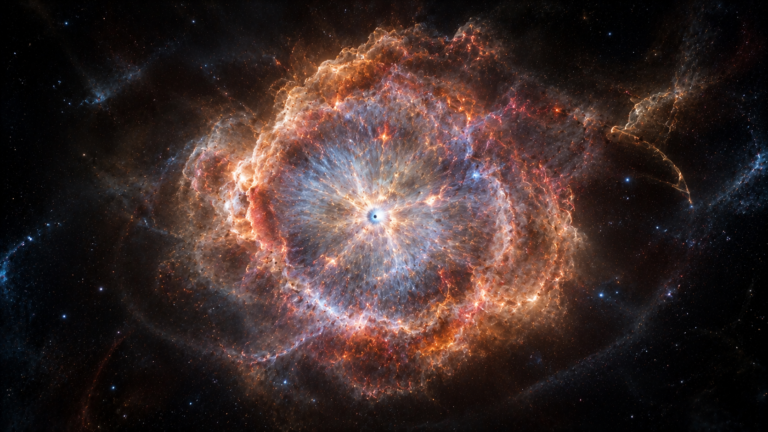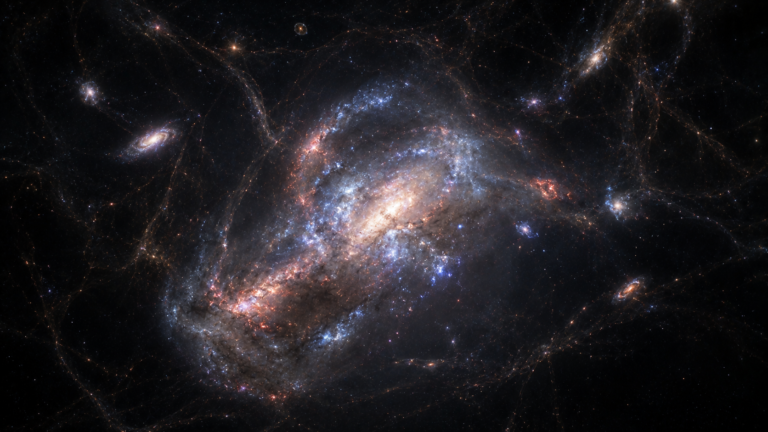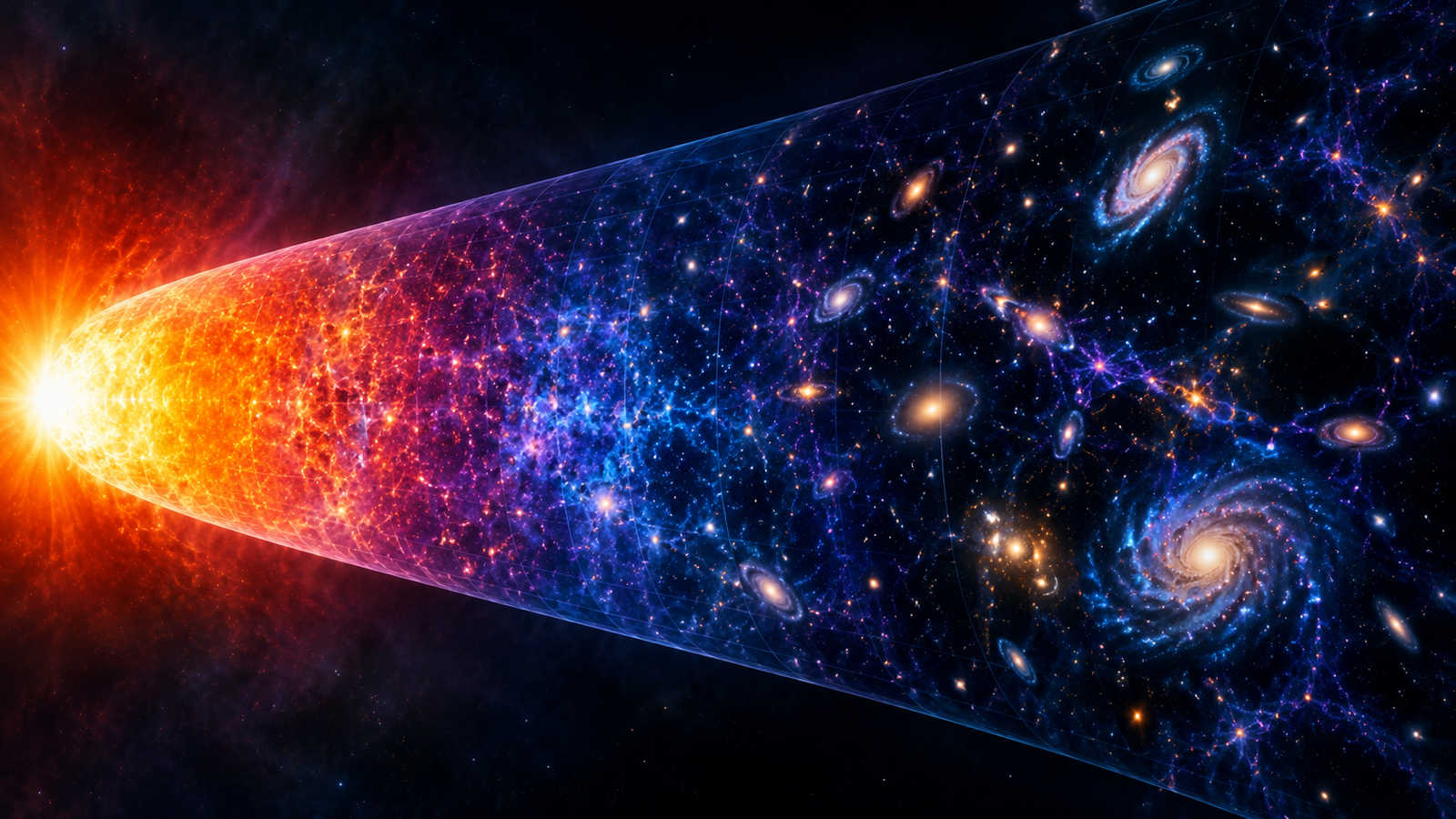
Look up at the night sky.
Every star you see is part of a much larger structure. Stars form galaxies, galaxies form groups and clusters, and enormous structures connect galaxies across the cosmos.
Beyond everything we can see lies a universe containing matter, radiation, dark matter, and dark energy.
This raises one of the biggest questions in science.
How did the universe begin?
Modern cosmology has developed a detailed picture of cosmic history. However, the Big Bang was not an ordinary explosion inside preexisting empty space. It describes the evolution of an extremely hot, dense early universe and its subsequent expansion.
The Universe Is Expanding
One of the most important discoveries in modern cosmology is that the universe is expanding.
Distant galaxies generally appear to move away from us. More distant galaxies tend to show greater recession speeds. This relationship is described by the Hubble-Lemaître law and provides evidence for cosmic expansion.
Galaxies are not simply flying through an already existing empty space from one central explosion. Instead, the expansion is a property of space itself.
Space Itself Expands
An expanding balloon provides a useful, although imperfect, analogy.
Imagine dots drawn across its surface. As the balloon expands, the distance between the dots increases. No single dot needs to represent the center of expansion.
The universe does not need to expand from one central location into surrounding empty space. Space itself expands.
What Is the Big Bang?
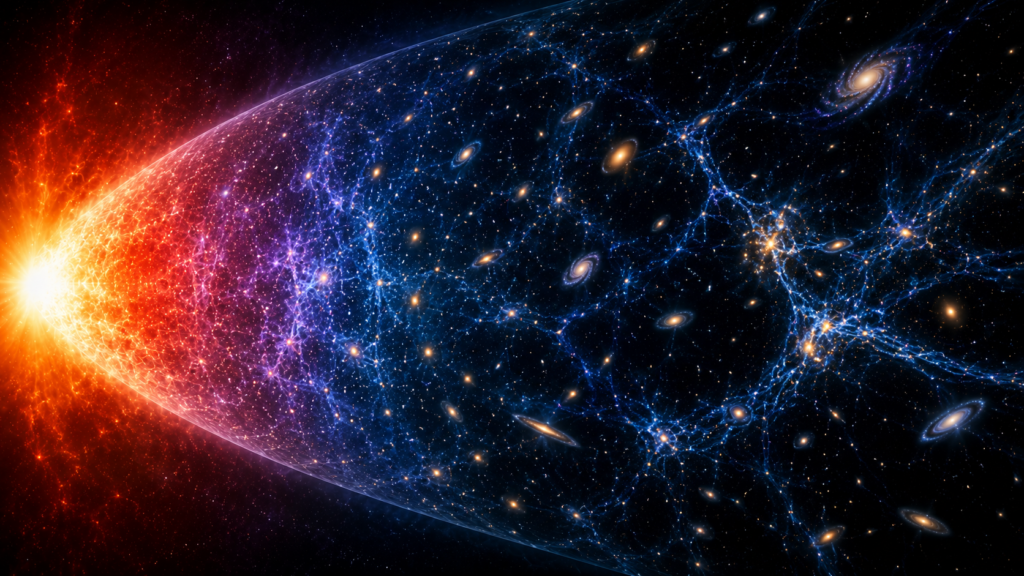
If the universe is expanding today, scientists can trace that expansion backward.
The observable universe becomes smaller. Matter and radiation become increasingly compressed. Temperature and density rise.
The early universe was therefore extremely hot and dense. This is the basic idea behind the hot Big Bang model.
The Big Bang describes the evolution of this early hot, dense state into the expanding cosmos we observe today.
It was not an explosion from one point into otherwise empty space. Every region of the early universe was part of the hot state.
How Old Is the Universe?
Current measurements indicate that the universe is about 13.8 billion years old.
Scientists estimate this age by combining observations of cosmic expansion, the cosmic microwave background, the composition of the universe, and cosmological models.
Because cosmic expansion has changed over time, scientists reconstruct its history to estimate the age of the universe.
What Was the Early Universe Like?
The early universe was dramatically different from the cosmos we see today.
At extremely high temperatures, atoms could not exist in their familiar form. The universe contained an extremely hot mixture of particles and radiation.
As space expanded, the universe cooled. That cooling allowed new physical processes to occur.
Particles could form and interact. Later, atomic nuclei could form. Eventually, neutral atoms appeared.
Cosmic evolution was therefore closely connected to the cooling of the expanding universe.
Where Does Our Current Understanding Begin?
Modern physical theories can describe much of cosmic history. However, conditions become increasingly extreme as scientists trace the universe toward its earliest known phases.
At sufficiently high energies, both quantum effects and gravity become important. General relativity provides our current theory of gravity, while quantum theory describes microscopic physics.
Scientists do not yet have a complete experimentally confirmed theory that unifies both under the extreme conditions of the earliest universe.
Was There a Period of Cosmic Inflation?
Inflation is the hypothesis that the universe underwent an extremely rapid period of accelerated expansion during its very early history.
The idea was developed to explain features of the observed universe, including its large-scale uniformity and geometry.
Inflation could also provide a mechanism through which tiny quantum fluctuations became seeds of later cosmic structure.
Scientists have not directly observed inflation itself, so it remains an active area of research.
How Could Tiny Fluctuations Create Galaxies?
At microscopic scales, quantum physics predicts fluctuations in physical fields.
During inflation, tiny fluctuations could have been stretched to enormous cosmic scales. Afterward, these variations could act as gravitational seeds.
A region containing slightly more matter would have slightly stronger gravity. It could attract additional matter, making the difference larger over time.
Over time, gravity amplified these variations. Gas gathered, stars formed, and galaxies developed.
The large-scale structure of the universe may therefore trace back to tiny variations present in the early cosmos.
How Did the First Matter Form?
As the universe expanded and cooled, particles could form and interact.
The early universe contained quarks and gluons. As temperatures decreased, quarks became confined into composite particles such as protons and neutrons.
Later, nuclear reactions produced the first light atomic nuclei. This process is called Big Bang nucleosynthesis.
It produced large amounts of hydrogen and helium, along with small amounts of other light elements.
The observed abundance of these elements provides important evidence supporting the hot Big Bang model.
When Did Atoms Form?
The early universe was initially too hot for stable neutral atoms to exist.
Electrons remained free, and photons interacted constantly with charged particles. As a result, light could not travel freely through the universe, making it opaque.
As the universe expanded and cooled, electrons combined with atomic nuclei to form neutral atoms.
This happened roughly 380,000 years after the beginning of the hot Big Bang expansion.
The universe then became much more transparent to light. We observe that ancient radiation today as the cosmic microwave background.
What Is the Cosmic Microwave Background?
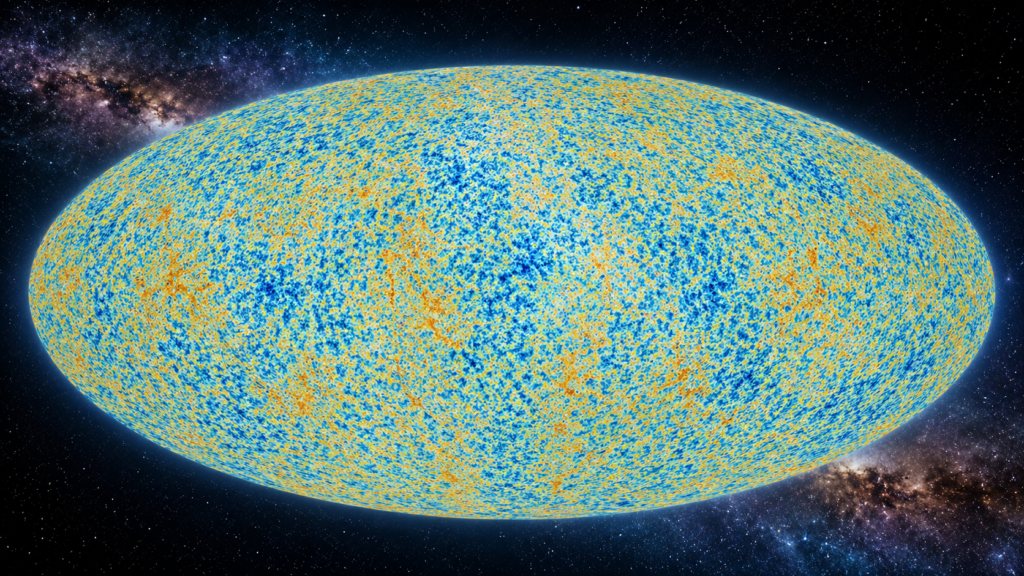
The cosmic microwave background, or CMB, is one of the most important pieces of evidence for the early hot universe.
It fills the universe and reaches us from every direction. It provides a snapshot of the universe when it was only about 380,000 years old.
As the universe expanded, the wavelengths of its photons stretched. Their energy decreased, and the radiation cooled.
Today, the CMB has a temperature of about 2.7 kelvin.
This ancient radiation carries valuable information about conditions in the early universe.
What Do CMB Fluctuations Tell Us?
The cosmic microwave background is remarkably uniform, but it is not perfectly uniform.
It contains tiny temperature variations and corresponding differences in density. These fluctuations are important because they represent early seeds from which cosmic structure developed.
Gravity amplified those differences. Matter gathered, gas collapsed, the first stars formed, galaxies developed, and the cosmic web emerged.
How Did the First Stars Form?
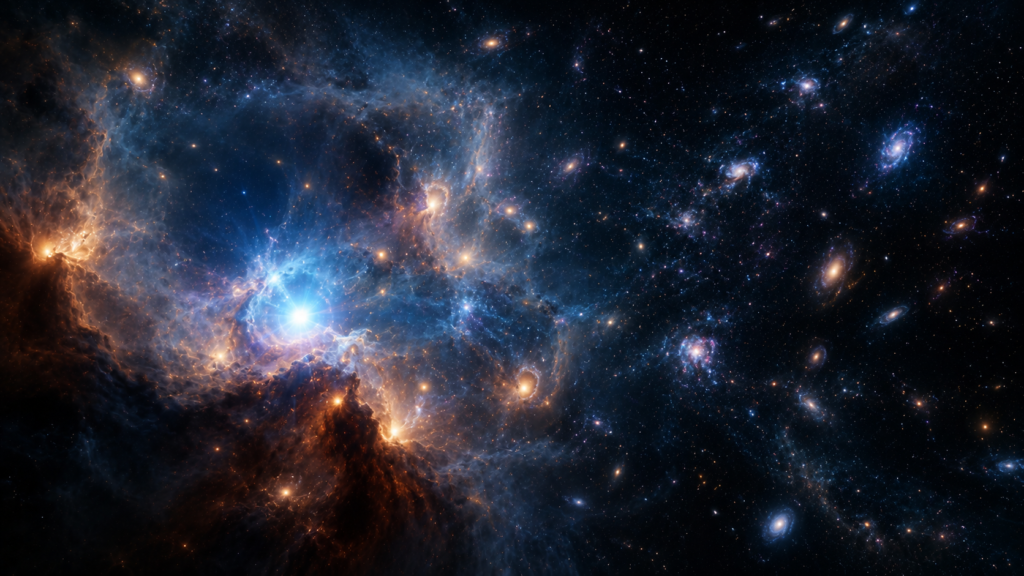
After the universe became transparent, it contained mostly hydrogen and helium gas.
Gravity gradually pulled some regions of this gas together. As the gas became denser, its temperature increased. Eventually, some clouds collapsed enough for stars to ignite.
The first stars were probably very different from many stars we see today because they formed from material containing almost no elements heavier than helium.
Some may have been extremely massive and short-lived. When they died, they produced heavier elements that were later incorporated into new generations of stars and planets.
Where Did the Elements in Our Bodies Come From?
The atoms in your body were not all created during the beginning of the universe.
Hydrogen was produced in the early universe. Many heavier elements formed later inside stars and during stellar explosions and other extreme astrophysical events.
The universe therefore became chemically richer over time. Eventually, planets could form and complex chemistry became possible.
The material around us carries part of the history of earlier generations of stars.
What Are Dark Matter and Dark Energy?
Visible matter is not enough to explain all of the gravitational behavior observed across the universe.
Galaxies rotate in ways that suggest additional unseen mass. Large-scale cosmic structure also points toward matter that does not interact strongly with light.
Scientists call this dark matter.
Dark matter interacts gravitationally and appears to have played an important role in cosmic structure formation. However, scientists still do not know what dark matter actually is.
Dark energy represents a different mystery.
Observations of distant supernovae in the late 1990s revealed that cosmic expansion is accelerating. Whatever is responsible for this acceleration is commonly called dark energy.
The simplest explanation is a cosmological constant associated with the energy density of empty space, but its physical nature remains unknown.
How Did the Cosmic Web Form?
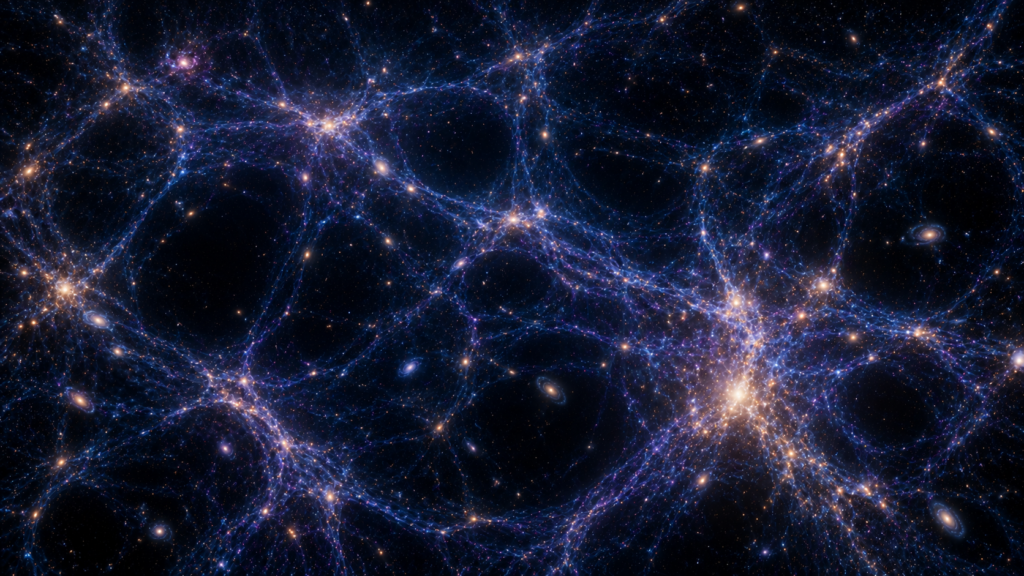
Galaxies are not distributed randomly.
On enormous scales, they form filaments, sheets, clusters, and large regions containing relatively little matter. This structure is called the cosmic web.
Dark matter appears to have provided an important gravitational framework. Ordinary matter followed that framework.
Gas accumulated. Stars formed. Galaxies emerged. Clusters grew.
Over billions of years, gravity transformed small early differences into the enormous structures we observe today.
Why Does Looking Into Space Mean Looking Into the Past?
Light takes time to travel through space.
When astronomers observe a distant galaxy, they see that galaxy as it existed when the light began its journey toward Earth.
The farther away the galaxy is, the farther back in cosmic history its light can show us.
This gives astronomers a natural way to study how the universe has changed over time.
The cosmic microwave background takes this even further. It provides a view of the universe when it was only about 380,000 years old.
Before that stage, the universe was opaque to light. Scientists therefore rely on other observations, physical models, and evidence from the early universe to reconstruct those earlier stages.
Did the Big Bang Happen at One Point?
No.
The Big Bang did not occur at one location in space while the rest of the universe remained empty.
The early universe was hot and dense throughout the observable region. As space expanded, the distances between regions increased.
There is no known central location from which the universe expanded.
An expanding raisin bread provides a useful, although imperfect, analogy. As the dough expands, the distance between every raisin increases. No single raisin needs to be the center of the expansion.
Does the Universe Have an Edge?
The observable universe has a limit determined by how far light has had time to travel to us.
This does not necessarily mean that the entire universe has a physical edge.
Some regions may be so distant that their light has not had enough time to reach us. ## Where Does Current Physics Reach Its Limit?
As we trace cosmic history backward, the universe becomes increasingly extreme.
Today, galaxies are separated by enormous distances. Earlier in cosmic history, they were much closer together.
Travel farther back and stars disappear from the picture. Earlier still, atoms could not exist because the universe was too hot.
At even higher energies, atomic nuclei could not remain intact, and the universe existed as an extremely hot plasma of particles and radiation.
Eventually, conditions become so extreme that our current physical theories can no longer provide a complete description.
The origin of the universe is therefore not simply a question about an ancient explosion. It is a question about how space expanded, how the universe cooled, how matter and radiation evolved, how gravity built cosmic structure, and where our current understanding of physics reaches its limit.
Related Reading
Key Takeaways
- The universe is expanding, and the Big Bang describes its evolution from an extremely hot, dense early state.
- The Big Bang was not an explosion from one point into preexisting empty space.
- Current measurements indicate that the universe is about 13.8 billion years old.
- Cosmic inflation is a hypothesis about a very rapid early period of expansion.
- Tiny early fluctuations may have provided seeds for later cosmic structure.
- Big Bang nucleosynthesis produced large amounts of hydrogen and helium and small amounts of other light elements.
- Neutral atoms formed roughly 380,000 years after the beginning of the hot Big Bang expansion.
- The cosmic microwave background provides an important observational window into the early universe.
- Dark matter appears to have played an important role in cosmic structure formation, while dark energy is associated with accelerated expansion.
- Scientists still do not have a complete theory describing the earliest extreme conditions or the ultimate origin of the universe.
Conclusion
The universe we see today is the result of a long process of cosmic evolution.
Based on current evidence, the universe began in an extremely hot and dense early state. As space expanded, the universe cooled. Particles formed, light atomic nuclei developed, and eventually neutral atoms appeared.
Ancient radiation then began traveling freely through space. Gravity amplified tiny differences in density, allowing gas to gather and form the first stars and galaxies. Over time, the cosmic web developed, stars produced heavier elements, planets formed, and complex chemistry became possible.
But our understanding has limits.
We do not yet have a complete theory that combines quantum physics with gravity under the extreme conditions of the earliest universe. We also do not know the ultimate origin of spacetime or why the universe exists at all.
What we do have is strong observational evidence. We observe cosmic expansion, detect the cosmic microwave background, measure the abundance of light elements, and observe galaxies and the large-scale structure of the universe.
The Big Bang is therefore not simply a story about an explosion. It is a story of expansion and cooling, matter and radiation, gravity and structure, and how an extremely hot early universe developed into the cosmos we observe today.
When you look at the night sky, you are also looking into the past. Every distant galaxy carries information about an earlier stage of cosmic history, while every photon from the cosmic microwave background carries information from the early universe.
And the biggest question remains.
How did everything begin?
Science does not yet have the final answer. That uncertainty is one of the reasons the origin of the universe remains one of the most important questions in modern science.
Explore more evidence-based explanations of space, astronomy, and the universe in CAVELYRA’s Science explained collection.