


Pick up a magnet and hold it near a metal object.
Nothing seems to happen at first.
Move it closer.
Suddenly, the object moves.
There is no visible string.
No gears connect the two objects.
Something you cannot see is producing a force.
That something is the magnetic field.
Magnetism is a fundamental interaction associated with moving electric charges and the magnetic moments of elementary particles. In ordinary magnets, the magnetic behavior of many atoms becomes organized so that their effects reinforce one another. This produces a magnetic field that can interact with other magnetic materials, electric currents, and moving charges.
A magnet therefore does not pull objects because it contains an invisible substance.
It produces a physical field.
And that field can exert forces.
A magnet produces a magnetic field that can exert forces on suitable materials and other magnetic fields.
What Is a Magnetic Field?
A magnetic field is a physical field associated with magnetism.
You cannot see it directly.
But you can observe what it does.
Place iron filings around a bar magnet and the filings arrange themselves into a recognizable pattern. The pattern reveals the direction of the magnetic field at different locations.
A compass provides another way to detect a magnetic field.
The compass needle contains a small magnet. It rotates until it aligns with the surrounding magnetic field.
Earth itself has a magnetic field.
That is why a compass can provide directional information.
The field is therefore not simply a drawing made with lines.
The lines are a visual representation that helps us describe the field.
The field itself is a physical quantity that exists in the space around the magnet.
Why Does a Magnet Have a Magnetic Field?
To understand this, we need to look much deeper than the magnet’s surface.
Matter is made from atoms.
Atoms contain electrons, and electrons have electric charge and intrinsic angular momentum called spin.
Charged particles in motion produce magnetic effects.
Electrons also possess intrinsic magnetic moments associated with their quantum mechanical properties.
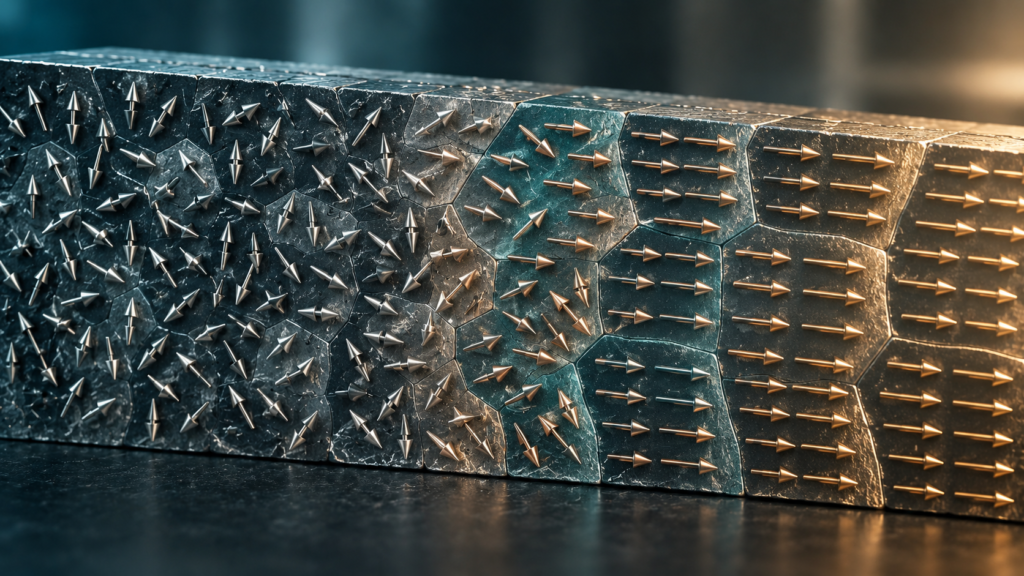
Inside many materials, the magnetic moments of individual atoms point in different directions.
Their effects can largely cancel.
In a permanent magnet, however, large numbers of atomic magnetic moments become aligned within regions called magnetic domains.
When enough domains align, their magnetic effects reinforce one another.
The material develops a strong overall magnetization.
This is one of the key physical reasons a permanent magnet can produce a strong external magnetic field.
Aligned magnetic domains allow microscopic magnetic moments to reinforce one another and produce macroscopic magnetization.
What Are Magnetic Domains?
A magnetic domain is a region inside certain materials where many atomic magnetic moments are aligned in a similar direction.
Imagine thousands of tiny arrows.
If every arrow points randomly, the overall effect can be small.
If many arrows point in the same direction, their effects reinforce one another.
That is what happens when a ferromagnetic material becomes strongly magnetized.
The exact behavior depends on the material and its microscopic structure.
Iron, cobalt, and nickel are familiar examples of ferromagnetic elements.
Some alloys and other materials can also become permanent magnets.
The important idea is that magnetism at the scale of the entire object comes from organized microscopic magnetic behavior.
Why Do Magnets Attract Iron?
Bring a magnet near an iron object.
The iron may move toward the magnet.
But iron is not permanently magnetized in the same way as the magnet itself.
The magnetic field from the permanent magnet can influence the magnetic domains within the nearby iron.
Domains that were previously oriented in different directions can become more strongly aligned.
This creates an induced magnetization.
The near side of the iron object can then develop a magnetic response that produces attraction toward the permanent magnet.
This process is called magnetic induction.
It helps explain why a magnet can attract an ordinary steel paper clip even when the paper clip is not itself a permanent magnet.
Why Don’t Magnets Attract Every Metal?

This is one of the most common misconceptions about magnets.
A magnet does not strongly attract every metal.
Iron, cobalt, nickel, and many alloys containing suitable magnetic structures can respond strongly.
Materials such as copper and aluminum behave differently.
They are not ferromagnetic.
They can interact with magnetic fields through weaker effects, but a typical permanent magnet does not strongly pull them across a table in the way it pulls an iron object.
The response depends on the material’s electronic structure.
So “magnetic” is not simply another word for “metal.”
A material can be metallic without being strongly attracted to a permanent magnet.
Only certain materials show the strong magnetic response associated with ordinary permanent magnets.
Why Does a Magnet Have Two Poles?
A typical bar magnet has two ends called the north pole and south pole.
These are called magnetic poles because of how the magnet interacts with magnetic fields.
If you bring two magnets together, their orientations matter.
Like poles repel.
Unlike poles attract.
A north pole tends to repel another north pole.
A north pole tends to attract a south pole.
The same applies in reverse.
This behavior reflects the structure of magnetic fields around the magnets.
Can You Separate the North and South Poles?
Cut a bar magnet in half.
You do not get one north magnet and one south magnet.
Instead, you get two smaller magnets.
Each new piece develops its own north and south poles.
Cut those pieces again.
You continue producing smaller magnetic dipoles.
This is because ordinary magnets behave as magnetic dipoles.
Physicists have never observed an isolated magnetic monopole in ordinary experiments, although hypothetical magnetic monopoles appear in some theoretical models.
The practical result is simple.
You cannot take a normal bar magnet and remove one pole while leaving the other behind.
What Makes Like Poles Repel?
The interaction between magnetic fields determines whether magnets attract or repel.
When two magnets are positioned with opposite poles facing each other, their fields can form a configuration associated with attraction.
When like poles face each other, the field configuration produces a force pushing the magnets apart.
The force depends on the magnets’ strength, their orientation, their distance, and the surrounding materials.
This is why the familiar rule “opposites attract, likes repel” works so reliably for ordinary permanent magnets.
It describes a deeper electromagnetic interaction.
What Happens When You Move a Magnet?
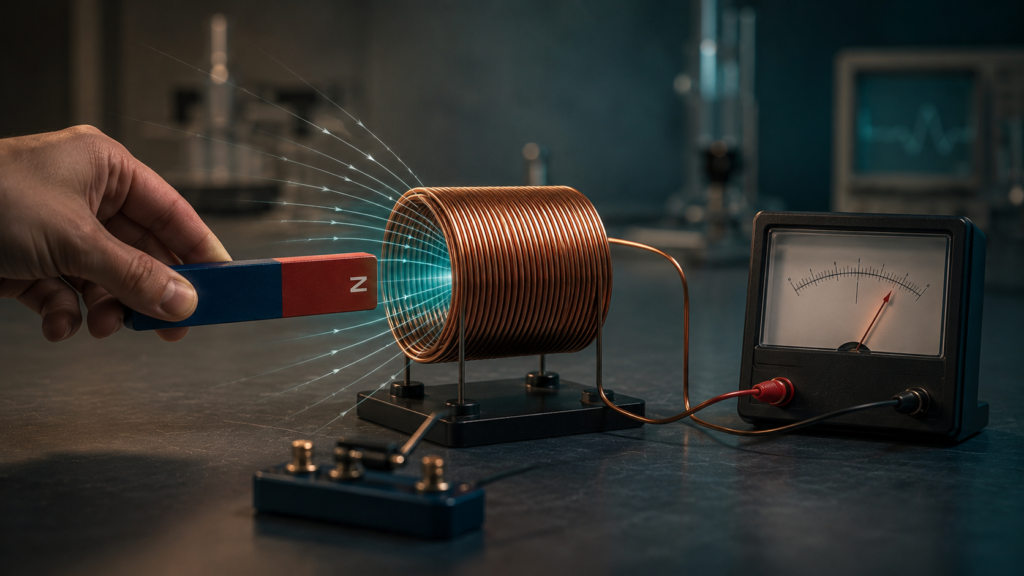
A changing magnetic field can produce an electric effect.
This is one of the most important connections between electricity and magnetism.
If a magnet moves relative to a conducting wire, the changing magnetic environment can induce an electric voltage.
This phenomenon is called electromagnetic induction.
Michael Faraday demonstrated the principle experimentally in the nineteenth century.
It became one of the foundations of modern electrical technology.
Generators use this principle to convert mechanical motion into electrical energy.
Changing magnetic fields can induce electrical voltage in a conductor.
How Do Magnets Help Generate Electricity?
Imagine a coil of wire.
Move a magnet through the coil.
The magnetic field through the coil changes.
That changing magnetic flux induces an electromotive force.
If the circuit is closed, current can flow.
Large electrical generators use the same underlying principle.
Instead of a person moving a small magnet through a small coil, a machine rotates magnetic fields and coils using mechanical energy.
That mechanical energy may come from steam turbines, flowing water, wind turbines, or other sources.
The generator converts that mechanical energy into electrical energy through electromagnetic induction.
How Do Electric Motors Use Magnets?
Generators convert mechanical energy into electrical energy.
Motors do the reverse.
They convert electrical energy into mechanical motion.
An electric current flowing through a conductor produces a magnetic field.
Place that current-carrying conductor in another magnetic field.
A force can act on the conductor.
In a motor, this interaction is carefully arranged so that forces create continuous rotation.
The motor can then turn a fan, pump, wheel, drill, compressor, or other machine.
This is one reason magnetism is so important to modern technology.
The same fundamental interaction connects electricity with motion.
How Do Speakers Use Magnetism?
A loudspeaker also relies on electromagnetic forces.
Inside a typical dynamic speaker is a permanent magnet and a coil of wire.
An audio signal produces changing current in the coil.
The coil experiences magnetic forces that cause it to move.
The coil is connected to a flexible cone.
As the cone moves back and forth, it pushes and pulls the surrounding air.
Those pressure changes travel through the air as sound waves.
The electrical signal has therefore been converted into mechanical motion and then into sound.
A simple speaker demonstrates electromagnetism in action every time you listen to music.
How Does a Compass Work?
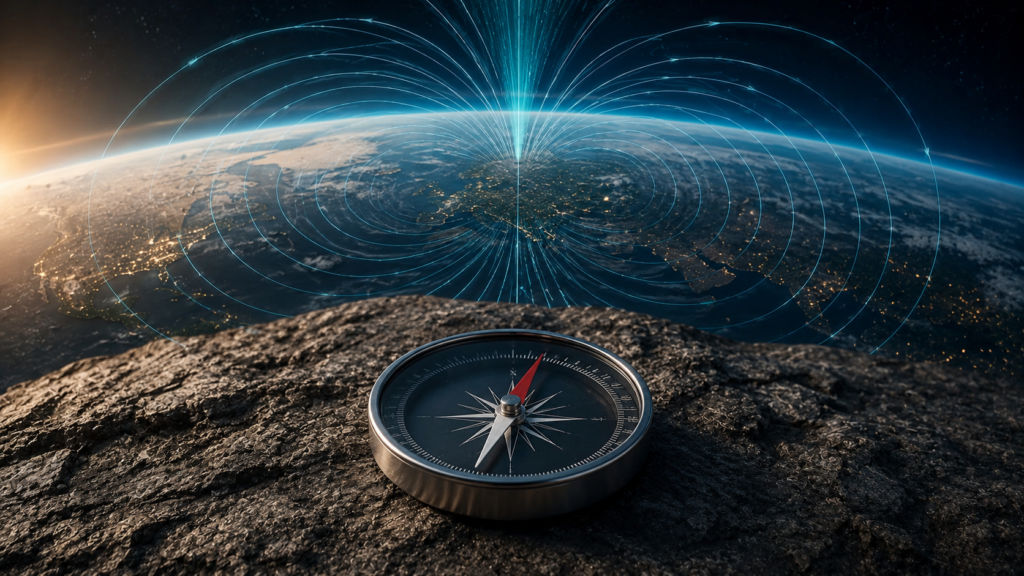
A compass works because its needle is a small magnet.
Earth produces a large-scale magnetic field.
The compass needle experiences a torque that tends to align it with that field.
The result is a useful directional reference.
This does not mean the compass points exactly toward the geographic North Pole.
The magnetic field has a complex structure, and magnetic north and geographic north are not identical locations.
Modern navigation systems therefore use more than a simple compass.
But the underlying magnetic principle remains the same.
A small magnetic dipole responds to a larger magnetic field.
A compass needle aligns with Earth’s magnetic field and provides a directional reference.
Where Does Earth’s Magnetic Field Come From?
Earth’s magnetic field is generated mainly by processes in its outer core.
The outer core contains electrically conducting molten metal.
Movement within this conducting fluid generates electric currents.
Those currents produce magnetic fields.
The interaction between the fluid motion and the magnetic field sustains what scientists call the geodynamo.
Earth’s magnetic field extends far beyond the surface and forms the magnetosphere.
The magnetosphere interacts with the solar wind, helping protect Earth’s atmosphere and surface environment from much of the charged-particle flow from the Sun.
Why Do Magnets Lose Their Strength?
Permanent magnets can lose magnetization.
Heat is one possible cause.
When temperature rises, thermal motion can disrupt the organized alignment of magnetic moments.
If a magnet is heated sufficiently, it can lose its ferromagnetic order.
Strong opposing magnetic fields can also reduce magnetization.
Physical damage can sometimes disrupt magnetic domains as well.
Different materials respond differently.
Some permanent magnets retain magnetization extremely well.
Others are more easily demagnetized.
This is why the material used to make a magnet matters.
Why Does Magnetism Work Through Empty Space?
This question goes to the heart of modern physics.
A magnetic field can exist in space even when there is no material between the objects.
The field carries information about how magnetic forces can act on charged particles, currents, and magnetic moments.
You do not need a physical rod connecting two magnets.
The field provides the physical description of the interaction.
Modern electromagnetism describes electric and magnetic fields as fundamental components of nature.
They are not simply mathematical tricks used to calculate forces.
They are part of the physical structure through which electromagnetic interactions occur.
Is Magnetism Separate From Electricity?
No.
Electricity and magnetism are deeply connected.
A moving electric charge produces magnetic effects.
A changing magnetic field can produce an electric field.
These relationships form the basis of electromagnetism.
James Clerk Maxwell developed equations in the nineteenth century that unified electricity and magnetism into a coherent mathematical theory.
His work also showed that changing electric and magnetic fields can propagate through space as electromagnetic waves.
Light is one example.
Radio waves, microwaves, infrared radiation, visible light, ultraviolet radiation, X-rays, and gamma rays all belong to the electromagnetic spectrum.
Magnetism is therefore connected to far more than the magnets on your refrigerator.
It is part of the same physical framework that describes light and wireless communication.
What Happens When You Bring a Magnet Near Your Phone?
Modern phones contain components that can respond to magnetic fields.
Some smartphones use magnetic sensors for functions such as detecting orientation.
Magnets can also interact with speakers, microphones, wireless charging components, magnetic cases, and other hardware.
The effect depends on the strength and location of the magnetic field and the specific device.
This is why manufacturers design magnetic accessories carefully.
A small magnet in an approved accessory can be useful.
A strong external magnetic field can interfere with certain sensors or components.
The key point is that electronic devices do not exist outside electromagnetic physics.
They depend on it.
How Do Magnets Help Modern Technology?
Magnetism appears in many technologies.
Electric motors use magnetic forces.
Generators use electromagnetic induction.
Speakers use magnetic forces to move coils.
Hard disk drives use magnetic patterns to store information.
Magnetic sensors detect position, speed, rotation, and direction.
MRI systems use extremely strong magnetic fields to produce detailed images of the body.
Transformers rely on changing magnetic fields to transfer electrical energy between circuits.
Even wireless communication depends on electromagnetic waves.
Magnetism is therefore not a niche physical phenomenon.
It is one of the foundations of modern engineering.
The Simple Physics Behind a Magnet
The basic story can be reduced to a few steps.
Electrons have magnetic moments.
In certain materials, many atomic magnetic moments can become organized.
Magnetic domains can align.
The material becomes magnetized.
A magnetic field extends around it.
That field can interact with other magnets, magnetic materials, electric currents, and moving charges.
Move a magnetic field relative to a conductor, and you can induce an electrical voltage.
Run electric current through a suitable conductor, and you can create magnetic effects.
Arrange these interactions carefully, and you can build motors, generators, speakers, sensors, and many other technologies.
The magnet sitting on your desk is therefore connected to a much larger physical system.
What Can You Observe With a Simple Magnet?
You can demonstrate several principles safely with an ordinary household magnet.
Bring it near a steel paper clip.
The clip moves.
Place two magnets near each other.
You can feel attraction or repulsion.
Move a compass around a magnet.
The needle changes direction.
These simple observations reveal the existence and direction of magnetic fields.
The experiments are small.
The underlying physics is not.
The same principles scale from a tiny compass to industrial generators and medical imaging systems.
The Strange Lesson of Magnets
A magnet looks like an ordinary piece of material.
But its behavior comes from organized electromagnetic effects at microscopic scales.
Electrons have magnetic moments.
Atoms interact.
Domains can align.
A macroscopic magnetic field emerges.
That field can exert forces without direct physical contact.
It can move an object.
It can turn a motor.
It can generate electricity.
It can store information.
It can help create medical images.
It can even influence how we detect and use electromagnetic waves.
The next time a magnet pulls a paper clip across a table, remember what you are seeing.
You are watching a fundamental interaction of nature produce a visible force.
Key Takeaways
- Magnetism is a fundamental electromagnetic interaction.
- Permanent magnets produce magnetic fields.
- Atomic magnetic moments can become organized into magnetic domains.
- Magnetic fields can exert forces on magnets, magnetic materials, electric currents, and moving charges.
- Iron is strongly attracted to ordinary permanent magnets because its magnetic domains can become aligned.
- Ordinary magnets have north and south poles.
- Cutting a magnet produces smaller magnets with both poles.
- Changing magnetic fields can induce electrical voltage.
- Motors use electromagnetic forces to create mechanical motion.
- Magnetism is fundamental to many technologies, including generators, speakers, sensors, storage systems, and MRI.
Conclusion
A magnet does not need a visible connection to move another object.
Its magnetic field provides the physical link.
At the microscopic level, magnetic behavior is connected to the properties of electrons and the organization of atomic magnetic moments.
In permanent magnets, large numbers of these microscopic effects reinforce one another.
The result is a macroscopic magnetic field.
That field can attract certain materials, repel other magnets, generate electricity, and produce motion.
The same principles operate inside motors, generators, speakers, sensors, and medical imaging systems.
What looks like a simple force from a small piece of metal is therefore part of one of the most important interactions in physics.
Explore more evidence-based explanations of physics, technology, and the natural world in CAVELYRA’s Science Explained collection.