

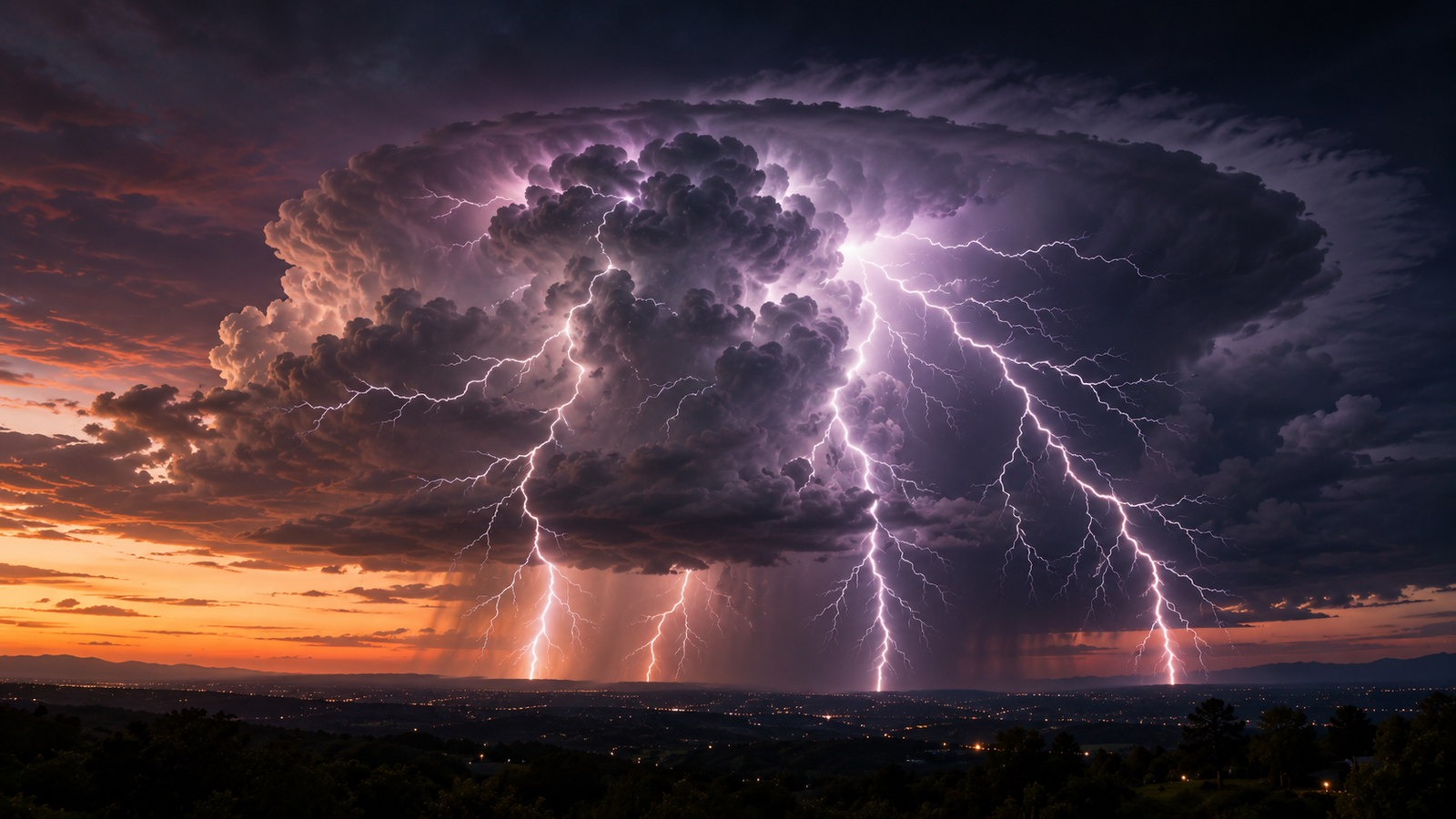
How does lightning work? A powerful thunderstorm can transform the sky in an instant.
Dark clouds tower overhead.
Rain falls.
Wind moves through the storm.
Then suddenly, the sky flashes.
A few seconds later, you hear a sharp crack followed by a long rumble.
Lightning can look almost magical.
But it is a physical process governed by electricity, atmospheric motion, thermodynamics, plasma physics, and fluid dynamics.
Lightning is an enormous electrical discharge in the atmosphere.
It can occur inside a cloud, between clouds, or between a cloud and the ground.
But how does a thunderstorm become electrically charged?
Why does the air suddenly become conductive?
How does a lightning channel form?
And why does lightning produce thunder?
To understand lightning, we need to enter the turbulent interior of a thunderstorm.
How Does a Thunderstorm Form?
A powerful thunderstorm begins with warm, moist air.
That air rises.
As it rises, it expands and cools.
Water vapor condenses and cloud droplets form.
Under suitable atmospheric conditions, the cloud continues growing upward.
Eventually, it can develop into a towering cumulonimbus cloud.
Inside this cloud, the atmosphere becomes extremely turbulent.
Air rises rapidly in some regions.
Air descends in others.
Water droplets move upward.
Ice particles move downward.
Hail and graupel form.
The storm becomes a highly dynamic environment.
This movement creates the conditions needed for electrical charge separation.
Why Do Thunderstorms Become Electrically Charged?
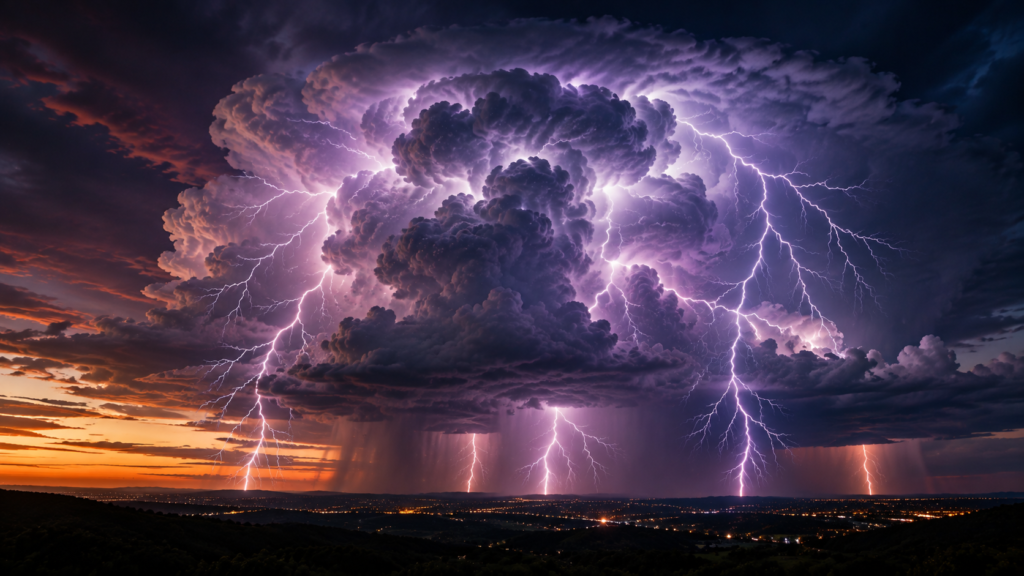
High inside a thunderstorm, temperatures can fall below freezing.
The cloud can contain:
- Tiny ice crystals
- Larger ice particles
- Supercooled water droplets
- Graupel
- Hail
Graupel is a soft form of hail that develops when supercooled water droplets freeze onto ice particles.
These different particles collide as they move through the storm.
Those collisions can transfer electrical charge.
The exact microscopic mechanism remains an active area of research.
However, scientists know that ice, graupel, and supercooled water play important roles in thunderstorm electrification.
How Does Charge Become Separated?
The particles do not all move in the same way.
Small ice crystals are more easily carried upward by strong updrafts.
Heavier graupel and hail tend to remain lower or fall through the storm.
This separates regions of electrical charge.
A simplified picture of a typical thunderstorm contains a strong negative charge in part of the middle and lower cloud and a positive charge higher in the cloud.
Real storm charge structures can be more complicated.
The key process is charge separation.
Different regions of the storm acquire different electrical states.
What Is an Electric Field?
When regions of opposite electrical charge become separated, they create an electric field.
As charge separation increases, the electric field can become stronger.
But there is an important obstacle.
Air is normally a very good electrical insulator.
Electricity does not simply flow freely through ordinary air.
The storm can therefore accumulate substantial electrical charge without immediately producing a discharge.
Eventually, however, the electric field can become strong enough to overcome the insulating properties of the air.
The air begins to break down electrically.
Lightning becomes possible.
Lightning begins when a thunderstorm’s electrical environment becomes strong enough for the insulating air to break down and a conductive pathway to develop.
How Does a Cloud-to-Ground Lightning Strike Begin?
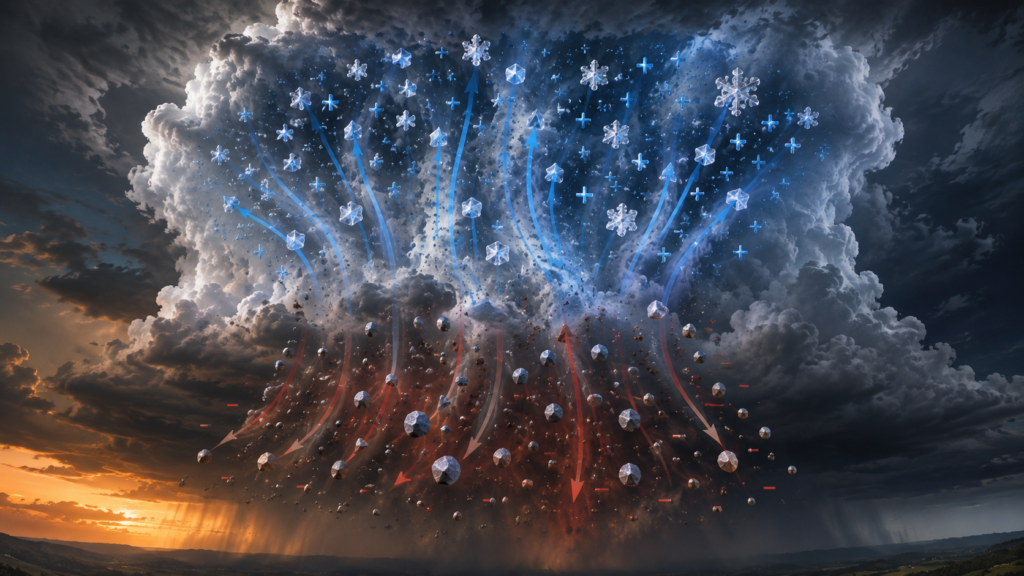
A cloud-to-ground flash does not simply begin as a bright bolt falling directly from the cloud.
The process is more complex.
A typical negative cloud-to-ground flash begins with a channel called a stepped leader.
The stepped leader develops downward from the negatively charged region of the cloud.
It advances in a series of steps.
As it moves, it creates a developing path of ionized air.
The leader is generally invisible to the human eye.
What Happens Near the Ground?
As the stepped leader approaches the ground, its electric field becomes very strong.
Positive charge can accumulate near the surface.
Objects such as trees, buildings, poles, and other elevated structures can develop upward electrical channels called streamers.
A descending leader and an upward streamer can eventually connect.
Once they connect, a powerful current surges through the newly formed channel.
The result is the brilliant flash we recognize as lightning.
What Is the Return Stroke?
One of the most surprising details is that the bright lightning you see is associated with the return stroke.
After the descending leader and upward streamer connect, the return stroke travels rapidly upward through the established channel toward the cloud.
It produces intense light.
The entire sequence happens so quickly that the human eye normally cannot separate its individual stages.
So the common image of lightning simply falling from the sky is incomplete.
The electrical process involves movement in both directions.
The stepped leader develops downward.
An upward streamer develops from the ground.
After they connect, the powerful return stroke travels upward through the channel.
Does All Lightning Reach the Ground?
No.
A large majority of lightning flashes remain within clouds or occur between different regions of the atmosphere.
Lightning can include:
Intra-cloud lightning
Cloud-to-cloud lightning
Cloud-to-ground lightning
Lightning extending from clouds into surrounding air
Cloud-to-ground lightning is therefore only one type.
When you see repeated flashes inside a thunderstorm, many may never reach the ground.
Why Does Lightning Branch?
A developing electrical channel does not always follow one straight path.
The stepped leader can branch as it searches for a conductive route through the atmosphere.
Multiple pathways can develop.
Some become inactive.
One pathway may eventually connect with an upward streamer.
The resulting lightning channel can contain an intricate branching structure.
This produces the tree-like appearance commonly associated with lightning.
Why Does Lightning Sometimes Flicker?
A single lightning flash can contain multiple strokes.
After the first stroke, additional electrical discharges can sometimes travel through the same channel.
To the human eye, these repeated strokes can appear as flickering.
What looks like one bolt can therefore contain several rapid electrical events.
Why Is Lightning So Bright?
Lightning rapidly heats the surrounding air.
The channel becomes ionized plasma.
The intense energy produces a luminous channel that we see as a lightning flash.
Its exact appearance can vary with atmospheric conditions and the way light is scattered through the atmosphere.
At its core, however, the process involves electrical energy creating an extremely hot, luminous channel.
Where Does Thunder Come From?
Thunder is a direct consequence of lightning.
The electrical discharge rapidly heats the surrounding air.
The temperature inside a lightning channel can reach roughly 30,000 degrees Celsius.
The air expands extremely rapidly.
That sudden expansion produces a shock wave.
As the shock wave travels away from the lightning channel, we hear it as thunder.
The sequence is straightforward:
Lightning produces intense heating.
The surrounding air expands rapidly.
The rapid expansion produces a shock wave.
The pressure disturbance travels through the atmosphere.
We hear the resulting sound as thunder.
Thunder is the sound produced by the rapid expansion of air heated by a lightning discharge.
Why Do You See Lightning Before Hearing Thunder?
Light travels through the atmosphere enormously faster than sound.
The flash therefore reaches your eyes almost immediately.
The sound takes longer to reach your ears.
The delay increases as the lightning gets farther away.
The source gives a rough estimate of about five seconds per mile, or about three seconds per kilometer.
For example:
5 seconds of delay, roughly 1 mile away
10 seconds, roughly 2 miles
30 seconds, roughly 6 miles
This is only an estimate.
But it demonstrates the enormous difference between the speed of light and the speed of sound.
Why Are Tall Objects Often Struck?
As a stepped leader approaches the ground, the electric field becomes very strong.
Objects on the surface can produce upward streamers.
Trees.
Buildings.
Communication towers.
Mountains.
These objects can provide favorable locations for a connection.
But height does not guarantee a lightning strike.
Lightning can strike open ground.
It can also strike objects that are not the tallest nearby.
The exact location depends on the developing electrical channels and local conditions.
Can Lightning Strike When It Is Not Raining?
Yes.
The electrical structure of a thunderstorm can extend beyond the region where rain is falling.
A lightning flash can therefore reach an area outside the immediate rain shaft.
This means a location can remain exposed to lightning even when rain is not falling directly overhead.
How Does the Ground Participate?
When a strong negative charge develops in the lower part of a storm, it influences the electrical state of the surface below.
Positive charge can accumulate near the ground.
This creates an electric field between the storm and Earth’s surface.
As that field strengthens, conditions become more favorable for a cloud-to-ground discharge.
The ground therefore participates in the electrical system of the storm.
Why Is Ice Important?
Lightning can occur in different atmospheric environments.
But in ordinary thunderstorms, ice plays an important role in charge separation.
Strong updrafts carry small particles upward.
Heavier particles move downward.
Collisions between these particles transfer electrical charge.
The exact microscopic physics is complicated and remains under investigation.
Scientists understand the broad conditions required for lightning while continuing to study the details of charge transfer.
This is an important feature of scientific understanding.
Scientists can understand a phenomenon at the system level while still investigating parts of its microscopic mechanism.
Are There Different Types of Lightning?
Yes.
Cloud-to-ground lightning travels between a cloud and Earth’s surface.
Intra-cloud lightning occurs within the same cloud.
Cloud-to-cloud lightning can connect different regions between clouds.
Lightning can also occur in unusual environments.
The source describes lightning associated with:
Volcanic eruptions
Intense wildfires
Snowstorms
Other extreme environments
Lightning is therefore not limited to ordinary summer thunderstorms.
What Is Upward Lightning?
Most natural cloud-to-ground lightning begins in a cloud and develops downward.
Very tall structures can sometimes initiate upward discharges.
The electrical field around an elevated structure can become intense enough to support an upward-developing channel.
This is one reason tall structures are important in lightning research.
Can Scientists Predict Lightning Strikes?
Scientists cannot currently predict the exact location and moment of an individual lightning strike.
Lightning is too variable and complex.
But scientists can forecast the likelihood of lightning activity.
They examine factors such as:
Atmospheric instability
Moisture
Storm growth
Temperature structure
Ice processes
Other characteristics of developing thunderstorms
Weather models can estimate environments favorable for lightning.
This is different from predicting exactly which tree or building will be struck.
How Do Satellites Study Lightning?
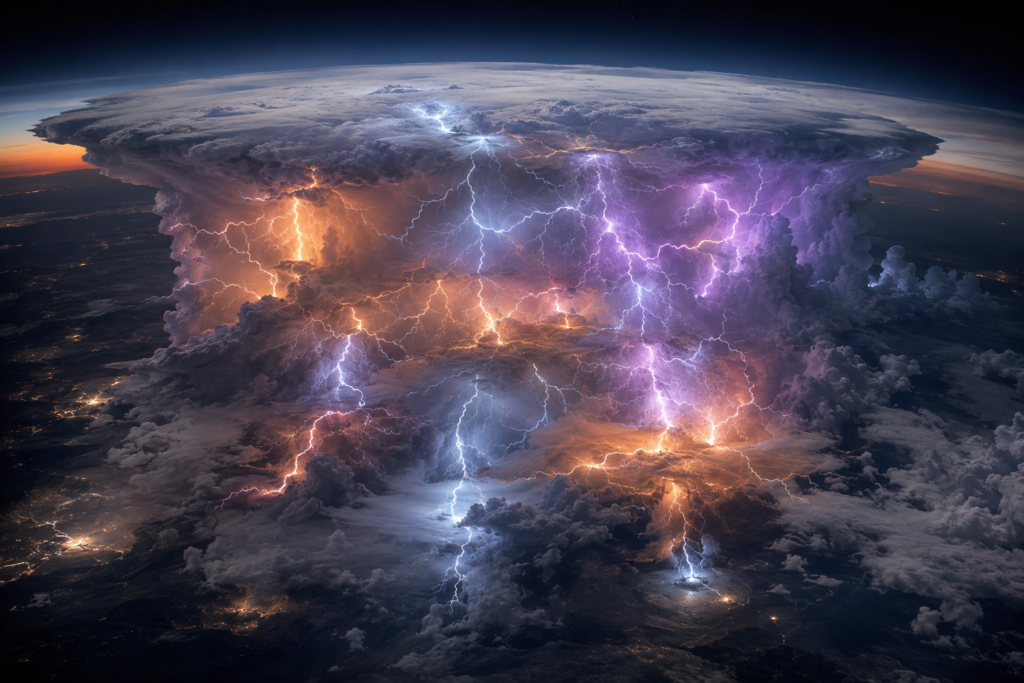
Modern weather satellites can detect lightning activity across enormous areas.
Lightning observations provide information about thunderstorms.
Changes in lightning activity can help meteorologists understand storm development.
Lightning mapping systems can also reconstruct the three-dimensional structure of lightning channels inside storms.
Lightning is therefore more than a hazard.
It is also a scientific measurement tool.
What Happens When Lightning Hits the Ground?
Lightning can produce significant physical effects.
The current can spread through the surrounding area.
The intense heat can damage trees.
It can ignite fires.
It can injure people and animals.
It can damage electrical systems.
Lightning can also produce fulgurites.
When lightning passes through certain sandy soils, its intense heat can melt and fuse minerals.
As the material cools, it can form a glassy structure called a fulgurite.
How Does Lightning Damage Trees?
Lightning current can travel through or along a tree.
The intense heating can rapidly convert moisture into steam.
That expanding steam can damage bark and wood.
A struck tree can therefore split or shed bark.
The tree does not simply absorb the electrical discharge harmlessly.
The electrical and thermal energy can produce substantial physical damage.
Why Is Lightning Dangerous?
A lightning channel carries an enormous electrical current.
The discharge occurs extremely quickly.
The combination of high electrical energy, intense heating, and rapid pressure changes makes lightning one of nature’s most powerful atmospheric phenomena.
A person does not need to be directly struck to be injured.
Current can spread through the ground.
It can travel through nearby objects.
It can also jump between conductive pathways.
This is why thunderstorms can create serious outdoor hazards.
Why Do Some Storms Produce More Lightning?
Lightning activity depends partly on storm structure.
Important factors include:
Moisture
Updraft strength
Temperature
Ice content
Graupel
Hail
Particle movement through the cloud
Strong, deep thunderstorms can provide conditions in which these processes become intense.
Scientists continue studying these relationships because lightning behavior can reveal information about storm development.
Lightning as a Window Into a Storm
Imagine observing a thunderstorm from a satellite.
The storm becomes a giant electrical system.
Individual flashes illuminate different regions.
Lightning mapping instruments can track the development of electrical channels.
Researchers can study:
Where lightning begins
How channels spread
How their structures change
How lightning activity relates to storm dynamics
Lightning therefore provides scientists with another way to study what is happening inside a thunderstorm.
The Physics Behind Lightning
The entire process begins with atmospheric conditions that allow a thunderstorm to develop.
Warm, moist air rises.
The cloud grows.
Water freezes.
Ice crystals and graupel move through strong updrafts and downdrafts.
Collisions transfer electrical charge.
Charges become separated.
An electric field strengthens.
The air eventually breaks down electrically.
A conductive channel develops.
A lightning discharge occurs.
The surrounding air becomes extremely hot.
It expands rapidly.
A shock wave forms.
You see the flash.
Then you hear thunder.
This sequence involves several branches of science:
Electricity
Atmospheric physics
Thermodynamics
Plasma physics
Fluid dynamics
Lightning is therefore a dramatic example of multiple physical processes operating together.
Key Takeaways
- Lightning is an electrical discharge in the atmosphere.
- Powerful thunderstorms create the conditions required for lightning.
- Ice crystals, graupel, supercooled water, and hail participate in thunderstorm electrification.
- Collisions between particles help transfer electrical charge.
- Strong updrafts and downdrafts help separate charged particles.
- Charge separation creates an electric field.
- When the electric field becomes strong enough, air can break down electrically.
- A stepped leader can develop downward during a cloud-to-ground flash.
- Upward streamers can develop from objects near the ground.
- Their connection allows a powerful return stroke to travel through the established channel.
- Most lightning does not reach the ground.
- Lightning can occur inside clouds, between clouds, and between clouds and the ground.
- Lightning channels can branch and contain multiple strokes.
- Lightning rapidly heats surrounding air and produces a shock wave.
- We hear that shock wave as thunder.
- You see lightning before hearing thunder because light travels much faster than sound.
- Tall objects can provide favorable locations for upward streamers, but height does not guarantee a strike.
- Lightning can reach areas where rain is not falling directly.
- Scientists can forecast conditions favorable for lightning but cannot precisely predict individual strikes.
- Satellites and lightning mapping systems allow scientists to study storm electrical activity.
- Lightning can damage trees, structures, electrical systems, and living organisms.
- Lightning can create fulgurites by melting and fusing certain sandy soils.
Conclusion
A lightning flash can last only a fraction of a second.
But the process behind it begins much earlier.
Warm, moist air rises.
A towering thunderstorm develops.
Water and ice move through turbulent updrafts and downdrafts.
Particles collide.
Electrical charge becomes separated.
An electric field strengthens.
Eventually, the insulating properties of air can no longer prevent electrical breakdown.
A conductive channel develops.
The discharge produces intense light.
The surrounding air heats rapidly.
It expands.
A shock wave travels outward.
You see lightning.
Then you hear thunder.
The next time a storm lights up the sky, you are not simply seeing a bright flash.
You are watching an enormous atmospheric electrical system temporarily transform ordinary air into a path for electrical energy.
Lightning connects cloud physics, electricity, atmospheric motion, thermodynamics, plasma physics, and fluid dynamics in one spectacular event.
That is how lightning works.
Explore more evidence-based explanations of weather, atmospheric science, and physics in CAVELYRA’s Science Explained collection.