
You wake up and check your phone.
Before you have even left your bed, artificial intelligence may already have influenced your day.
Your phone recognizes your face. Your keyboard predicts the next word. Your email filters spam. Your music app recommends a song. Your video platform decides what to show you. Your navigation app estimates traffic. Your bank monitors unusual transactions. Your camera improves a photograph automatically.
AI in daily life is already more common than many people realize.
But what exactly is artificial intelligence, and how did it become part of so many ordinary activities?
What Is Artificial Intelligence?
Artificial intelligence is a broad field of computing focused on creating systems that can perform tasks involving aspects of human intelligence.
These tasks can include recognizing patterns, understanding language, analyzing images, making predictions, generating content, planning actions, and making decisions based on data.
AI is not one machine or one specific technology. It includes machine learning, neural networks, computer vision, natural language processing, recommendation systems, predictive models, and generative AI.
A spam filter and a language model can both be described as AI, but they solve very different problems.
Traditional software often follows explicit rules. A programmer defines what should happen when particular conditions are met.
Machine-learning systems work differently. Developers provide data and a learning method. During training, the system adjusts internal parameters so it can capture patterns in that data. Once trained, the model can process new information and produce predictions or other outputs.
Many modern AI systems use neural networks. These contain layers of mathematical operations whose parameters are adjusted during training to reduce errors according to a particular objective.
There is no mysterious substance inside a neural network creating intelligence. The mechanism is mathematical. Algorithms operate on data, and the resulting model uses learned patterns to process new inputs.
That basic process now appears in many technologies you use every day.
How Does AI Work on Your Smartphone?
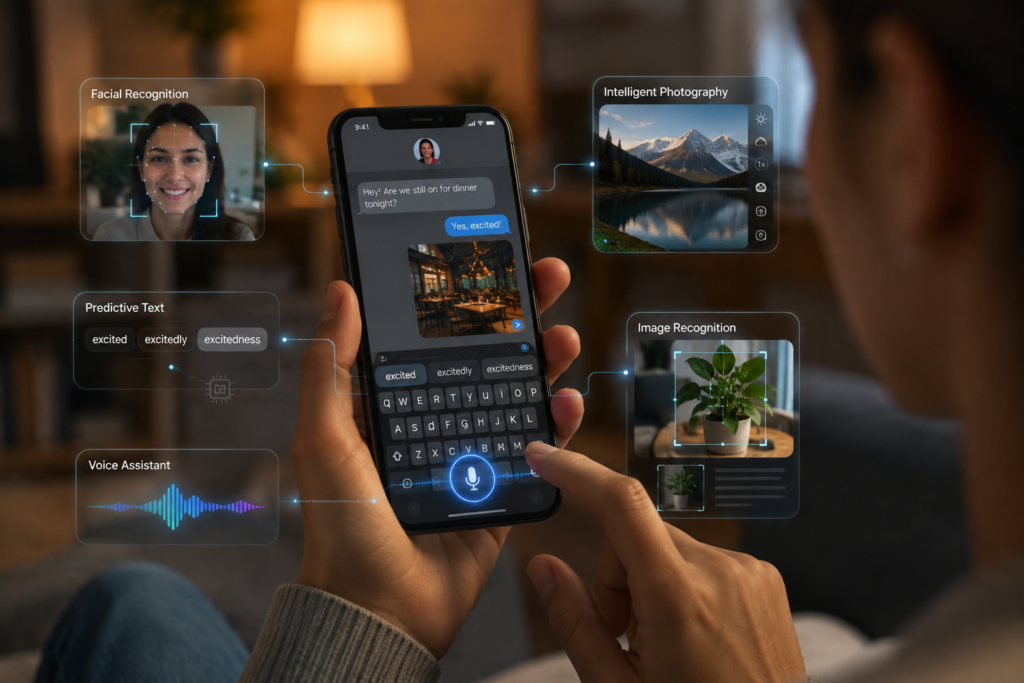
Your smartphone contains several AI-powered features.
Face recognition can analyze patterns in facial features and compare a current image with stored representations. If the system determines that the match is sufficiently strong, the phone can unlock.
You simply see the screen open. Behind that action, a machine-learning system has processed visual information.
Your keyboard can use AI-based prediction as well. As you type, it estimates which word is likely to come next. More advanced language models perform much more complex forms of prediction, but the basic principle is similar. The system uses learned patterns to estimate what may come next.
AI can also improve photographs, organize images, detect objects, recognize scenes, and separate subjects from backgrounds.
Your smartphone therefore acts as one of the clearest examples of how AI has moved from specialized research into ordinary technology.
How Does AI Understand Voice and Images?
When you speak to a digital assistant, several systems may work together.
Speech-recognition software processes your voice and converts the sound into text or another machine-readable representation. A language system analyzes the request and determines what you are asking. Another system can execute the requested task, while speech synthesis can produce a response.
You might ask the system to set an alarm, send a message, play music, or provide information.
Computer vision works with visual information in a related way.
A camera captures light and produces an image. An AI system can process that image and identify patterns. It may recognize faces, detect objects, identify scenes, improve photographs, or organize your photo library.
You can even search a collection of photographs for something such as a beach without manually labeling every image.
The system has analyzed visual patterns to make that possible.
Why Does AI Recommend What You Watch and Buy?

Consider what happens when you watch a video, listen to music, buy a product, or read an article.
Platforms can collect signals from your interactions. Machine-learning systems can analyze patterns across users and items. The system then estimates what you may find useful or interesting and generates recommendations.
Recommendation systems are among the most visible forms of AI in daily life.
They can influence what you watch, read, listen to, buy, and discover next.
The important distinction is that a recommendation is not necessarily a decision. An AI system may determine which options you encounter, while you still make the final choice.
Online shopping uses similar systems. Products can be recommended based on browsing or purchase history. Search results can be personalized. Fraud-detection systems can analyze transactions. Inventory systems can predict demand.
One ordinary purchase can therefore involve several AI systems operating behind the scenes.
How Does AI Protect Email and Bank Accounts?
Your inbox may receive hundreds of messages. AI and machine-learning systems can classify them using signals such as language, sender behavior, links, attachments, and other characteristics.
The system estimates whether a message is likely to be unwanted or dangerous and can move suspicious messages away from your main inbox.
Banks use a related pattern-recognition approach.
A fraud-detection system can examine large numbers of transactions and look for unusual behavior. If an account normally shows one pattern of activity and a transaction suddenly differs from that pattern, the system may flag it.
The system does not necessarily know that fraud has occurred. It detects an unusual pattern. A person or another security process can then investigate.
AI can therefore act as an early warning system rather than an independent judge.
How Is AI Changing Search, Translation, and Communication?
When you type a question into a search engine, the system needs to interpret what you mean.
Modern search systems can use machine learning to understand language, identify relevant concepts, and rank information. Some search experiences can also use generative AI to produce direct answers.
Translation systems use AI differently from simple word-for-word substitution. Modern systems can learn relationships between languages and analyze context, grammar, word relationships, and recurring patterns.
AI can also assist everyday communication by correcting spelling, suggesting replies, translating messages, detecting spam, summarizing conversations, and generating responses.
These tools can save time. They also raise an important question: when AI helps write a message, how much of the message represents your own thinking?
How Is AI Changing Education and Healthcare?
AI can support education by explaining difficult concepts, generating practice questions, providing examples, summarizing information, supporting language learning, and giving feedback on certain types of work.
It can also personalize learning.
Two students may understand the same subject at different levels. An AI-based learning system could adjust difficulty, recommend additional practice, identify repeated mistakes, and generate examples at different levels.
But effective personalization depends on accurate assessment. Poor data can lead to poor recommendations.
AI can support learning. It does not eliminate the need to think, practice, retrieve information, apply knowledge, and receive feedback.
Healthcare is another important application.
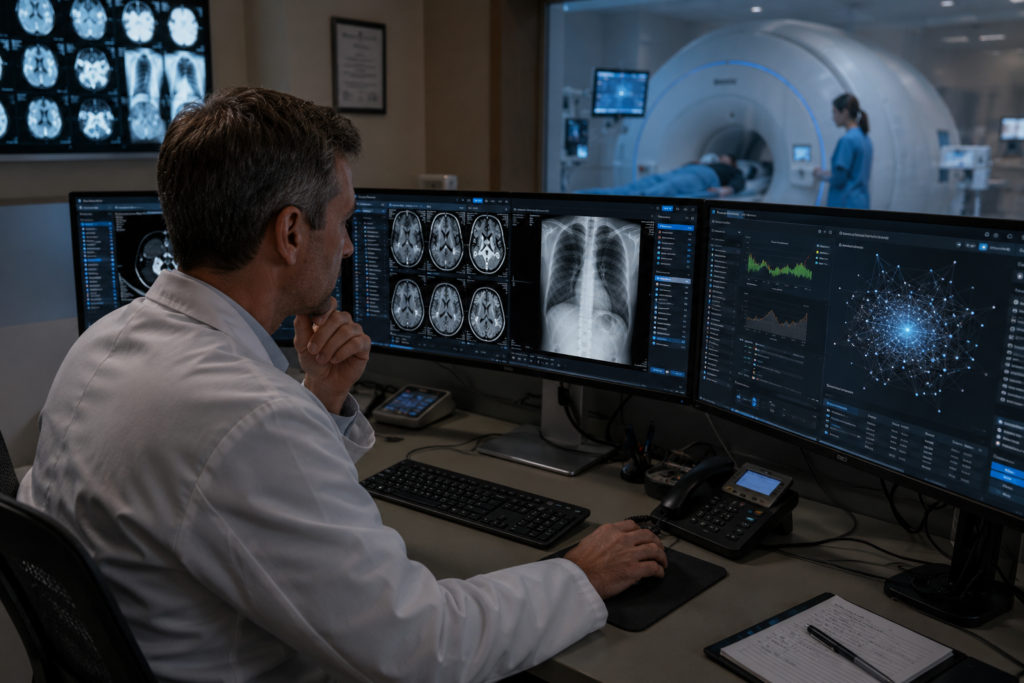
For a broader discussion of responsible AI in health, see the World Health Organization’s guidance on ethics and governance of AI for health. AI can analyze medical images, identify patterns, assist with documentation, support research, analyze large datasets, and help predict certain outcomes.
It does not automatically replace the clinician. Human professionals remain important for interpretation, context, communication, and decision-making.
Healthcare demonstrates why the consequences of AI depend heavily on where and how the technology is used.
How Does AI Work With Wearables and Navigation?
A smartwatch can measure heart rate, movement, sleep-related signals, and other physiological measurements. For background on one of the body’s core physiological systems, see How Do Your Lungs Work? The Science of Human Breathing. AI can analyze patterns in this data and provide estimates or personalized suggestions.
However, wearable measurements can contain noise. A wearable does not have direct access to everything happening inside your body. Its conclusions depend on the quality of its sensors and algorithms.
Navigation systems provide another familiar example.
When you enter a destination, the system can analyze traffic conditions, road information, historical patterns, and current reports. It can estimate travel time and change the route as conditions change.
What looks like a simple map can therefore involve continuous analysis of large amounts of information.
How Is AI Changing Work?

AI can automate or assist with repetitive tasks.
It can classify documents, summarize information, generate drafts, analyze data, create reports, translate languages, search large collections of information, and assist with customer service.
Imagine an employee who spends three hours preparing a report.
An AI system may summarize raw data, generate a first draft, create charts, and identify unusual trends. The employee can then spend more time checking the analysis and making decisions.
That can be a productive use of AI.
But automation can also change job requirements. Some tasks may disappear, new tasks may appear, and workers may need new skills.
The effect on employment is therefore more complicated than simply saying that AI will replace jobs. In many cases, AI changes the tasks within existing jobs.
What Is Generative AI?
Generative AI can produce new content, including text, images, audio, video, and code.
Language models can generate text by predicting likely sequences based on learned patterns and the input they receive.
This makes generative AI useful for summarizing documents, rewriting paragraphs, generating ideas, translating content, answering questions, creating images, and exploring creative concepts.
But usefulness does not guarantee accuracy.
A language model can produce fluent information that is incorrect. Human verification remains important when accuracy matters.
Fluent does not always mean correct.
How Does AI Influence Entertainment and Social Media?
Streaming services can recommend films. Music platforms can recommend songs. Games can adapt to player behavior. AI can assist animation, visual effects, voice generation, and content personalization.
Social media systems can rank posts, recommend accounts, detect spam, moderate content, recognize images, translate text, and predict which content a user may engage with.
This creates an important effect.
AI does not simply organize information. Recommendation systems can shape attention.
If an algorithm continually shows what it predicts you will enjoy, you may encounter less unfamiliar content. Personalization can make information easier to discover, but it can also influence where you spend your attention.
What Are the Risks of AI?
AI becomes more consequential as it moves into systems that influence important decisions.
AI systems learn from data. If training data contains biases, a model can reproduce or amplify them.
Generative AI can also produce convincing but incorrect information. A system may generate a fluent answer without reliably checking every statement against reality.
Privacy is another concern.
AI systems can depend on data from searches, purchases, location, photographs, voice commands, wearable devices, and application interactions.
More data can enable more personalization. At the same time, data collection raises questions about what information is collected, how it is used, who can access it, and how long it is retained.
Facial recognition raises additional questions involving consent, accuracy, surveillance, and misuse.
The technology itself does not determine the outcome. Design, data, deployment, oversight, and human decisions all matter.
The NIST AI Risk Management Framework similarly treats AI risk as something organizations need to manage across the system and its context of use.
How Is AI Used Beyond Consumer Technology?
AI is not limited to phones, websites, and entertainment platforms.
Researchers can use AI to analyze large datasets, identify patterns, predict molecular properties, analyze images, assist simulations, and search scientific literature.
In agriculture, AI can help monitor crops, analyze weather data, estimate crop risks, and survey fields.
Manufacturers can use AI for predictive maintenance. Sensors can monitor equipment and identify patterns associated with potential failures.
Energy systems can use AI to analyze electricity demand, predict consumption, optimize heating and cooling, and support complex energy systems.
Weather forecasting can also incorporate machine learning alongside traditional physical models and observations.
Across these fields, the same broad principle keeps appearing:
Collect information. Identify patterns. Generate predictions. Use those predictions to support a task.
Does AI Make Decisions for Us?
AI can recommend a route, product, article, video, or other action.
But a recommendation is not necessarily a decision.
An AI system may rank options while a person still evaluates the context and decides what to do.
That distinction becomes increasingly important as AI systems become more capable.
You need to know when to trust a system, when to question it, when to verify information, and what the system cannot know.
AI can process enormous amounts of information.
Humans still need to determine what matters.
Will AI Replace Learning and Creativity?
AI can explain a difficult topic, generate practice material, produce drafts, and explore ideas.
But receiving an AI-generated answer is not the same as learning.
Learning still involves mental effort, practice, retrieval, application, and feedback.
Creativity also involves more than producing an output. Human creativity includes goals, values, experience, taste, judgment, and meaning.
AI can generate possibilities quickly.
Humans still decide which possibilities are worth pursuing.
What Does the Future of AI Look Like?

AI is likely to become increasingly integrated into ordinary digital tools.
Instead of opening a separate AI application, you may encounter AI inside software you already use.
Phones, cars, browsers, email, workplace tools, medical systems, home devices, and educational platforms may increasingly include AI capabilities.
The technology may become less visible as it becomes more common.
That may be one of the most significant changes.
You may interact with many AI systems without consciously thinking about them.
The important question is therefore not whether AI will enter everyday life.
It already has.
The more important question is how deeply it will become integrated and what humans choose to do with it.
Why Understanding AI Matters
You do not need to become an AI engineer to understand the technology affecting your life.
A few principles go a long way:
AI systems learn patterns from data.
They can make useful predictions.
They can generate impressive outputs.
They can also make mistakes.
Data quality matters.
Model design matters.
Context matters.
Human oversight matters.
The consequences of an error also depend on the application.
An incorrect movie recommendation is inconvenient.
An incorrect medical recommendation can be serious.
An incorrect navigation suggestion may waste time.
An incorrect autonomous-driving decision can create physical danger.
The same broad concept, prediction, can therefore have very different consequences depending on where an AI system is used.
AI Is Already Part of Your Day
Return to your morning.
You unlock your phone with your face.
AI may be involved.
You type a message.
AI may predict the next word.
You open a video platform.
AI recommends content.
You search for information.
AI may help interpret your query.
You receive an email.
AI may filter spam.
You use navigation.
AI may help estimate traffic.
You take a photograph.
AI may improve the image.
You buy something online.
AI may recommend products or detect fraud.
You speak to a digital assistant.
AI may recognize your voice and interpret your request.
You may already be living with artificial intelligence.
The technology is no longer something that exists only in research laboratories or futuristic demonstrations. It is increasingly embedded in ordinary digital life.
Understanding how it works gives you a better way to understand what it can do, where it can fail, and how much influence it can have over your decisions.
Related Reading
- How Do Smart Home Devices Communicate?
- How Do AI Smart Glasses Work?
- How Do Driverless Cars Work?
- Science Explained
Key Takeaways
- Artificial intelligence is a broad field involving systems that perform tasks associated with aspects of human intelligence.
- Many AI systems learn statistical patterns from data and use those patterns to produce predictions or other outputs.
- AI already operates inside smartphones, search systems, email services, recommendation platforms, navigation tools, banks, and cameras.
- Recommendation systems can influence what people watch, read, listen to, buy, and discover.
- AI can support education, healthcare, communication, scientific research, agriculture, manufacturing, and energy systems.
- Generative AI can create text, images, audio, video, and other content, but its outputs can contain errors.
- AI systems depend heavily on data quality, model design, context, and appropriate evaluation.
- AI can influence human attention and decision-making even when it does not make the final decision.
- Privacy, bias, misinformation, security, and accuracy become important concerns as AI becomes more deeply integrated into daily life.
- Human judgment and verification remain important, particularly when AI is used in situations where errors have serious consequences.
Conclusion
Artificial intelligence is changing daily life because it is becoming a layer between people and information.
It helps decide what you see, what you hear, what you buy, how you travel, how you work, how you learn, and increasingly, how you create.
AI can reduce repetitive work, analyze large amounts of information, support accessibility, personalize services, assist science and medicine, and create new forms of communication.
It can also introduce problems involving bias, privacy, attention, misinformation, security, and inaccurate outputs.
The outcome depends partly on how people design and use these systems.
When an AI system influences an important part of your life, useful questions remain simple:
What data does it use? What decision does it influence? What happens when it is wrong? What safeguards exist? When should a human verify the result?
These questions become more important as AI becomes less visible and more deeply integrated into ordinary technology.
The next time your phone recommends a video, your map changes your route, your camera improves a photograph, or an AI system answers a question, remember one useful principle:
AI can be useful.
It can be impressive.
And it can still be wrong.
Explore more CAVELYRA‘s explanations of the technology and science shaping everyday life.