

Every few seconds, you take a breath. You inhale, you exhale, and you repeat the process thousands of times every day, usually without thinking about it.
But every breath involves a remarkable sequence of mechanical and chemical events. Air enters your body, travels through a branching network of airways, reaches millions of tiny structures deep inside your lungs, and comes into close contact with your bloodstream.
Oxygen moves into the blood. Carbon dioxide moves out.
Your lungs therefore do much more than simply fill with air. They create the connection between the atmosphere and your cells.
So how do your lungs actually work?
Your Respiratory System Starts With a Pathway for Air

Your lungs are the central organs of the respiratory system, but they cannot work alone.
The respiratory system includes the nose, mouth, pharynx, larynx, trachea, bronchi, bronchioles, and alveoli. Together, these structures create a pathway that carries air from the outside environment to the regions where gas exchange occurs.
When you inhale, air enters through your nose or mouth. If you breathe through your nose, the nasal passages help warm, humidify, and filter incoming air. Tiny hairs and mucus help trap particles before they can travel deeper into the respiratory system.
The air then passes through the pharynx and larynx before entering the trachea, commonly called the windpipe. The trachea divides into two main bronchi, with one entering each lung. Inside the lungs, these bronchi continue branching into smaller bronchi and then bronchioles.
Eventually, the air reaches the alveoli.
That is where one of the most important processes in your body takes place.
The Alveoli Are Where Oxygen Enters Your Blood
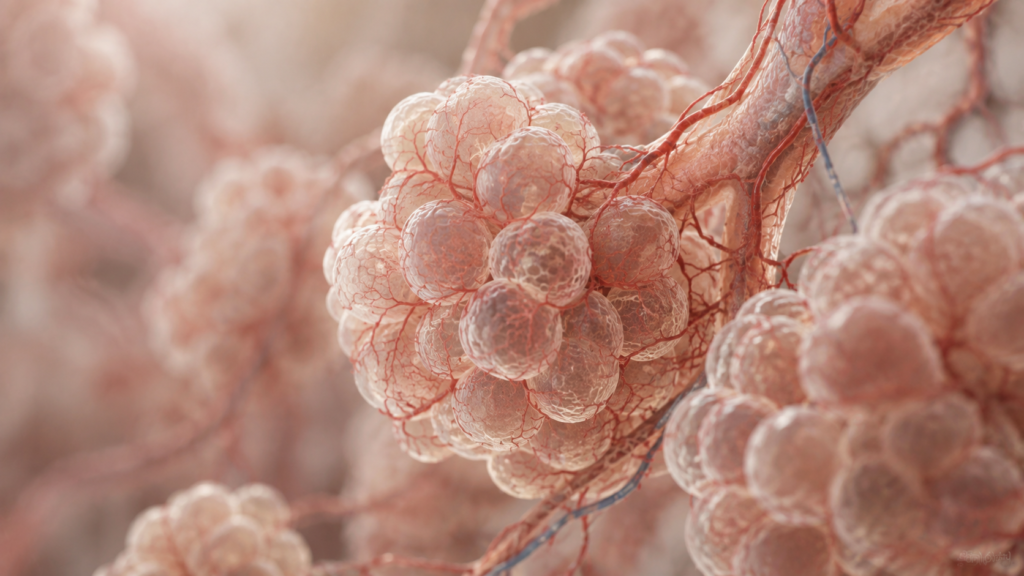
An alveolus is a tiny air sac inside the lungs. Your lungs contain hundreds of millions of these structures, creating an enormous surface area for gas exchange.
Each alveolus has an extremely thin wall surrounded by tiny blood vessels called capillaries. The alveolar wall and capillary wall are separated by a very thin barrier called the respiratory membrane.
This arrangement brings air and blood extremely close together.
Oxygen in the alveolar air moves across this membrane into the blood. At the same time, carbon dioxide moves from the blood into the alveolus. You then exhale that carbon dioxide.
This is pulmonary gas exchange.
The movement occurs because of differences in partial pressure. In simple terms, gases move from regions where their partial pressure is higher toward regions where it is lower.
Oxygen has a higher partial pressure in the alveolar air than in the deoxygenated blood arriving at the lungs, so oxygen moves into the blood. Carbon dioxide follows the opposite gradient and moves into the alveoli.
Your Lungs Do Not Pull Air In by Themselves
Your lungs do not actively pull air into your body. Breathing depends on pressure changes created by the respiratory muscles.
The diaphragm plays the central role.
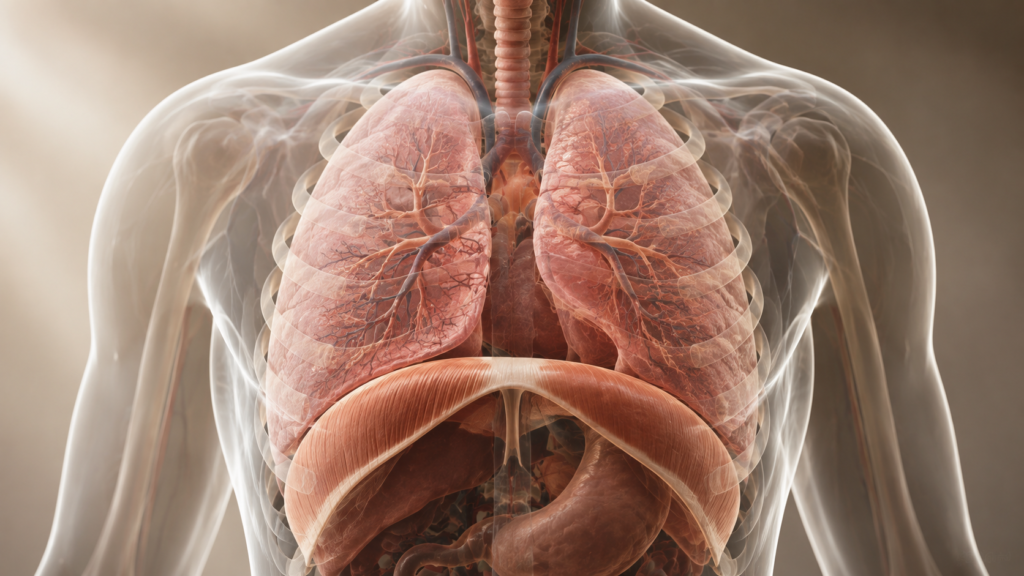
The diaphragm is a large dome-shaped muscle located beneath the lungs. When it contracts, it moves downward. This increases the volume of the thoracic cavity and lowers the pressure inside the lungs relative to atmospheric pressure. Air then flows inward.
That is inhalation.
When the diaphragm relaxes, it moves upward. Thoracic volume decreases and pressure inside the lungs rises. Air flows outward.
That is exhalation.
During quiet breathing, normal exhalation is largely passive because the lungs and chest wall naturally recoil toward their resting positions.
The basic principle is simple. Change the volume, change the pressure, and move the air.
Your Rib Cage Helps Your Lungs Expand
The diaphragm is not working alone.
Your ribs and intercostal muscles also contribute to breathing. During inhalation, the external intercostal muscles help expand the thoracic cavity. The rib cage moves upward and outward, and the lungs expand with it.
During deep breathing, the diaphragm contracts more strongly and additional respiratory muscles can become involved. Your chest expands further, allowing more air to enter.
During forceful exhalation, muscles including the abdominal muscles can help increase pressure within the thoracic cavity and push more air out.
The lungs are also surrounded by a double-layered membrane called the pleura. A small amount of fluid occupies the pleural space between its layers. This arrangement reduces friction and helps keep the lungs mechanically coupled to the chest wall.
Your Airways Also Protect Your Lungs
Every breath can bring dust, particles, and microorganisms into your respiratory system. Your airways therefore need several layers of defense.
Mucus can trap particles, while ciliated cells move mucus toward the throat, helping clear material from the conducting airways. This process is part of the mucociliary clearance system.
Coughing provides another defense. A cough involves a deep inhalation followed by closure of the vocal cords and a rapid increase in pressure. The airway then opens and air is expelled at high velocity, helping remove mucus and foreign material.
Sneezing primarily protects the upper respiratory tract by helping expel irritants from the nose.
Your respiratory system therefore combines several protective mechanisms before air reaches the deepest parts of the lungs.
Surfactant Helps Keep the Alveoli Open
The alveoli need to remain stable while they repeatedly expand and contract.
A substance called pulmonary surfactant helps make this possible. Surfactant is produced by specialized type II alveolar cells and reduces surface tension at the air-liquid interface inside the alveoli.
Without adequate surfactant, the tendency of small alveoli to collapse would increase.
The alveoli also contain different specialized cells. Type I alveolar cells form most of the thin gas exchange surface. Type II alveolar cells produce surfactant and can contribute to repair of the alveolar epithelium. Alveolar macrophages help remove particles and microorganisms that reach the deeper lung.
So an alveolus is not simply an empty air sac. It is a living biological structure.
How Oxygen Travels From Your Lungs to Your Cells
Once oxygen crosses into the blood, another system takes over.
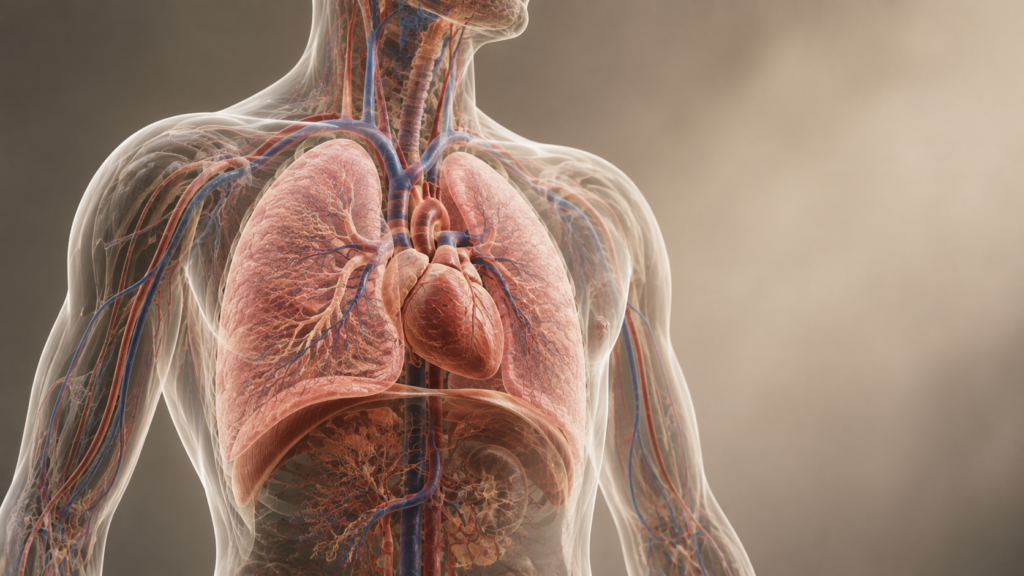
Deoxygenated blood leaves the right side of the heart through the pulmonary arteries. These vessels branch into smaller vessels and eventually form capillary networks around the alveoli.
Oxygen moves into the blood, while carbon dioxide moves into the alveolar space. The oxygenated blood then travels through the pulmonary veins toward the left atrium of the heart, where it enters the circulation.
Most oxygen does not simply remain dissolved in the blood plasma. Instead, it is transported by hemoglobin inside red blood cells.
Hemoglobin contains iron-containing heme groups that bind oxygen reversibly. This allows blood to transport much more oxygen than plasma alone could carry.
The left ventricle then pumps oxygenated blood into the aorta. Arteries distribute it throughout the body. Eventually, oxygen reaches tissue capillaries, leaves the blood, and enters cells.
Inside cells, mitochondria use oxygen during aerobic metabolism to support ATP production.
One breath has therefore become part of the process that supplies energy to your cells.
Your Lungs Also Remove Carbon Dioxide
Your cells continuously produce carbon dioxide as a metabolic waste product.
Carbon dioxide enters the blood and travels back toward the lungs. Much of it is transported as bicarbonate. Some binds to proteins, including hemoglobin, while a smaller amount remains dissolved in plasma.
When the blood reaches the lungs, carbon dioxide is converted back toward a form that can diffuse into the alveoli.
You exhale it.
This process also helps regulate the body’s acid-base balance. When carbon dioxide rises in the blood, hydrogen ion concentration tends to increase and blood pH falls. Breathing provides a rapid way to control carbon dioxide.
If ventilation increases, more carbon dioxide is removed. If ventilation decreases, carbon dioxide can accumulate.
Your lungs are therefore involved in both gas exchange and the regulation of your internal chemical environment.
Your Brain Automatically Adjusts Your Breathing
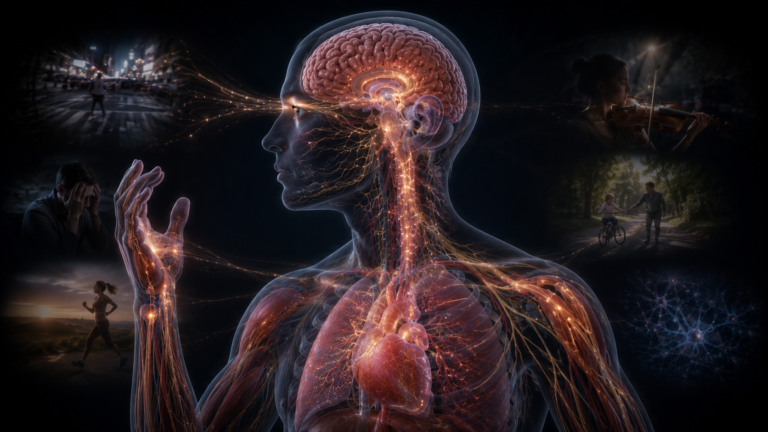
You do not have to consciously remember to breathe every few seconds. Your brain automatically regulates ventilation.
Important respiratory control centers are located in the brainstem. They receive information about carbon dioxide, oxygen, and pH. Chemoreceptors detect changes in the body’s internal environment, and the brain adjusts the rate and depth of breathing accordingly.
This becomes obvious during exercise.
When you begin running, your muscles increase their metabolic activity. They consume more oxygen and produce more carbon dioxide. Your breathing becomes faster and deeper.
Your heart also beats faster and blood flow increases. The respiratory and cardiovascular systems coordinate their responses to deliver more oxygen and remove more carbon dioxide.
Feeling out of breath during intense exercise does not necessarily mean that your lungs have stopped working effectively. It can reflect the body’s response to increased metabolic demand.
Your Lungs Must Balance Airflow and Blood Flow
Effective gas exchange requires two things:
- Ventilation, meaning air reaching the alveoli.
- Perfusion, meaning blood reaching the pulmonary capillaries.
If an alveolus receives air but little blood, gas exchange is limited. If it receives blood but little air, gas exchange is also limited.
This relationship helps explain why different lung conditions can interfere with oxygen exchange in different ways.
In pneumonia, infection and inflammation can fill parts of the alveoli with fluid and inflammatory material. This can interfere with gas exchange.
In pulmonary embolism, a blood clot can obstruct part of the pulmonary circulation. Air may continue reaching an area of the lung while blood flow is reduced.
Different problems can therefore disrupt breathing at different points in the system.
What Happens When Your Breathing Changes?
Your breathing responds continuously to your body’s needs.
During breath holding, your cells continue consuming oxygen and producing carbon dioxide. Carbon dioxide rises, and the brain detects the changing chemical environment. The urge to breathe becomes increasingly strong.
During hyperventilation, you may breathe faster or deeper than your metabolic needs require. Carbon dioxide can fall, causing blood pH to rise. This can produce symptoms such as lightheadedness or tingling.
During hypoventilation, ventilation becomes insufficient for the body’s carbon dioxide production. Carbon dioxide can rise and blood pH can fall. Oxygen levels may also decrease.
The respiratory system continuously adjusts ventilation to match metabolic demand.
Your Lungs Work While You Sleep
Breathing does not stop when you fall asleep.
Your brainstem continues generating respiratory rhythms. Your diaphragm continues contracting, air continues moving, and gas exchange continues.
However, respiratory control and muscle activity change during sleep.
Some people experience significant airway obstruction during sleep. In obstructive sleep apnea, effective airflow can repeatedly stop or decrease. Oxygen levels may fall and carbon dioxide can rise. The brain responds by increasing respiratory effort and causing brief arousals.
Your lungs therefore remain active throughout the night, even when you are completely unaware of the process.
Your Breathing Also Responds to Your Environment
Your respiratory system is directly connected to the outside world.
Smoking exposes respiratory tissues to thousands of chemical compounds. Repeated exposure can damage airway and lung structures, impair ciliary function, increase inflammation, and contribute to chronic respiratory disease and lung cancer.
Air pollution can also affect the lungs. Fine particulate matter can penetrate deeply into the respiratory system, and repeated exposure can contribute to respiratory and cardiovascular disease.
Altitude creates another challenge.
At high altitude, atmospheric pressure is lower, so the partial pressure of oxygen is also lower. The oxygen gradient driving diffusion into the blood becomes smaller.
Your body responds by increasing ventilation and, over longer periods, making other physiological adjustments that help improve oxygen delivery.
The Entire Journey of One Breath
It can be difficult to appreciate how many processes occur during something as ordinary as breathing. Consider the journey of one oxygen molecule.
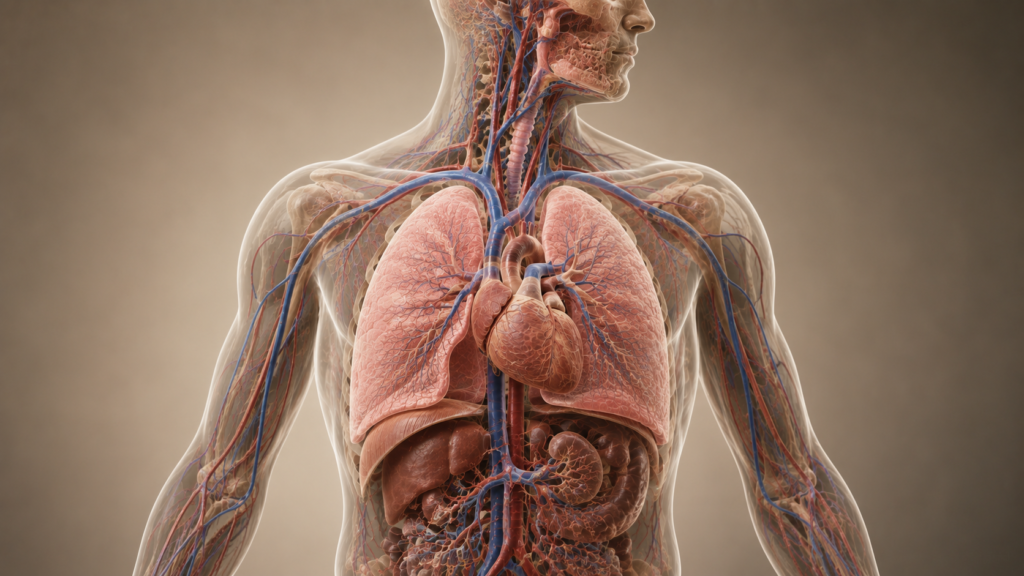
You inhale, and the molecule enters through your nose. It passes through the pharynx, larynx, and trachea before entering a bronchus and traveling through smaller airways. Eventually, it reaches an alveolus, where it crosses the alveolar membrane and enters the plasma.
From there, the oxygen moves into a red blood cell and binds to hemoglobin. The heart receives the oxygenated blood and pumps it through the systemic circulation. Eventually, the oxygen reaches a tissue, leaves hemoglobin, enters a cell, and reaches a mitochondrion, where it contributes to ATP production.
The journey does not end there. At the same time, carbon dioxide produced by your cells begins the opposite journey. It enters the blood and returns to the heart. The right side of the heart sends it toward the lungs, where the carbon dioxide reaches the alveoli and is exhaled.
A single breath therefore connects the air around you with the cells throughout your body.
So, How Do Your Lungs Work?
Your lungs work by moving air through a branching airway system and bringing that air into close contact with blood through millions of alveoli.
The diaphragm and other respiratory muscles create the pressure changes that move air. The alveoli provide a huge surface for gas exchange. Oxygen diffuses into the blood, while carbon dioxide diffuses out. Hemoglobin transports oxygen, the cardiovascular system distributes it, and the brain continuously adjusts ventilation according to the body’s needs.
Your lungs therefore connect the outside world directly to your internal environment.
Every breath brings molecules from the atmosphere into contact with your bloodstream. Every exhalation removes carbon dioxide produced by your cells.
The process seems simple because it happens automatically.
But beneath every quiet breath, millions of alveoli are participating, countless capillaries are carrying blood, hemoglobin is loading and unloading oxygen, the diaphragm is moving, neural circuits are regulating ventilation, and chemical gradients are driving diffusion.
You breathe because your cells need oxygen.
You exhale because your cells produce carbon dioxide.
Between those two actions lies one of the most important physiological processes in the human body.
Respiration.
Every breath is a connection between the atmosphere and your cells.
And that connection keeps you alive.