
You suddenly feel thirsty. Why do you get thirsty? Your mouth feels dry. You want water. You drink, and a few minutes later, the urge begins to fade.
Quick answers
- Short answer: Your brain monitors how concentrated your body fluids are and how much blood volume you have, and it creates thirst when the balance shifts. Thirst can begin before severe dehydration develops. [1]
- Why it fades so fast: Signals from your mouth, throat, and digestive system reduce thirst before the water has been absorbed, while ADH helps the kidneys conserve water. [1][2]
- When to get checked: Persistent or excessive thirst with frequent urination can signal an underlying medical problem.
It feels simple. But thirst is the visible part of a much larger process. Your body is constantly losing and redistributing water. Your brain monitors changes in your internal environment, your kidneys adjust how much water you lose, and hormones help coordinate the response. Together, these systems help keep your body’s fluid balance within a controlled range.
So why does your brain make you thirsty? Why does salty food increase thirst? Why can you feel thirsty before you become severely dehydrated? And why can the urge disappear before the water you drank has even been fully absorbed? The answer begins with homeostasis.
Why Does Your Body Need to Control Water Balance?
Water is essential for normal cellular function. Your cells use water in countless chemical processes, and blood contains a large amount of it. Water helps transport nutrients and waste products, regulate body temperature, support digestion, and maintain normal organ function. Your body therefore cannot treat water as optional: it must continuously regulate how much water is present and how that water is distributed. This process is called homeostasis.
Water exists in different compartments throughout your body. A large portion is inside cells, known as intracellular fluid, and the rest is outside cells, including blood plasma and the fluid surrounding cells. These compartments constantly exchange water, and changes in the concentration of dissolved substances influence how water moves between them. Your body therefore needs to monitor more than simply how much water you have consumed. It also needs to monitor the concentration and distribution of that water.
Why Do You Get Thirsty? How Does Your Brain Detect That You Need Water?
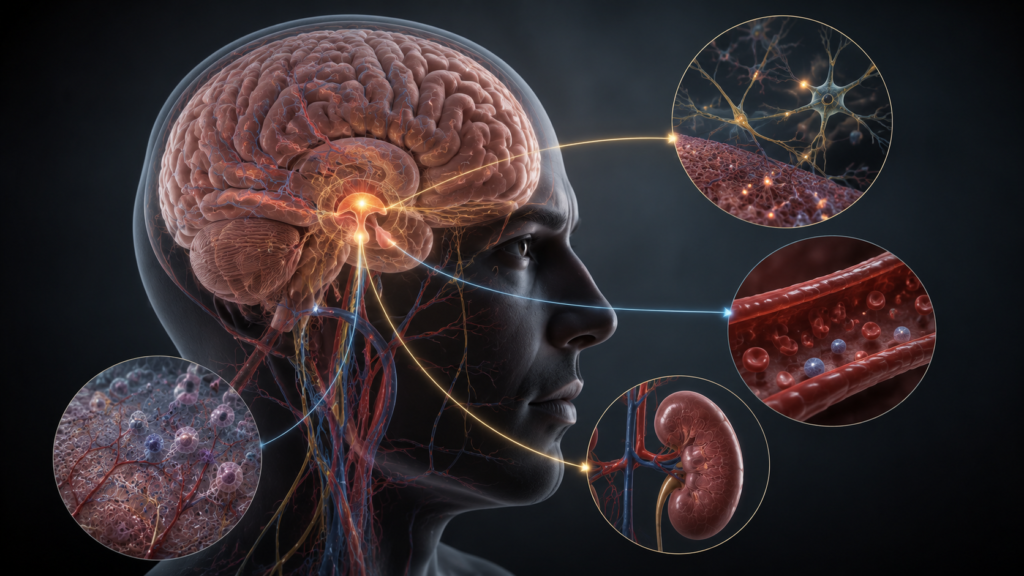
Your brain does not have to wait until you are severely dehydrated before responding. It receives information from several sources. One important signal involves the concentration of dissolved substances in your body fluids, and another involves blood volume and pressure. Specialized cells in and around the hypothalamus can detect changes related to fluid concentration, while signals from the cardiovascular system and kidneys provide additional information. Your brain combines these signals, and when the overall pattern indicates that your body needs more water, thirst increases. [1]
This is an important feature of the system. Thirst can begin before major dehydration develops, which gives you an opportunity to correct the imbalance before it becomes severe. You do not need to measure the concentration of your blood yourself, because your nervous system converts complex physiological information into a sensation that motivates you to seek water. That is one reason thirst works so effectively.
What Is Osmolality, and Why Does It Matter?
Your blood contains many dissolved substances, including sodium and other electrolytes, and osmolality describes the concentration of dissolved particles in a fluid. Imagine losing water without losing an equivalent amount of dissolved substances. The amount of water falls relative to the dissolved particles, so the body fluid becomes more concentrated. Sensors detect this change, and the brain responds by increasing thirst. At the same time, the body can begin conserving water, which gives it two complementary responses: drink more, and lose less. The first response changes behavior, and the second changes kidney function. Both work toward restoring fluid balance.
Why Does Salty Food Make You Thirsty?
Think about what happens after a very salty meal. You have added sodium to your body, and sodium contributes strongly to the concentration of extracellular fluid. As the concentration of dissolved substances changes, water shifts within the body’s fluid compartments, your brain detects the change, and thirst increases. The additional water helps move the concentration of body fluids back toward its normal range. This is why a salty meal can make you reach for water. The important point is that thirst is not simply a response to an empty water tank. Your body is also responding to changes in the relationship between water and dissolved substances.
Why Do Exercise and Heat Increase Thirst?
Exercise creates another challenge for fluid balance. Your muscles produce heat, and sweating helps your body release it, but sweat contains water as well as electrolytes. As you continue exercising, you can lose increasing amounts of fluid, blood volume can decrease, and the concentration of body fluids can change. Your brain receives these signals, and thirst increases. Hot conditions can produce a similar response because they increase sweating and therefore water loss. So when heat makes you thirsty, the sensation is connected to what heat does to your body’s fluid balance, rather than simply to the feeling of being hot.
Why Does Your Mouth Feel Dry When You Are Thirsty?
Dry mouth and thirst often occur together, but they are not exactly the same thing. Saliva keeps the mouth moist and supports swallowing, digestion, and oral health, and dehydration can reduce saliva production and make your mouth feel dry. But other factors can do the same: some medicines reduce saliva production, anxiety can affect the sensation of dryness, and breathing through your mouth can also make the mouth feel dry. A dry mouth therefore does not necessarily mean that your body is significantly dehydrated. Thirst is a broader physiological signal involving the body’s internal fluid state.
Why Does Drinking Water Reduce Thirst So Quickly?
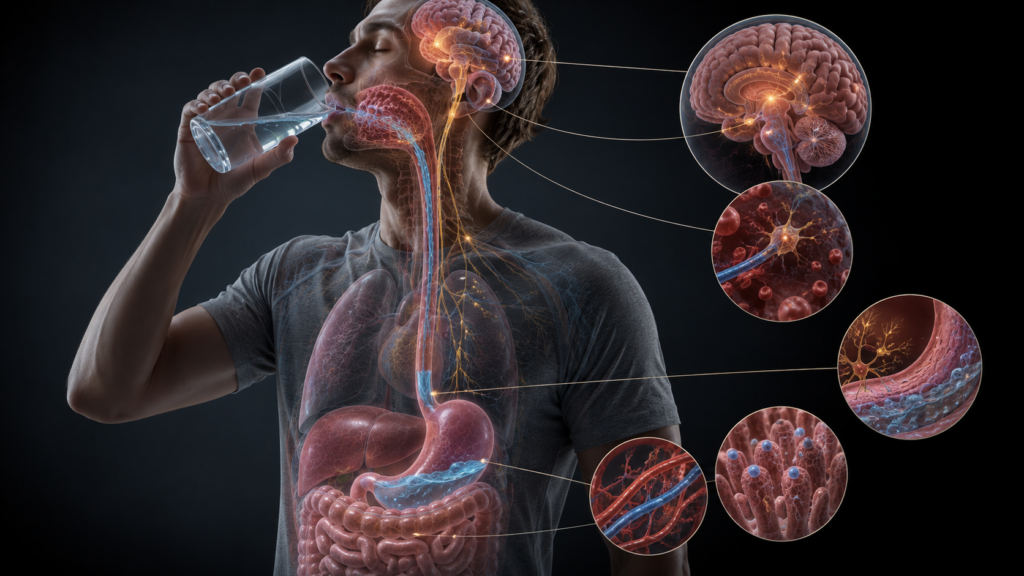
Here is one of the most interesting parts of the system. The water you drink does not instantly enter your bloodstream, yet your thirst can begin to decrease almost immediately. Your mouth and throat detect the act of drinking, and your stomach and digestive system also receive information that fluid has entered the body. These signals reach the brain and give an early indication that water is on its way, so the brain can reduce the thirst response before the water has been completely absorbed. [1] Later, as water is absorbed, changes in the body’s fluid conditions provide additional information. The system combines early prediction with later confirmation, which helps prevent you from continuing to drink large amounts simply because the water you have already consumed has not yet had time to reach the bloodstream.
How Do Hormones Help Your Body Save Water?
Thirst encourages you to drink, but your body also needs a way to reduce water loss. One of the key hormones involved is antidiuretic hormone (ADH), also called vasopressin, which is made in the hypothalamus and acts on the kidneys. [2] When the body needs to conserve water, ADH helps the kidneys reabsorb more of it, so less is lost in urine and the urine becomes more concentrated. The thirst system and the ADH system therefore work together: one encourages water intake and the other reduces water loss. This coordination is essential for maintaining fluid balance.
How Do the Kidneys Control Water?
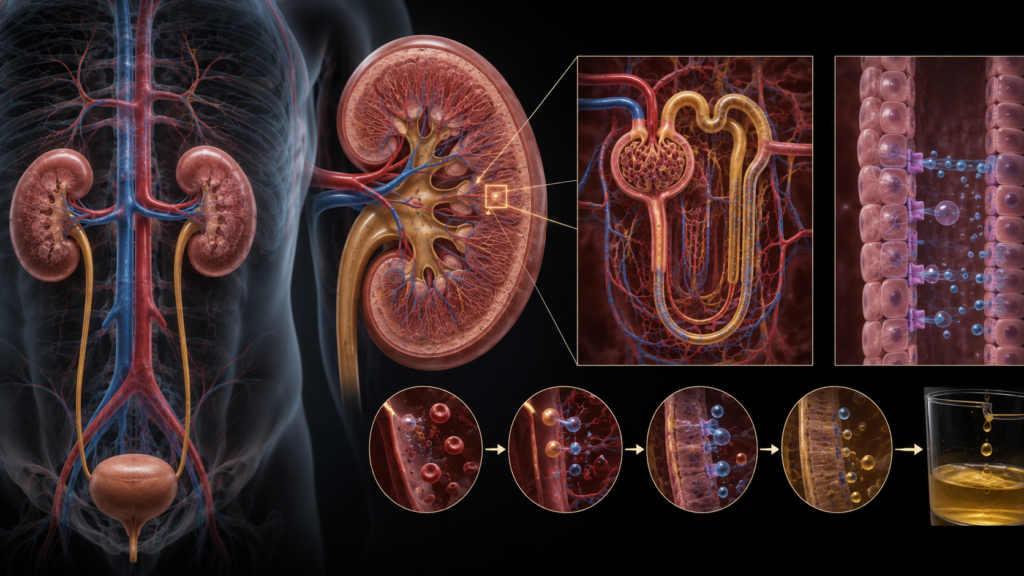
Your kidneys continuously filter your blood and then selectively reabsorb substances and water that your body needs. When water needs to be conserved, hormonal signals increase water reabsorption in specific parts of the kidney, and when the body has excess water, less is retained and more dilute urine can be produced. The kidneys therefore act as adjustable regulators of water loss. They do much more than remove waste, because they help control the chemical environment inside your body.
Why Does Urine Become Darker When You Are Dehydrated?
When your body needs to conserve water, the kidneys reabsorb more of it and less water remains in the urine, so the urine becomes more concentrated. A higher concentration of waste products and other substances can make urine appear darker, so urine color can provide a rough clue about hydration. It is not a perfect measurement, however, because food, medicines, supplements, and other factors can also change urine color. The larger physiological picture matters more than one visual observation.
What Happens When You Lose Too Much Water?
Dehydration can develop through many routes. Exercise and sweating can cause fluid loss, hot conditions can increase sweating, vomiting and diarrhea can remove substantial amounts of water and electrolytes, and fever can also increase fluid loss. As dehydration becomes more severe, the body’s conservation mechanisms become stronger: thirst increases, urine output decreases, and the kidneys conserve more water. More severe dehydration can affect circulation and may lead to weakness, dizziness, a faster heartbeat, and falling blood pressure. At that point, thirst is no longer a minor inconvenience. It is a signal that the body’s ability to maintain its internal environment is under increasing stress.
Can You Be Dehydrated Without Feeling Very Thirsty?
Yes. Thirst is an important defense mechanism, but it is not perfect. Thirst perception can change with age, illness, medications, and some neurological conditions, which means you cannot always judge fluid needs by thirst alone. Your body’s fluid state and the sensation of thirst are closely connected, but they are not identical measurements.
Can You Drink Too Much Water?
Water is essential, but more is not automatically better. If someone consumes very large amounts of water faster than the kidneys can excrete it, blood sodium concentration can fall. This condition is called hyponatremia. [3] Severe hyponatremia can affect brain function, because changes in blood concentration can cause water to move into cells, including brain cells. Your kidneys have a substantial capacity to regulate water, but that capacity has limits, so healthy hydration involves maintaining balance rather than simply maximizing water intake.
Why Can Illness Cause Thirst?
Illness can disturb fluid balance in several ways. Vomiting can remove water and electrolytes, diarrhea can cause rapid fluid loss, fever can increase water loss, and heavy sweating can produce similar effects. As these losses change fluid concentration or blood volume, the brain responds by increasing thirst, and the kidneys also increase their efforts to conserve water.
Some illnesses can produce persistent or excessive thirst through other mechanisms as well. For example, very high blood glucose can cause the kidneys to excrete more glucose into the urine, and water follows the glucose, increasing urine production and fluid loss. Excessive thirst together with frequent urination can therefore sometimes signal an underlying medical problem, and it deserves medical evaluation. Extreme thirst with confusion, severe weakness, or fainting is more urgent, and in the United States you should call 911 or seek emergency care.
Is Thirst Always a Sign of Dehydration?
No. Thirst is a signal, not a diagnosis. Salt intake can increase thirst, and so can exercise and heat. Dry mouth can create a similar sensation, certain medicines can affect fluid balance or saliva production, and high blood glucose and illness can also increase thirst. The sensation tells you that your body or environment has created a condition associated with an increased need for fluid. It does not identify the exact cause by itself.
The Simple Science of Thirst
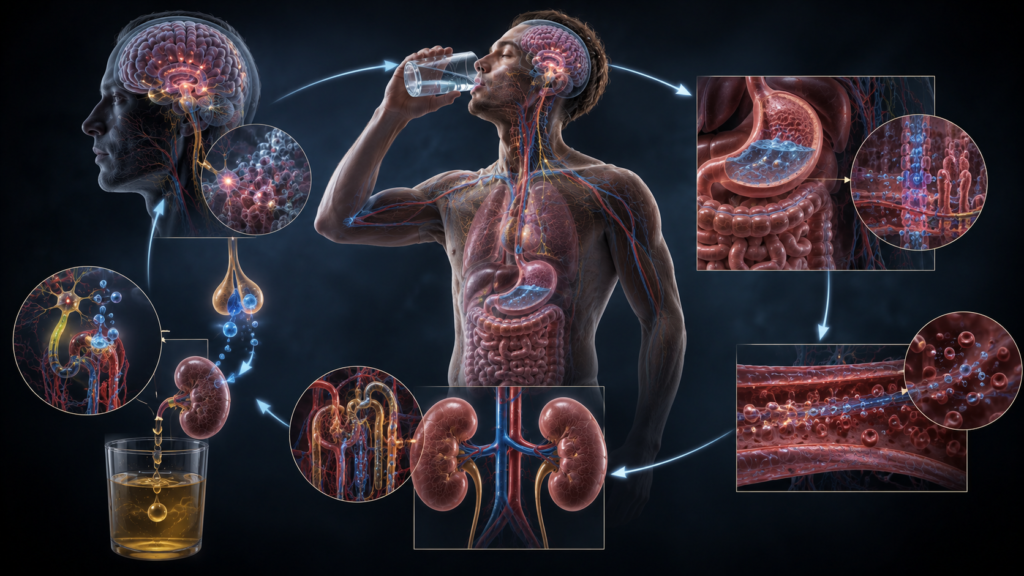
Your body continuously loses water. Changes occur in blood volume and in the concentration of dissolved substances in your body fluids, sensors detect those changes, and the brain processes the information. Thirst increases, and ADH helps the kidneys conserve water. You drink, your mouth, throat, stomach, and digestive system provide rapid signals that fluid has entered, and water is absorbed. Body-fluid conditions improve, and the thirst signal decreases. The cycle continues throughout your life.
The system does not require conscious calculations. You do not need to know your blood osmolality before deciding to drink, because your body converts complicated internal information into a simple sensation that can change your behavior. That is the deeper purpose of thirst: it links what is happening inside your body with what you do next. The underlying system is described in detail in this review of the neuroscience of thirst. [1]
Key Takeaways
- Thirst helps maintain the body’s water balance and is part of a larger homeostatic control system, in which the brain monitors body-fluid concentration, blood volume, and circulation.
- Osmolality describes the concentration of dissolved particles in a fluid, and sodium strongly influences it, which helps explain why salty food can make you thirsty.
- Exercise and heat can increase thirst because sweating causes water and electrolyte loss.
- Drinking can reduce thirst quickly because signals from the mouth, throat, and digestive system reach the brain before all the water has been absorbed.
- ADH, also called vasopressin, helps the kidneys conserve water, and dehydration can make urine more concentrated and darker.
- Thirst is not a perfect measure of hydration, and excessive water intake can also be dangerous because it can lower blood sodium.
- Persistent or excessive thirst, especially with frequent urination, deserves medical evaluation.
Conclusion
You get thirsty because your body is constantly working to maintain fluid balance. Because you continuously lose water, your body needs a system that can detect changes and encourage you to replace what has been lost. Your brain monitors internal signals related to fluid concentration and circulation, the hypothalamus and related systems help generate thirst, and ADH helps the kidneys conserve water. Salt, exercise, heat, illness, and other changes can alter this balance and increase thirst, and even the rapid relief you feel after drinking has a physiological explanation.
Thirst is therefore more than a simple desire for water. It is a homeostatic control system connecting your brain, kidneys, hormones, circulation, digestive system, and behavior. Every time you feel thirsty, your body is turning complex internal information into one remarkably simple message: drink.
Explore more evidence-informed explanations of the body and everyday health in CAVELYRA’s Body & Health collection.
References
- Leib DE, Zimmerman CA, Knight ZA. Thirst. Current Biology. 2016;26(24):R1260–R1265. PubMed Central
- Cuzzo B, Padala SA, Lappin SL. Physiology, vasopressin. StatPearls. NCBI Bookshelf
- “Hyponatremia.” StatPearls. NCBI Bookshelf