
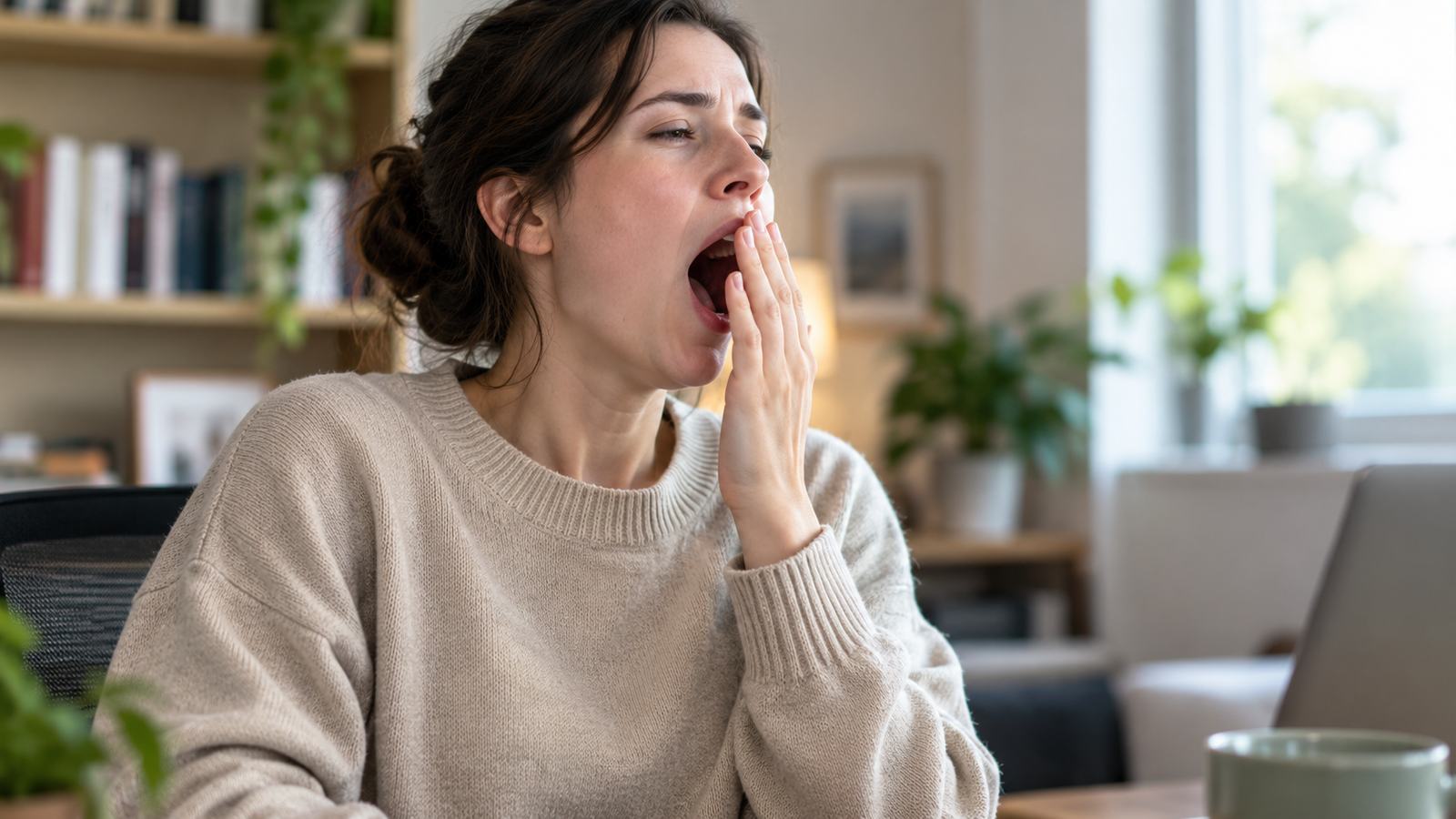
You are sitting in a meeting.
Someone starts talking.
You feel perfectly awake.
Then, without warning, your mouth opens wide and you take a deep breath.
You have just yawned.
A few minutes later, someone across the room yawns too.
Now you feel another one coming.
Yawning seems simple. We usually associate it with tiredness, boredom, or the moment before sleep. So why do we yawn even when we feel awake?
But the biology behind this ordinary reflex is much more complicated.
Yawning is an involuntary behavior involving coordinated activity in the brain, respiratory system, facial muscles, and jaw. The respiratory system remains active during sleep, even though breathing control changes. Learn how human breathing works at CAVELYRA. It occurs throughout human life and has also been observed in many other vertebrate species.
Scientists have studied yawning for centuries, yet they still do not have one explanation that accounts for every situation in which we yawn.
That uncertainty makes the reflex more interesting.
What Happens When You Yawn?
A yawn begins with a characteristic opening of the mouth.
Your jaw stretches.
Your eyes may narrow or close.
You take a deep breath.
The muscles around your face and neck change their activity.
Then you exhale.
The entire sequence happens automatically.
Your nervous system coordinates the movement without requiring a conscious decision.
Researchers have identified several brain regions involved in yawning, including areas associated with the hypothalamus and brainstem. The brain also continuously regulates functions such as breathing and temperature. Learn how the human brain works at CAVELYRA.
This shows that yawning is more than simply taking a large breath.
Your brain coordinates a complex sequence of movements to produce the familiar action.
Why Do We Yawn When We Are Tired?

The strongest everyday association is between yawning and changes in alertness.
You may yawn when you are sleepy.
You may yawn before going to bed.
You may yawn shortly after waking.
Yawning can also occur during transitions between different levels of activity.
This pattern is well established. Humans commonly yawn around sleep and waking transitions, although yawning is not limited to these situations.
So is yawning simply a signal that you are tired?
Not necessarily.
Yawning appears to be associated with changes in arousal and alertness, but scientists have not established one universal function that explains every yawn.
Your yawn may therefore accompany tiredness without being a direct measurement of how sleepy you are.
Yawning commonly occurs around transitions between sleep and wakefulness.
Does Yawning Give You More Oxygen?
For a long time, people believed that yawning happened because the body needed more oxygen.
It sounds reasonable.
You open your mouth.
You take a deep breath.
Your body must need more oxygen.
But experiments do not support this simple explanation.
Changing oxygen and carbon dioxide levels does not reliably produce the expected changes in yawning. Exercise also does not produce the response that would be expected if yawning were simply an oxygen-restoration mechanism.
Yawning is therefore not simply your body's way of asking for more oxygen.
The deep breath is part of the reflex, but the reflex itself has a more complicated biological basis.
Does Yawning Cool the Brain?
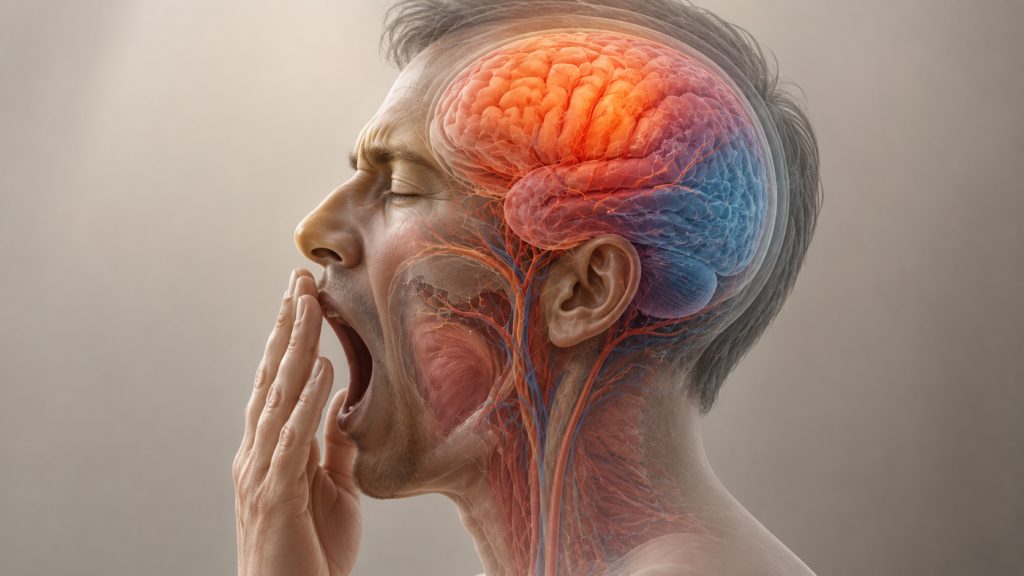
One of the most interesting explanations is the thermoregulatory theory.
The basic idea is that yawning may contribute to temperature regulation around the brain.
The large jaw movement, changes in blood flow, and inhalation during a yawn could influence heat exchange around the head.
Research has found relationships between yawning, temperature, and physiological changes. Some experiments have also reported differences in yawning behavior under different environmental temperatures.
But the evidence requires careful interpretation.
The brain-cooling explanation remains an important scientific hypothesis.
It does not explain every aspect of yawning, and researchers continue to debate how much temperature regulation contributes to the behavior.
Temperature regulation is one proposed explanation for yawning, although researchers continue to investigate its precise role. Research on yawning and thermoregulation is available through PubMed.
Why Do We Yawn Before Sleep?
If yawning is associated with alertness, why does it appear when we are preparing to sleep?
This question shows why yawning cannot be reduced to one simple purpose.
Yawning commonly occurs around major transitions in behavioral state.
You may yawn as your alertness declines before sleep.
You may also yawn as your alertness changes after waking.
Researchers have therefore proposed that yawning may be associated with changes in arousal rather than simply causing sleepiness.
The yawn may be part of the body's transition between different states.
It does not necessarily mean that the yawn itself is making you sleepy.
Why Do We Yawn When We Are Bored?
Boredom and yawning often appear together.
Sit through a long lecture.
Wait in a quiet room.
Read something repetitive.
A yawn may appear.
But boredom itself does not fully explain the reflex.
Boredom often occurs when stimulation and engagement are low. At the same time, low vigilance and changes in arousal are associated with yawning.
So boredom may create conditions in which yawning becomes more likely without being the direct biological cause.
This distinction matters.
A yawn can accompany boredom without being a dedicated “boredom reflex.”
Why Is Yawning Contagious?

This is perhaps the strangest part.
You see another person yawn.
Suddenly, you feel like yawning.
Sometimes you only need to read about yawning.
Or think about it.
And now you may feel one coming.
This is called contagious yawning.
It has been documented in humans and several other animals.
Researchers have proposed that contagious yawning may involve social and cognitive processes. Some studies have examined possible relationships with social attention, emotional processing, and empathy.
But the evidence remains complex.
The exact function of contagious yawning has not been established.
Contagious yawning may involve social and cognitive processes, but its exact function remains under investigation. A PubMed-indexed study examined the neural basis of contagious yawning.
Why Does Seeing Someone Yawn Make You Yawn?
Your brain is highly responsive to the behavior of other people.
When you see someone yawn, your visual system processes the action.
Your brain then interprets what you are seeing.
In some people, that process can trigger the same behavioral response.
But contagious yawning is not equally strong in everyone.
Some people yawn frequently when they see others yawn.
Others rarely do.
Individual differences, attention, age, and social context can influence the response.
Research has also produced mixed findings about the relationship between contagious yawning and empathy.
So if someone yawns beside you and you do not yawn, nothing is wrong with you.
The reflex varies between people.
Why Does Yawning Happen Even When We Are Not Tired?
Yawning can occur in situations that do not involve obvious sleepiness.
You might yawn before an important event.
You might yawn while preparing for exercise.
You might yawn during a change in activity.
You might even yawn when you feel highly alert.
This is another reason scientists do not consider tiredness a complete explanation.
Yawning appears to be associated with changes in behavioral state, physiological regulation, and social context.
The reflex is therefore broader than the simple message:
“You need sleep.”
Can Yawning Make You More Alert?
Some researchers have proposed that yawning may help shift the brain toward a different level of arousal.
The thermoregulatory theory also suggests that changes in temperature could influence cognitive efficiency.
But the evidence does not support a simple rule that every yawn makes you more alert.
The relationship between yawning and arousal is complicated.
Current research continues to examine several possible functions rather than treating yawning as having one confirmed purpose.
This distinction matters.
A plausible explanation is not the same as a proven explanation.
Why Do We Sometimes Yawn So Much?
Occasional yawning is normal.
You may yawn because you are tired.
You may yawn during a change in activity.
You may yawn after waking.
You may yawn simply because someone else yawned.
But unusually frequent yawning can sometimes occur alongside sleep deprivation, medication effects, or certain neurological and systemic conditions.
That does not mean frequent yawning automatically indicates a medical problem.
If you are yawning after a poor night’s sleep, tiredness provides a straightforward explanation.
Persistent or unexplained excessive yawning is different, especially when it occurs together with other unusual symptoms.
In that situation, the useful response is to consider the broader pattern rather than interpreting the yawning by itself.
What Have Scientists Actually Learned?
The biggest lesson from yawning is that a simple behavior can have a complicated biological basis.
We know that yawning is an involuntary reflex.
We know it involves coordinated activity across several brain and body systems.
We know it commonly occurs around changes in sleep and alertness.
We know it can be contagious.
We know environmental temperature can influence yawning under some conditions.
But we do not have one universally accepted explanation that accounts for every aspect of the behavior.
That uncertainty is not a weakness in science.
It is what careful research looks like when the evidence does not yet support a single final answer.
The next time you yawn, you do not need to assume that your brain is simply telling you to sleep.
The yawn may be part of a broader transition in alertness.
It may involve temperature regulation.
It may reflect your physiological state.
And when someone else yawns, your own brain may reproduce the behavior through a contagious response.
A reflex that looks almost meaningless turns out to reveal how closely the brain, body, environment, and social world interact.
Key Takeaways
- Yawning is an involuntary reflex involving coordinated brain and body activity.
- Yawning commonly occurs around sleep and waking transitions.
- The old idea that yawning simply increases oxygen is not supported by experimental evidence.
- Brain temperature regulation is an important hypothesis, but its precise role remains debated.
- Yawning is associated with changes in alertness and behavioral state.
- Seeing another person yawn can sometimes trigger contagious yawning.
- Contagious yawning may involve social and cognitive processes, but its exact function remains uncertain.
- People differ in how strongly they respond to contagious yawning.
- Occasional yawning is normal.
- Persistent unexplained excessive yawning can sometimes occur with medical conditions and deserves attention when other symptoms are present.
Conclusion
A yawn looks simple.
You open your mouth.
You breathe deeply.
You close your mouth.
And the moment passes.
But behind that brief reflex is a complex interaction between the brain, muscles, breathing, body temperature, alertness, and social behavior.
For decades, scientists have proposed different explanations for why we yawn.
Some have been weakened by experiments.
Others remain active areas of research.
The idea that yawning simply supplies extra oxygen has not survived experimental testing.
The possibility that yawning contributes to thermoregulation remains scientifically interesting, but it is not the complete answer.
The relationship between yawning, arousal, sleep, and social behavior is also still being studied.
That makes the yawn more interesting, not less.
It is a reminder that ordinary human behavior can have mechanisms far more complicated than they first appear.
And if you have started yawning while reading this article, that may be the simplest demonstration of all.
At CAVELYRA, we explore the science behind the ordinary things your body and mind do every day. From sleep and reflexes to behavior and brain function, our goal is to make complicated ideas easier to understand without oversimplifying what science actually knows.
Explore more on CAVELYRA’s Body & Health collections to understand the surprising science behind sleep, reflexes, and the everyday functions of the human body.