

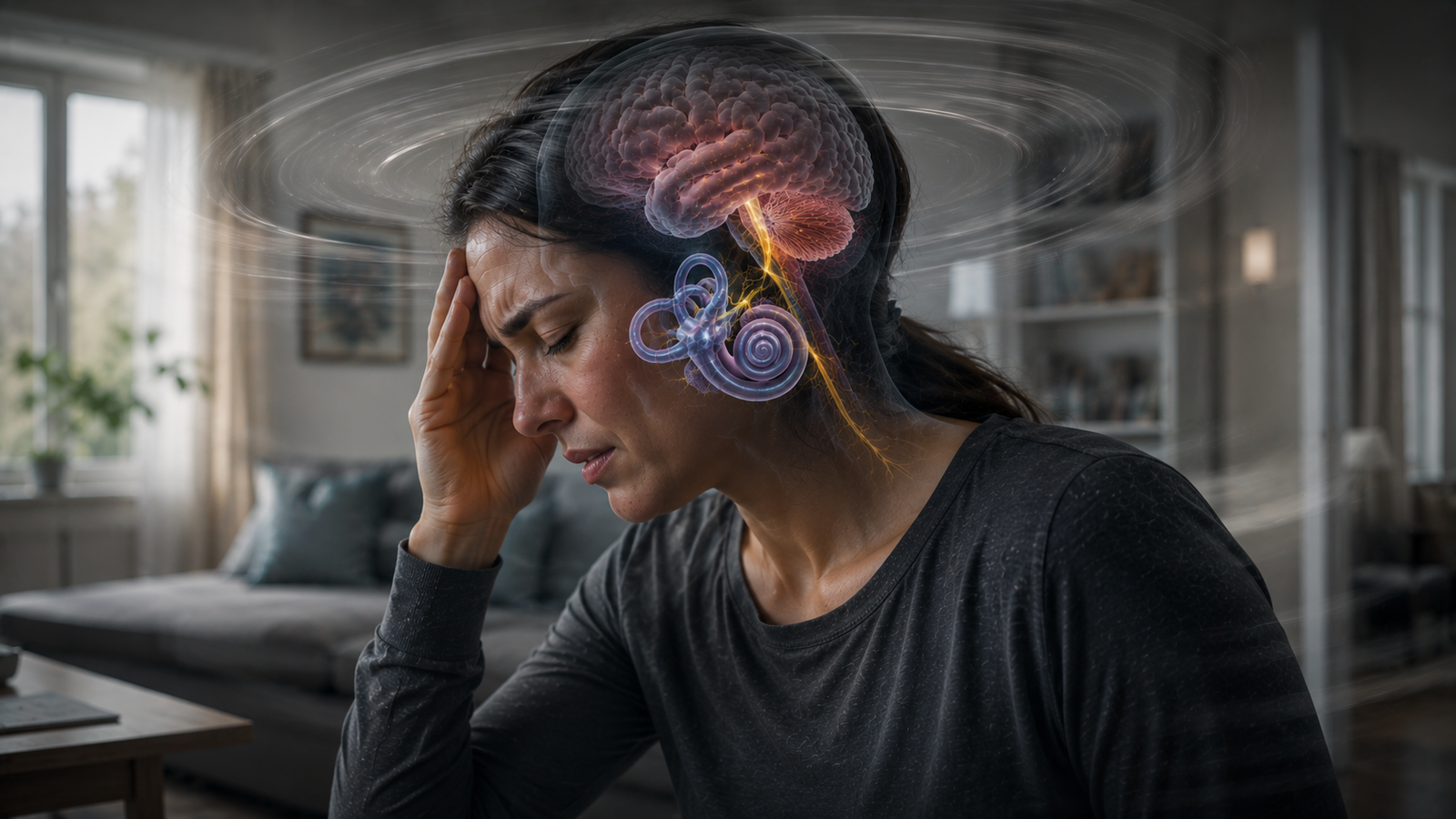
You stand up. For a moment, the world feels different. Maybe your head feels light. Maybe your body feels unsteady. Or perhaps the room seems to spin even though you know you are standing still.
You might describe all of these experiences with one word: dizzy. But your body does not treat them as the same thing.
So, why do you feel dizzy? The answer begins with how your brain combines information from several systems.
Dizziness is a broad symptom that can arise from different systems. The inner ear can be involved. So can your eyes, brain, blood pressure, circulation, muscles, joints, or nervous system. That is why understanding dizziness starts with a more basic question: how does your body know where it is in space?
Your Brain Is Constantly Calculating Balance
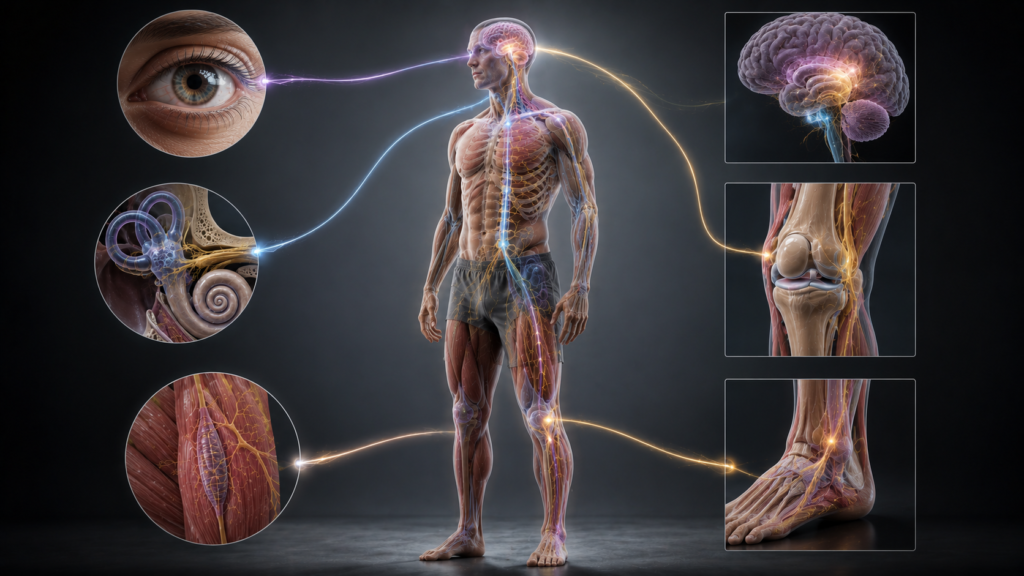
You rarely think about balance. You stand, walk, turn your head, climb stairs, and change direction without consciously calculating every movement. Your brain does that work for you. To keep you stable, it needs continuous information about where your body is, how it is moving, and which direction is up.
No single sense can provide all of that information. Your eyes monitor the environment and tell your brain whether the room, horizon, and nearby objects appear to be moving. Your inner ears detect head movement and acceleration. Your muscles, joints, tendons, and skin provide information about the position of your body — a system called proprioception.
Your brain brings these signals together and creates a working estimate of your position. The National Institute on Deafness and Other Communication Disorders describes balance as an interaction among the eyes, inner ear, and body-position signals. NIDCD balance disorders provides further background. When the information agrees, you feel stable. When something changes or the signals conflict, you may suddenly notice the system that normally operates silently in the background. You feel dizzy.
The brain combines information from vision, the vestibular system, and proprioception to maintain balance.
What Does the Inner Ear Have to Do With Balance?
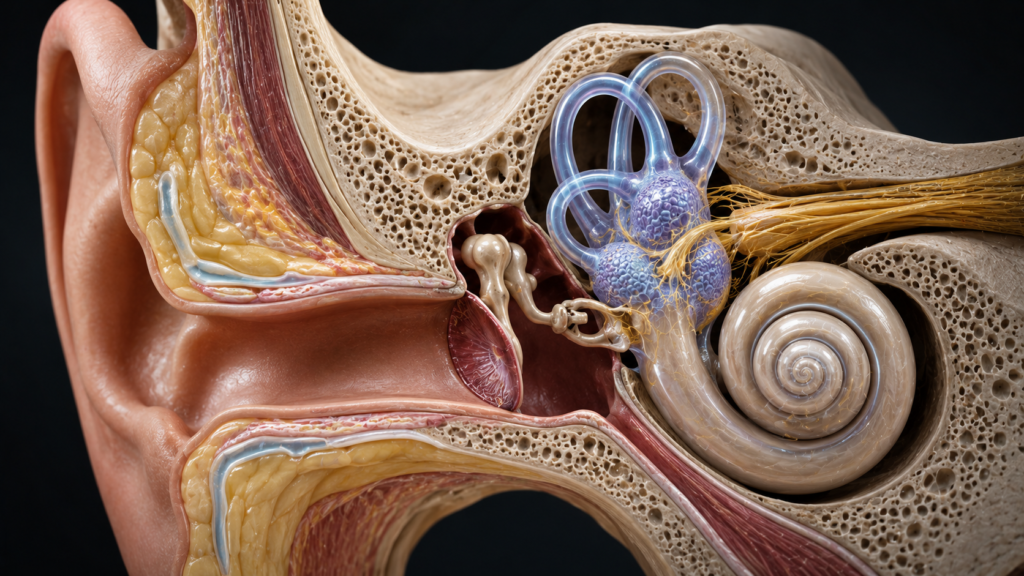
Deep inside each inner ear is the vestibular system, one of the body's major balance systems. It contains three semicircular canals, arranged in different planes, which allow it to detect rotational movements of the head. It also contains the otolith organs, which detect linear acceleration and provide information related to gravity and head position.
When you turn your head, fluid inside the semicircular canals moves relative to the surrounding structures. Sensory cells detect that movement and send signals through the vestibular nerve toward the brain, which uses those signals to determine how your head is moving. This gives the brain information that vision alone cannot provide.
Your eyes tell you what the world looks like. Your vestibular system tells your brain how your head is moving. Your proprioceptive system adds information about where the rest of your body is positioned. Together, these systems create your sense of physical stability.
The vestibular system detects head movement and contributes essential information for maintaining balance.
Why Can Conflicting Signals Make You Dizzy?
Imagine reading a book inside a moving car. Your inner ear detects acceleration, turns, and movement. Your eyes, however, are focused on a page that appears relatively stable. Your brain receives two different descriptions of what is happening, and the conflict can produce dizziness and nausea. This is the basic principle behind motion sickness.
The same idea helps explain why spinning around can leave you feeling dizzy after you stop. While you are spinning, the fluid inside your semicircular canals moves. When you suddenly stop, your body stops moving immediately, but the fluid can continue moving briefly. Your vestibular receptors continue sending signals while your eyes provide different information, so your brain temporarily receives conflicting messages about whether you are still rotating. You may feel as though you are moving even though you are standing still. Eventually, the fluid settles, the signals become consistent again, and the sensation fades.
Why Does the Room Sometimes Seem to Spin?
The sensation that you or your surroundings are moving or spinning when there is no corresponding movement is called vertigo. Vertigo can occur when the brain receives abnormal or conflicting information from the balance system.
One common example is benign paroxysmal positional vertigo, or BPPV. Inside the vestibular system are tiny calcium-containing particles, and in BPPV, some of these particles become displaced. Certain head movements can then produce abnormal signals — you may experience a brief spinning sensation when you roll over in bed, look upward, bend down, or change the position of your head.
The important point is that BPPV has a physical mechanism. The displaced particles interfere with the normal mechanical behavior of the vestibular system, and your brain receives a signal suggesting movement that does not match the other information it is receiving. The result can be sudden vertigo.
In BPPV, displaced particles within the inner ear can produce abnormal signals during specific head movements.
Why Can an Inner Ear Problem Cause Nausea and Imbalance?
Your brain normally compares information coming from the vestibular system on both sides of your head. If one side suddenly sends different information from the other, the brain can interpret the difference as movement. This can produce vertigo, imbalance, and nausea.
Some conditions affect the inner ear or vestibular nerve. Labyrinthitis involves inflammation of the labyrinth and can cause vertigo, imbalance, nausea, and sometimes hearing loss. Vestibular neuritis involves inflammation of the vestibular nerve, producing dizziness, vertigo, unsteadiness, and nausea, but typically not hearing loss, because the primary problem affects the vestibular nerve rather than the hearing structures.
These examples show why the inner ear is so important for balance. It is not simply an organ of hearing — it also provides the brain with continuous information about movement and orientation.
Why Do You Feel Dizzy When You Stand Up?
Not all dizziness comes from the balance system. Sometimes the problem involves circulation. When you stand up, gravity causes blood to shift toward the lower parts of your body. Your cardiovascular system normally responds quickly: blood vessels constrict, heart rate can adjust, and blood pressure is regulated. These changes help maintain adequate blood flow to the brain.
If the adjustment is insufficient, blood pressure can temporarily fall, and you may feel lightheaded or faint. This is different from vertigo — you are not necessarily experiencing an illusion that the room is spinning, but instead may feel as though you might lose consciousness. That distinction can provide an important clue about what is happening.
Can Dehydration Make You Dizzy?
Yes. Your circulation depends partly on adequate body fluid. If you lose substantial fluid through sweating, vomiting, diarrhea, or inadequate intake, blood volume can decrease. Under some circumstances, this can make it harder to maintain blood pressure, and you may feel weak, lightheaded, or dizzy. Dehydration can also occur alongside heat illness, which can produce additional symptoms.
Again, the mechanism is different from an inner-ear problem. The sensation may be described with the same word, but the physiological reason can be completely different.
Can Low Blood Sugar or Anemia Feel Like Dizziness?
Dizziness can also result from problems that do not directly involve the balance system. Your brain depends heavily on glucose as an energy source, and if blood glucose falls too low, the nervous system can become affected — symptoms may include weakness, sweating, shaking, confusion, and dizziness.
Anemia provides another example. Red blood cells carry oxygen through the body, and hemoglobin inside those cells binds oxygen. When anemia reduces the blood's oxygen-carrying capacity, some people experience fatigue, weakness, shortness of breath, or lightheadedness. These sensations can feel like dizziness, but they do not necessarily mean that the brain is receiving false movement signals from the vestibular system.
Why Can Anxiety Make You Feel Dizzy?
Anxiety can change your breathing. Some people begin breathing faster or more deeply, and if ventilation becomes excessive, carbon dioxide levels in the blood can fall. That change can produce lightheadedness, tingling, and other uncomfortable sensations.
The sensation can then create more fear. You feel strange. You become concerned about what is happening. Your breathing changes further, and the symptoms become more noticeable. A feedback loop can develop. This helps explain why intense anxiety or panic can sometimes produce dizziness or lightheadedness.
Why Can Dizziness Make Walking Difficult?
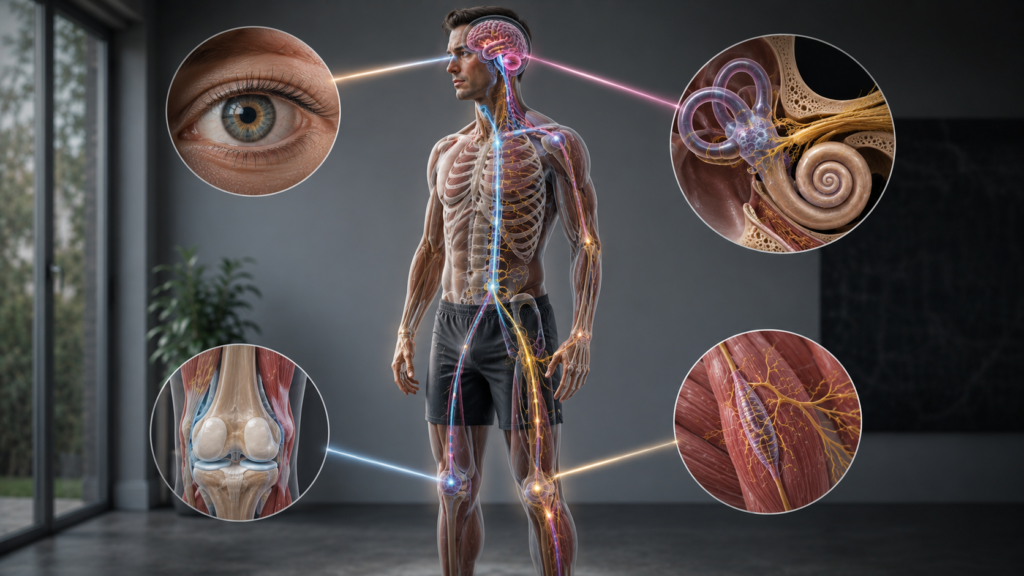
Walking requires continuous balance corrections. Your eyes monitor the environment. Your inner ears monitor head movement. Your muscles and joints report body position. Your brain combines all of this information while coordinating movement.
If one source becomes unreliable, the brain has to work harder to maintain a stable estimate of your position. You may slow down, widen your stance, or avoid turning your head quickly. These changes can help you remain stable while your brain is dealing with less reliable sensory information.
Can Your Brain Adapt to Balance Problems?
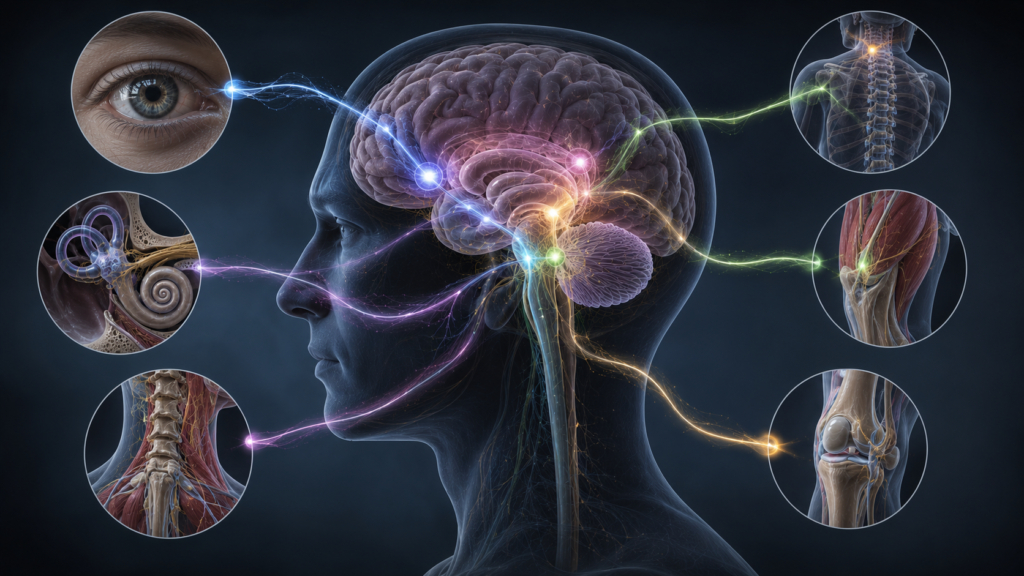
Your brain is not simply receiving balance information — it is constantly interpreting it. If vestibular information becomes unreliable, the nervous system can gradually adapt to the changed signals. Information from vision and proprioception can become more important, and movement can provide new sensory information that helps the brain adjust.
This process is one reason some people improve after vestibular problems. It also helps explain why vestibular rehabilitation can help some people with longer-lasting balance difficulties. Controlled movement gives the nervous system an opportunity to process and adapt to new sensory information, while prolonged avoidance of movement can sometimes interfere with this adaptation. The appropriate exercises depend on the underlying condition.
The brain continuously integrates information from several sensory systems to maintain stable posture and movement.
Why Does the Pattern of Dizziness Matter?
Consider two people. The first becomes dizzy for several seconds whenever they roll over in bed. The second becomes lightheaded every time they stand after sitting for a long time. Both might say, "I feel dizzy." But the pattern is different — the first is consistent with positional vertigo, while the second can suggest a blood-pressure-related problem.
This is why clinicians ask detailed questions about dizziness. What does the sensation feel like? When did it begin? How long does it last? What triggers it? Does turning the head bring it on? Does standing trigger it? Does it occur during illness? Did it begin after starting or changing a medicine? Are there other symptoms such as hearing loss, tinnitus, headache, nausea, weakness, or visual changes? The answers help narrow down which physiological systems may be involved.
When Should Dizziness Be Evaluated?
Many episodes of dizziness are not caused by dangerous disease. But persistent, recurring, or unusual dizziness deserves attention. Some combinations of symptoms require urgent medical assessment. Guidance from the NHS also highlights neurological symptoms such as trouble speaking, weakness, numbness, or vision changes as reasons for urgent evaluation. NHS guidance on dizziness. sudden dizziness accompanied by trouble speaking, new weakness or numbness, double vision, severe difficulty walking, or other neurological changes can indicate a serious problem. Severe headache, sudden hearing loss, fainting, chest pain, or significant changes in consciousness also change the situation.
If you suddenly feel dizzy, your first priority is to prevent a fall. Sit or lie down. Move slowly. Avoid driving. Avoid climbing. Avoid operating machinery until you are stable. If the dizziness keeps returning or does not resolve, medical evaluation can help identify the cause.
Key Takeaways
- 1. Dizziness is a broad symptom that can describe lightheadedness, unsteadiness, faintness, or the sensation of movement.
- 2. Vertigo specifically describes the sensation that you or your surroundings are moving or spinning when there is no corresponding movement.
- 3. Balance depends on information from the eyes, inner ears, muscles, joints, and brain.
- 4. The vestibular system detects head rotation, linear acceleration, and information related to gravity and head position.
- 5. Conflicting sensory signals can produce dizziness and motion sickness.
- 6. BPPV can cause brief episodes of positional vertigo when displaced calcium-containing particles interfere with the inner ear's balance system.
- 7. Blood-pressure changes, dehydration, low blood glucose, and anemia can cause lightheadedness that may feel like dizziness.
- 8. Anxiety can produce lightheadedness partly through changes in breathing and carbon dioxide levels.
- 9. The brain can adapt to altered balance signals, and appropriate vestibular rehabilitation can support this adaptation.
- 10. Persistent, recurring, or unusual dizziness, especially when accompanied by concerning symptoms, should be medically evaluated.
Conclusion
Dizziness is not one disease. It is a signal that something has changed in the systems involved in balance, circulation, movement, or perception. Sometimes the inner ear is responsible. Sometimes the problem involves blood pressure, dehydration, low blood glucose, anemia, anxiety, migraine, medication, or another condition.
The sensation may be spinning, faintness, or unsteadiness. The word is the same. The mechanism is not.
Your eyes watch the world. Your inner ears detect movement. Your muscles and joints report position. Your cardiovascular system helps maintain circulation. Your brain brings these signals together. When they stop agreeing, you notice. That is dizziness.
Explore more evidence-based explanations of the human body and everyday health in CAVELYRA's Body & Health collection.