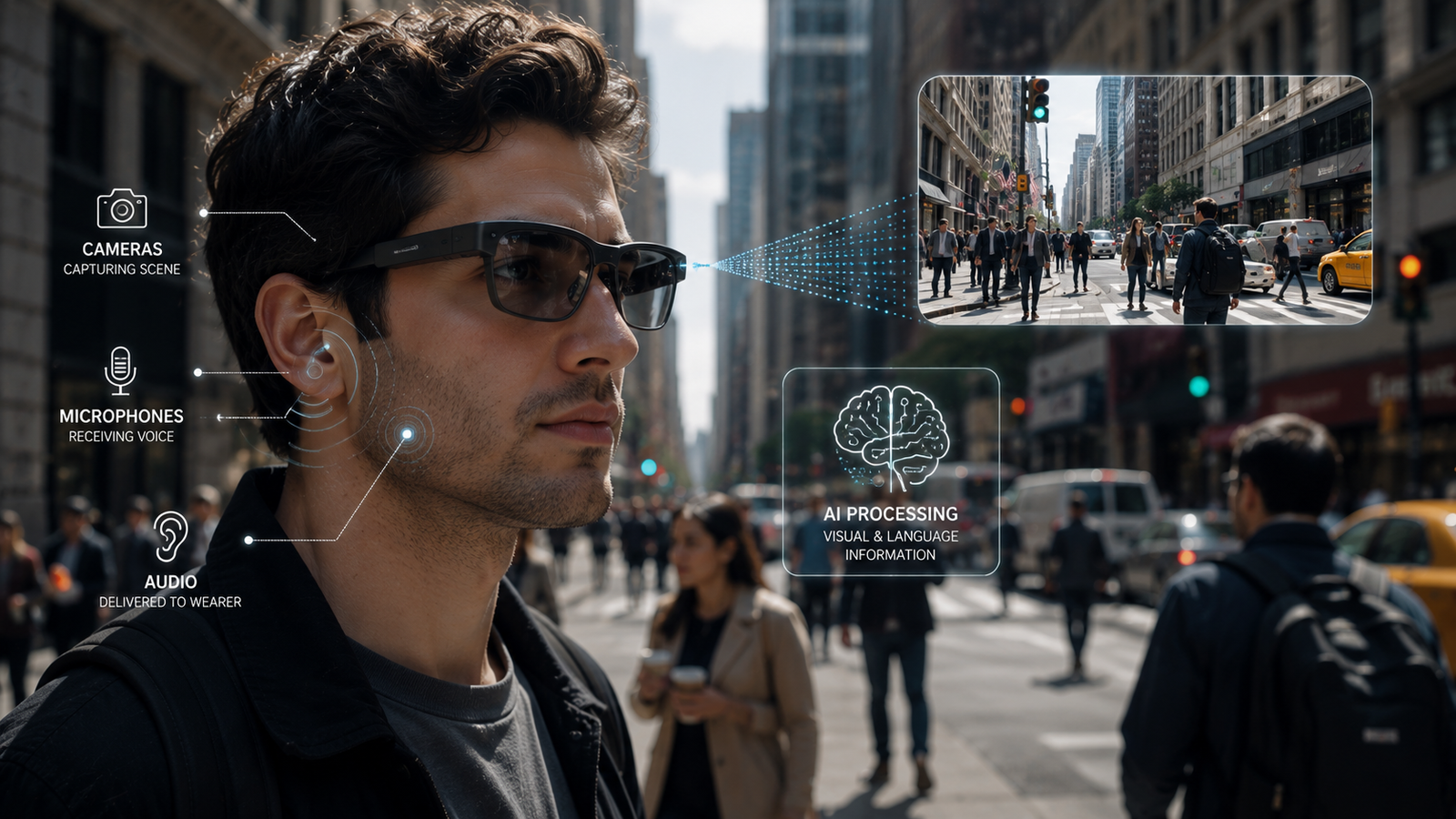
AI smart glasses can look surprisingly ordinary.
They may resemble a familiar pair of glasses, yet inside the frame they can contain cameras, microphones, speakers, processors, wireless radios, sensors, and a battery.
Together, these components create a wearable computing system.
Imagine walking through a city and seeing a restaurant sign written in another language. Instead of taking out your phone, you ask your glasses to translate it.
Or you look at a landmark and ask, "What building is that?"
The glasses can capture what you are looking at, process your question, connect the two forms of information, and deliver an answer through their speakers.
That is the basic idea behind AI smart glasses.
They bring computing closer to your eyes, ears, and immediate surroundings.
But how does all of this actually work?
Your Glasses Can Become a First-Person Computer
A smartphone sits in your hand.
AI smart glasses sit at eye level.
That difference changes how you interact with information.
A camera can capture part of the scene in front of you. Microphones can capture your voice. Speakers can provide an answer directly to your ears.
AI software connects these inputs.
Instead of stopping to look down at a screen, you can potentially ask questions while continuing to look at your surroundings.
This creates a more natural form of hands-free interaction.
The glasses do not necessarily perform every computing task themselves. A smartphone or cloud service may provide additional processing and connectivity.
The important idea is that the glasses become the interface between you and a larger computing system.
How Does an AI Smart Glasses Camera Work?
The camera is one of the most important components in many AI smart glasses.
It captures images or video.
The image sensor converts incoming light into electrical signals, which become digital information that a computer can process.
But capturing an image is only the beginning.
The system has to interpret what the image contains.
Imagine looking at a traffic sign.
The camera captures it.
Computer vision software can analyze its shapes, colors, patterns, and text. An AI model can then identify the object and help interpret what it says.
The camera itself does not understand the sign.
It provides visual data.
AI and computer vision process that data.
This distinction is important because much of the intelligence comes from what happens after the image has been captured.
How Can Smart Glasses Read Signs and Menus?
Suppose you are looking at a restaurant menu.
The camera captures the visible text.
Optical character recognition, or OCR, can convert the characters in the image into digital text.
An AI system can then process that text.
It could summarize it, answer a question about it, or translate it into another language.
The result can be delivered through the glasses' speakers.
What once required several steps with a phone can become a hands-free interaction.
The same basic process can work with street signs, labels, notices, and other visible text.
How Do the Microphones Understand You?
Smart glasses can contain multiple microphones.
Your voice is only one sound source in the environment.
Traffic, conversations, wind, construction, and other sounds can compete with your speech.
The microphone system captures these acoustic signals.
Software then processes them to identify the relevant speech.
Suppose you say, "Take a picture."
Speech recognition converts your voice into machine-readable information.
The AI system interprets the request.
The camera captures the image.
The glasses can then provide an audio confirmation.
Several technologies can therefore participate in one simple interaction.
Speech recognition handles your voice.
AI interprets the request.
The camera performs the visual task.
The speakers communicate the result.
What Is Multimodal AI?
![PLACEHOLDER IMAGE: multimodal-ai-smart-glasses-vision-language.png]
This is where AI smart glasses become particularly interesting.
A traditional voice assistant mainly receives your words.
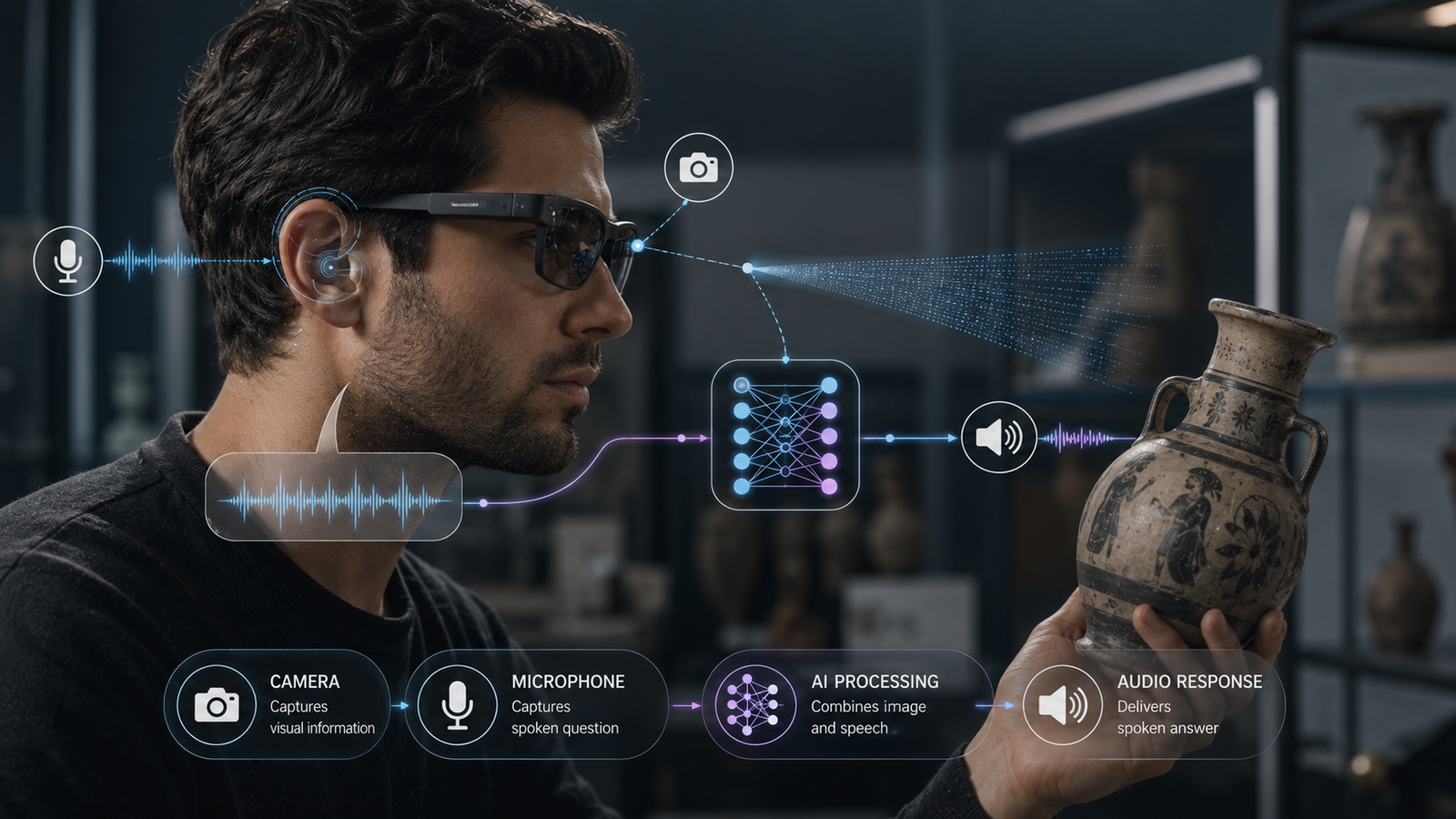
A multimodal AI system can combine different types of information, such as language, images, audio, and sensor information.
Imagine you look at a bicycle and ask:
"How much does this usually cost?"
The word "this" does not identify anything by itself.
The camera provides the missing visual context.
Your voice provides the question.
The AI combines both.
It can then attempt to determine what object you are referring to and respond to your question.
This ability to connect language with visual context is one of the important capabilities behind AI-powered eyewear.
How Does Object Recognition Work?
Imagine the camera captures a busy street.
There may be cars, people, bicycles, buildings, signs, and trees in the image.
Computer vision models can identify some of these objects and estimate where they appear within the scene.
This is related to object detection.
The detected objects can support other functions.
The system might recognize a landmark, identify a vehicle, describe part of a scene, or answer a visual question.
For example:
"What color is that car?"
The system needs to identify the car, determine its color, and connect that information to your question.
That requires both visual understanding and language understanding.
How Can AI Glasses Help With Navigation?
Imagine walking through an unfamiliar city.
Instead of repeatedly looking down at your phone, you could ask for directions through your glasses.
A navigation system determines the route.
Location services help establish where you are.
Map data provides information about the surrounding area.
The AI assistant can communicate the instruction.
"Turn left at the next intersection."
The instruction reaches you through the speakers.
The glasses therefore act as the interface while other systems can provide location, maps, and route computation.
This is an important principle of wearable technology.
The glasses do not have to contain every capability themselves.
Why Do Smart Glasses Connect to Smartphones?
A smartphone already contains powerful hardware.
It may have a processor, GNSS positioning, cellular connectivity, Wi-Fi, Bluetooth, cameras, microphones, and a comparatively large battery.
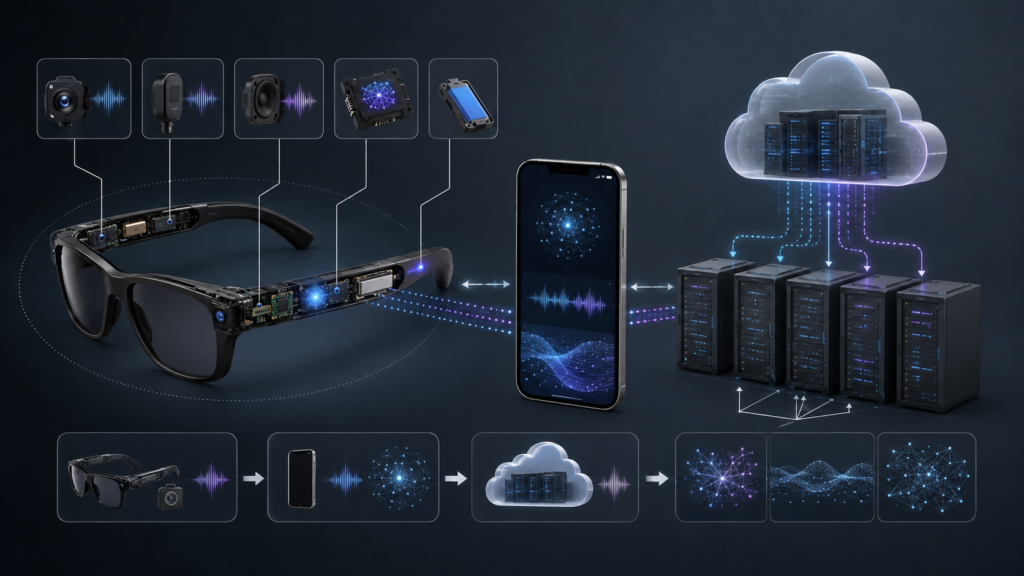
Smart glasses can therefore work as a companion device.
The glasses collect information.
The smartphone can provide connectivity or additional processing.
Cloud services can provide more computing power.
The result is a distributed system in which different devices perform different tasks.
Bluetooth can connect the glasses to the phone and transfer audio, commands, and other information.
This approach also helps keep the glasses smaller and lighter.
What Is Cloud AI?
Large AI models can require substantial computing resources.
A small wearable device cannot necessarily run the largest models locally.
Cloud computing provides access to powerful remote processors.
Selected information can be sent to a remote AI service.
The server processes the request.
The result returns to the device ecosystem.
The glasses then deliver the response.
This architecture can provide more sophisticated AI capabilities than the wearable might be able to support by itself.
But there is a tradeoff.
Information has to travel across a network.
That can introduce latency.
For some tasks, the delay is acceptable.
For other tasks, local processing can be more useful.
What Is On-Device AI?
![PLACEHOLDER IMAGE: ai-smart-glasses-device-cloud-processing.png]
Some AI functions can run directly on the glasses.
This is called on-device or edge processing.
Local processing can reduce latency and may allow some information to remain on the device rather than being transmitted elsewhere.
But wearable hardware has strict limits.
There is little physical space.
The battery is small.
Heat must be controlled.
Computing power is limited.
AI models therefore need to be optimized for wearable hardware.
Some processors also contain specialized AI hardware designed to accelerate particular neural-network calculations efficiently.
For smart glasses, every computational decision has consequences for battery life, heat, size, and weight.
Why Is Battery Life Such a Difficult Problem?
A pair of glasses has very little room for a battery.
At the same time, the system may need to power:
Cameras
Microphones
Speakers
Processors
Wireless communication
Sensors
Displays in some designs
More computing requires more energy.
More sensors require more energy.
Displays can require additional energy.
Designers therefore have to balance performance with battery life.
This is one of the fundamental engineering challenges of wearable AI.
Heat creates another problem.
Electronic components consume power, and power consumption produces heat.
Because the glasses sit directly on your face, excessive heat would be uncomfortable.
The system therefore has to balance performance, battery life, weight, size, and temperature.
Why Do Many AI Glasses Focus on Audio?
Audio can provide information without requiring a display.
The glasses can remain closer to the appearance and size of conventional eyewear while delivering information through small speakers near the ears.
You can potentially hear the AI response while remaining aware of the surrounding environment.
This makes audio-based glasses particularly useful for hands-free interaction.
But audio also creates a privacy issue.
Someone nearby may hear what the glasses are saying.
The technology therefore has to balance usefulness with privacy.
Can AI Smart Glasses See Everything You See?
No.
The camera has its own field of view.
Its position on the frame also matters.
You may be looking toward something that the camera does not capture.
To place an object within the camera's view, you may need to turn your head.
This means the AI does not automatically have access to everything within your visual field.
It can process only the information its sensors actually capture.
That limitation is easy to overlook when the glasses appear to understand their surroundings.
What About Privacy?
![PLACEHOLDER IMAGE: ai-smart-glasses-privacy-consent.png]
AI smart glasses create an unusual privacy situation.
A smartphone camera is usually visible when someone holds the phone up to record.
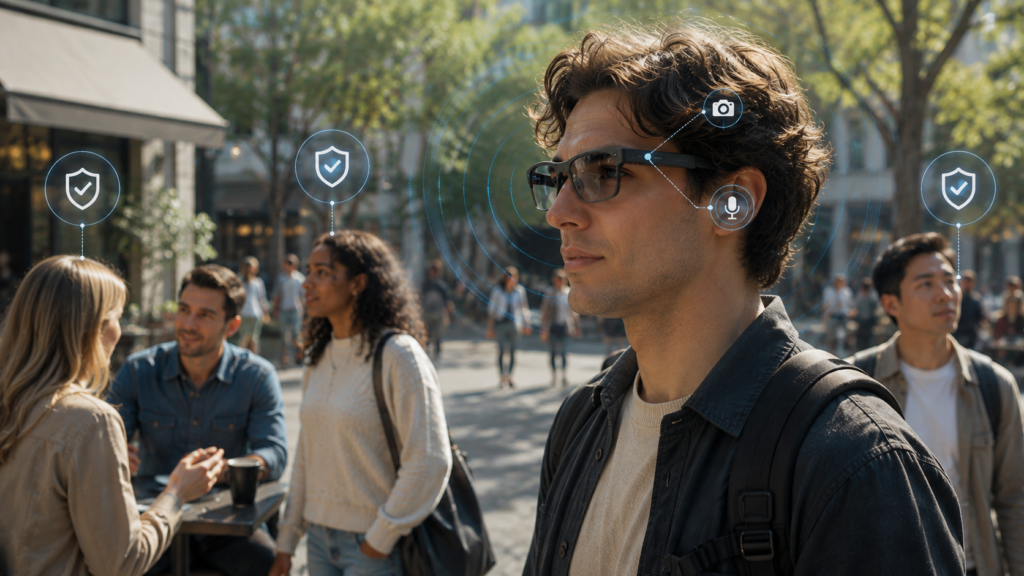
A camera integrated into ordinary-looking glasses can be less obvious.
That raises questions about consent.
People may want to know when they are being recorded.
There is also the question of where captured information goes.
Suppose the glasses capture someone's face.
The information could potentially be processed locally.
Or it could be sent to a remote service.
These approaches have different privacy implications.
The same camera that helps you identify a sign can capture another person's face.
The same microphone that recognizes your voice can capture background conversations.
As wearable AI becomes more capable, privacy controls, recording indicators, security, consent, and data handling become increasingly important.
How Does Live Translation Work?
Imagine speaking with someone who uses another language.
The microphone captures speech.
Speech recognition converts the audio into machine-readable information.
A translation system converts the content into another language.
Speech synthesis can then generate the translated response.
The glasses play the result through their speakers.
A similar process can work with written language.
The camera captures a sign or menu.
OCR extracts the text.
An AI or translation system processes it.
The translated result is delivered through audio.
Several different systems can therefore work together to create what feels like one simple conversation.
Can AI Glasses Improve Accessibility?
Potentially.
Because they provide hands-free access to information, smart glasses can support certain accessibility needs.
They can potentially describe aspects of a scene, read signs, recognize objects, provide navigation assistance, or translate information.
The usefulness depends on the capabilities and limitations of the particular system.
The broader idea is important.
Wearable AI can place information closer to the user without requiring a conventional screen.
Are AI Glasses the Same as AR Glasses?
No.
AI smart glasses can provide cameras, microphones, speakers, connectivity, and AI assistance without placing digital images directly into your field of view.
Augmented reality glasses add visual information through displays.
Some products can combine both approaches.
Others focus mainly on audio and AI.
Display-equipped glasses also introduce additional engineering challenges.
The display has to be compact, bright enough, power efficient, and properly aligned with your eyes.
Optical systems are needed to deliver the image into your field of view.
That makes display-based eyewear more complex than simply adding a small screen to a pair of glasses.
Why Does Context Matter So Much?
Context can make a wearable AI system more useful.
The system may have information about what the camera sees, what you asked, where you are, the time, and which application you are using.
It can combine these signals to produce a more relevant response.
But more context can also mean more data.
That creates a direct relationship between capability and privacy.
The more information a system can access, the more useful it may become in some situations, but the more carefully that information needs to be managed.
What Happens When AI Gets Something Wrong?
AI smart glasses can make mistakes.
An assistant may misunderstand your question.
It may misidentify an object.
It may produce an incorrect answer.
Generative AI can sometimes produce information that sounds convincing while being wrong.
This matters because wearable AI operates in the physical world.
An incorrect description of a restaurant may be inconvenient.
An incorrect navigation instruction can create a more serious problem.
AI output therefore still requires appropriate judgment and verification, especially when the information affects important decisions.
What Makes AI Smart Glasses Difficult to Build?
The engineering challenge is not simply creating a capable AI model.
All of the necessary hardware has to fit inside a small, comfortable frame.
The glasses may need cameras, microphones, speakers, batteries, antennas, processors, sensors, and sometimes displays.
Every component competes for limited space.
Power consumption affects battery life.
Computing affects heat.
Hardware affects weight.
Wireless communication affects energy use.
Displays require additional optics.
AI capability has to be balanced against all of these physical constraints.
This is why building useful AI glasses is fundamentally a hardware and software integration problem.
How Does a Complete AI Glasses Interaction Work?
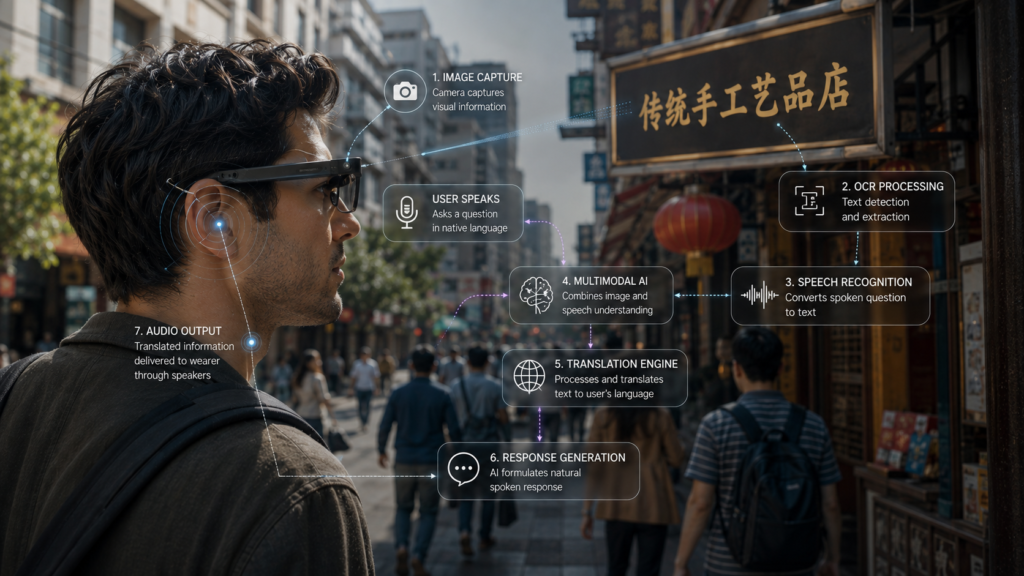
![PLACEHOLDER IMAGE: ai-smart-glasses-complete-processing-system.png]
Imagine you see a sign written in another language and ask your glasses to translate it.
The camera captures the sign.
Computer vision identifies the relevant text.
OCR converts the characters into digital information.
Your microphone captures your spoken request.
Speech recognition processes your words.
The AI connects your question with the visual information.
The translation system converts the text.
Speech synthesis produces the translated result.
The speakers deliver the answer.
Behind what feels like a simple conversation is a chain of separate technologies working together.
That is the real architecture of AI smart glasses.
The Future of AI Smart Glasses
AI smart glasses are part of a broader shift in computing.
The smartphone placed computing in your hand.
Wearable AI can place computing closer to your senses and your physical surroundings.
Future systems may become better at multimodal understanding, spatial awareness, translation, navigation, and context-aware assistance.
Hardware will also continue to become smaller and more efficient.
But fundamental constraints will remain.
Battery capacity.
Heat.
Weight.
Processing power.
Connectivity.
Optics.
Privacy.
AI reliability.
The future of AI glasses will depend on how well engineers solve these problems together.
The most important change may therefore be less about the glasses themselves and more about the interface they create between the physical world and artificial intelligence.
Related Reading
Key Takeaways
- 1. AI smart glasses combine cameras, microphones, speakers, processors, sensors, connectivity, and artificial intelligence.
- 2. Cameras capture visual information that computer vision and AI can interpret.
- 3. Microphones allow the glasses to recognize spoken commands.
- 4. Multimodal AI can combine language with visual information and other inputs.
- 5. Smart glasses can work with smartphones and cloud services instead of performing every task locally.
- 6. On-device AI can reduce latency and keep some processing local.
- 7. Battery life, heat, weight, and computing power are major wearable hardware constraints.
- 8. AI glasses can support hands-free translation, navigation, object recognition, photography, and accessibility-related functions.
- 9. AI glasses are not necessarily the same as augmented reality glasses. AR requires additional display and optical technology.
- 10. Cameras and microphones create important privacy and consent considerations.
- 11. AI systems can make mistakes, so important outputs still require appropriate human judgment.
- 12. The central idea behind AI glasses is the integration of physical-world sensing with artificial intelligence in a wearable interface.
Conclusion
AI smart glasses may look like ordinary eyewear, but their operation involves a surprisingly complex chain of technology.
Cameras capture the physical world.
Microphones capture speech.
Computer vision interprets images.
Speech recognition interprets voice.
Multimodal AI can connect what you say with what you are looking at.
Smartphones and cloud services can provide additional computing and connectivity.
Speakers return the result to you as sound.
All of this happens through a device small enough to sit on your face.
That creates a new way to interact with information.
Instead of reaching for a screen, you can look at something and ask about it.
You can read a sign.
Translate a language.
Ask for directions.
Identify an object.
Take a photograph.
Receive information while continuing to interact with the world around you.
But the technology has limits.
Battery life, heat, weight, processing power, AI reliability, connectivity, privacy, and social acceptance all affect how useful these devices can become.
The future of AI smart glasses will depend on solving those problems while making the technology feel natural.
The deeper change is already clear.
Computing is moving closer to the way humans experience the world.
Your eyes provide the visual context.
Your voice provides the question.
AI connects the two.
That is what makes smart glasses an important new form of wearable computing.
Explore more evidence-based explanations of technology and how modern systems work in CAVELYRA's Science Explained collection.