
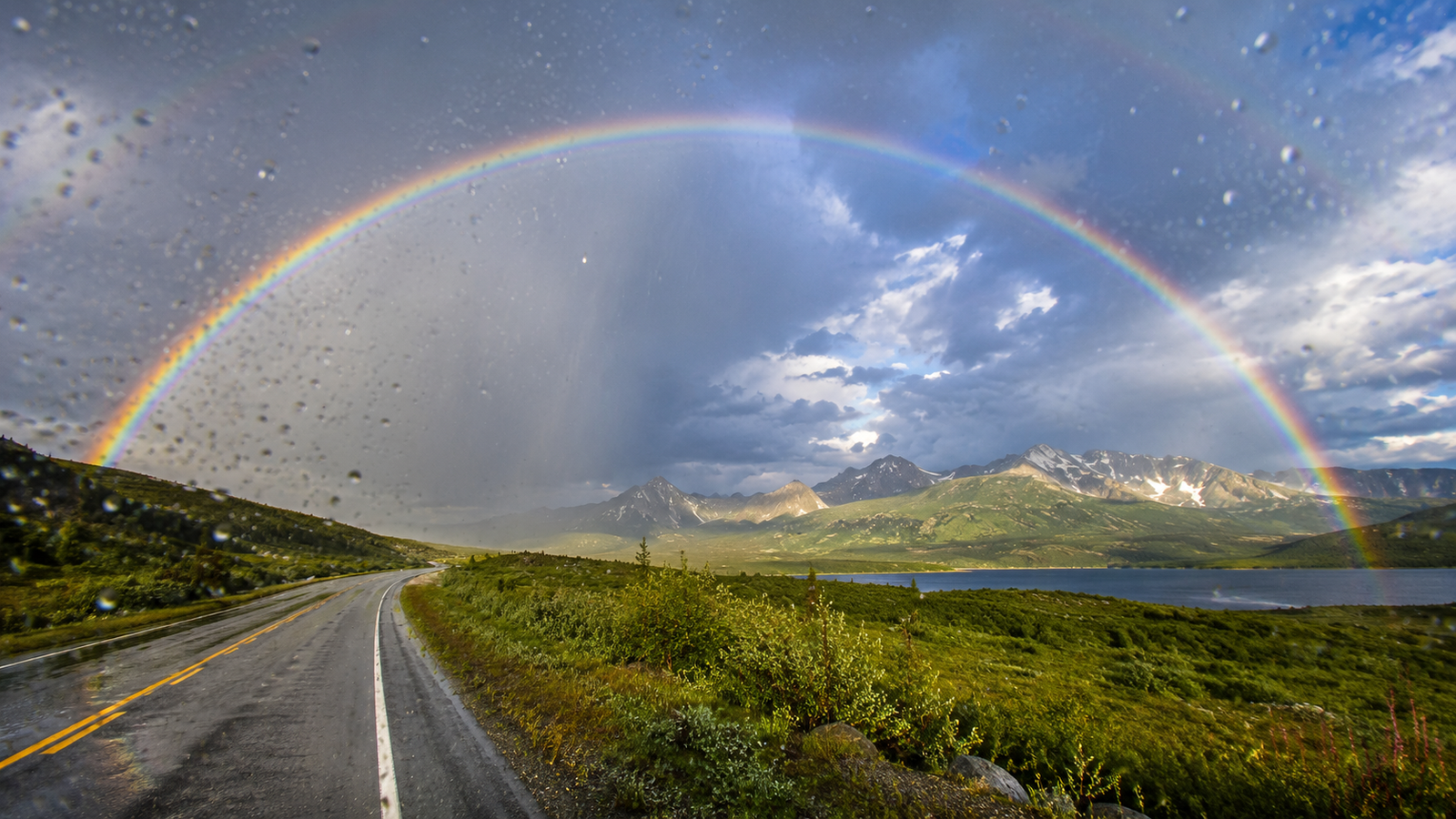
You look toward the sky after a rain shower. The clouds begin to break, sunlight appears, and then a band of red, orange, yellow, green, blue, and violet stretches across the sky.
Quick Answers
- Short answer: A rainbow forms when sunlight enters raindrops, is refracted, reflected once inside, and refracted again as it leaves. Each color exits at a slightly different angle, so white light is spread into a spectrum.
- Where to look: Opposite the Sun, about 42 degrees from the antisolar point (the shadow of your head), with red on the outside. The Sun must be fairly low in the sky. [1][2]
- Why there is no end: A rainbow is an optical pattern that depends on your position, not an object at a fixed place.
A rainbow can look like a giant object floating in the distance. But there is no physical arc hanging in the sky. A rainbow is an optical phenomenon created when sunlight interacts with water droplets in the atmosphere. As sunlight enters a droplet, it is refracted, reflected inside the droplet, and refracted again as it leaves, and at the same time different wavelengths of visible light bend by slightly different amounts. This separates the sunlight into its familiar range of colors. [1]
The remarkable part is that a single raindrop does not create the entire rainbow you see. Millions of droplets can contribute light toward your eyes, with different droplets sending different colors in the correct directions. That is how an invisible interaction between sunlight and falling water becomes one of the most recognizable sights in nature.
What Is a Rainbow?
A rainbow is a visible spectrum of sunlight produced by water droplets. Sunlight may look white to your eyes, but white sunlight contains a continuous range of visible wavelengths, and when those wavelengths interact with water they do not all behave in exactly the same way. Water droplets therefore act somewhat like tiny natural prisms, separating visible light into colors.
But the rainbow is not an object with a fixed location. It is an optical pattern created by the particular arrangement of the Sun, water droplets, and your eyes. Move, and the rainbow moves with you.
What Happens When Sunlight Enters a Raindrop?
The process begins when sunlight reaches a water droplet. As light passes from air into water, its speed changes, and the change in speed causes the light to bend. This bending is called refraction.
But the light does not simply bend once and leave. Inside the droplet, some of the light reaches the far side of the curved water surface and is reflected back toward the inside of the droplet. The reflected light then travels toward the opposite side, and when it leaves the droplet, it is refracted again. The basic sequence is:
- Sunlight enters the droplet and is refracted.
- The light is reflected inside the droplet.
- The light is refracted again as it exits.
This combination produces the geometry needed for a primary rainbow: refraction, one internal reflection, and a second refraction as light exits the droplet. [1]
Why Does White Sunlight Separate Into Colors?
This is the key to understanding the rainbow. Different colors of visible light have different wavelengths, and when light enters water, different wavelengths are refracted by slightly different amounts. Shorter wavelengths, such as violet, bend more than longer wavelengths, such as red, so the colors begin to separate as the sunlight travels through the droplet. This process is called dispersion.
A prism does something similar. When white light passes through a glass prism, its different wavelengths separate and form a spectrum, and a raindrop performs a natural version of the same optical process. The difference is that a raindrop also has a curved surface and an internal reflection, which creates the characteristic geometry of a rainbow.
Why Is Red on the Outside?
The colors do not leave the raindrop at exactly the same angle. For a primary rainbow, the light from the most concentrated region of the rainbow reaches you from about 42 degrees away from the antisolar point, the direction opposite the Sun. Red light appears at roughly 42 degrees and violet light at roughly 40 degrees, which is why red appears on the outer edge of the primary rainbow and violet on the inner edge. [2]
The exact appearance can vary because a rainbow is made from a continuous spectrum rather than seven sharply separated bands. The familiar seven-color sequence is a useful way to describe what we see, but the actual spectrum contains continuously changing wavelengths.
Why Does a Rainbow Form Opposite the Sun?
Look at the direction of the rainbow, then turn around and look for the Sun. The rainbow will be on the opposite side of the sky. This happens because the light reaching your eyes has traveled through the droplets in a specific geometry: for a primary rainbow, the Sun must be behind you while the rain or water droplets are in front of you. That is why rainbows often appear when a rain shower is in front of you and sunlight is coming from behind. The Sun, the water droplets, and your viewing position must line up correctly.
Why Is the Rainbow Curved?
The curved shape comes from the geometry of the droplets. A single spherical water droplet can send rainbow light toward your eyes from a particular range of angles, but droplets are distributed throughout a large region of the sky. Together, they create a circular pattern centered around the antisolar point. From the ground, the horizon usually blocks the lower part of that circle, so what you see is an arc. The lower the Sun is in the sky, the more of the circular rainbow can become visible.
From a high enough viewpoint, such as an aircraft, observers can sometimes see much more of the circle. The complete geometric pattern is circular, and the visible rainbow is usually an arc only because the ground blocks part of it.
Why Can’t You Find the End of a Rainbow?
You cannot reach the end of a rainbow because it has no fixed physical endpoint. The rainbow you see depends on your position: if you move, the angle between the Sun, water droplets, and your eyes changes, and a different collection of droplets sends rainbow light toward you. Two people standing several meters apart are therefore not seeing exactly the same optical rays, and each receives light from droplets that are correctly positioned for their own line of sight.
This is why the familiar idea of finding a place where the rainbow touches the ground is misleading. There is no physical band of color sitting on the landscape. There is an optical pattern created relative to the observer, which is also why moving a short distance can change the rainbow’s apparent position.
Why Do We Sometimes See a Double Rainbow?
Sometimes a second rainbow appears outside the primary rainbow. This is called a secondary rainbow, and it forms when sunlight undergoes two internal reflections inside a water droplet instead of one. The extra reflection changes the path taken by the light and also reverses the order of the colors. In the primary rainbow, red is on the outside and violet is on the inside, while in the secondary rainbow the order is reversed. The secondary bow also sits farther out, at roughly 50 degrees from the antisolar point, and it is usually fainter because less light follows the two-reflection pathway. [3]
Why Is the Sky Between Two Rainbows Sometimes Darker?
When a primary and secondary rainbow appear together, the region between them can look noticeably darker. This region is known as Alexander’s band. It occurs because the geometry of the light paths sends relatively little rainbow light toward the observer between the two arcs. The effect is not a physical dark band in the atmosphere. It is part of the optical pattern produced by the way light reaches the observer.
Can You See a Rainbow Without Rain?
Yes. You do not necessarily need a rainstorm, because any collection of suitably sized water droplets can produce rainbow colors under the right lighting geometry. Water spray from a fountain, waterfall mist, a garden sprinkler, or even a fine spray from a hose can create a rainbow. The essential ingredients are light, water droplets, and the correct viewing geometry, which is why you can sometimes create a small rainbow yourself with a garden hose on a sunny day.
Why Are Some Rainbows Brighter Than Others?
Rainbow brightness depends on several factors: the amount and distribution of water droplets, the intensity and direction of sunlight, the size and shape of the droplets, and your position relative to the Sun and the droplets. A dense region of appropriately positioned droplets can send more rainbow light toward your eyes, while a thinner or poorly aligned collection may produce a faint rainbow. This is why one rainbow can appear vivid and sharply colored while another looks pale.
Why Does the Sun Need to Be Low in the Sky?
For a primary rainbow, the relevant light reaches the observer at an angle of roughly 42 degrees from the direction opposite the Sun. If the Sun is too high above the horizon, the geometry places the rainbow below the horizon from a ground observer’s perspective, which is why primary rainbows are not seen around midday at most latitudes. [3] Rainbows are therefore often easier to see during the morning or late afternoon, when the Sun is lower in the sky, and when the Sun is very low, a larger portion of the circular rainbow can appear above the horizon.
Are All Colorful Arcs Rainbows?
No. Several atmospheric optical phenomena can look similar to rainbows but form through different physical mechanisms. For example, glories can appear as colorful circular patterns around the antisolar point, but they are produced by backward diffraction rather than the refraction and internal reflection responsible for ordinary rainbows. Ice crystals can also create colorful arcs and halos in the sky. These are not ordinary rainbows because they involve different optical structures, and similar colors do not necessarily mean the same physical process.
The Simple Physics Behind a Beautiful Rainbow
A rainbow looks mysterious because it appears to float across the sky, but the physics is precise. Sunlight enters water droplets, the light bends, and its wavelengths separate. The light reflects inside the droplets and bends again as it leaves. Some of those rays reach your eyes at the right angle, millions of droplets repeat the process, and your brain interprets the resulting spectrum as a curved band of color.
Nothing is painted across the sky and nothing is physically suspended above the landscape. The rainbow is created by light following predictable rules, and because those rules depend on your position, the rainbow you see belongs to your viewpoint.
What Can You Do to See a Rainbow?
You do not need special equipment. Look for a combination of sunlight and water droplets: the simplest setup is sunlight behind you and rain or spray in front of you, with the Sun relatively low in the sky. Waterfalls, sprinklers, fountains, and the edges of rain showers can all provide suitable droplets. If you cannot see a rainbow, change your position rather than simply looking harder, and move until the sunlight, water droplets, and your eyes form the right arrangement.
Key Takeaways
- A rainbow is an optical phenomenon produced by sunlight and water droplets, not a physical object.
- Light is refracted when it enters a droplet, internally reflected, and refracted again as it leaves, and different wavelengths bend by different amounts, producing dispersion.
- Red appears on the outside of a primary rainbow and violet on the inside, about 42 degrees from the antisolar point.
- The rainbow appears opposite the Sun, and the Sun must be fairly low in the sky.
- The complete geometric pattern is circular, although the ground usually hides part of it.
- A secondary rainbow forms after two internal reflections and has reversed color order.
- Rainbows can form from mist, spray, fountains, and waterfalls as well as rain.
- A rainbow has no physical endpoint because its appearance depends on the observer’s position.
Conclusion
A rainbow is one of nature’s clearest demonstrations of how light behaves. Sunlight enters a water droplet, bends, and separates into colors, reflects inside the droplet, and bends again as it exits. When the geometry is right, those rays reach your eyes from millions of droplets and form the familiar arc. The colors are already present in sunlight, and the water droplets simply separate them and redirect them into your field of view.
That is why a rainbow can appear after an ordinary rain shower and disappear a few minutes later: the water may still be there and the sunlight may still be there, but the geometry has changed. The rainbow does not exist as a physical object in the sky. It exists as an optical relationship between light, water, and the observer, which is why you cannot walk to its end and why moving a few steps can change what you see. The next time a rainbow appears after rain, you are watching the physics of light unfold across the sky.
Explore more evidence-based explanations of science, Earth, and the natural world in CAVELYRA’s Science Explained collection.
References
- National Weather Service, Flagstaff. “Rainbow.” weather.gov
- American Meteorological Society. “Primary rainbow.” Glossary of Meteorology. glossary.ametsoc.org
- Nave R. “Secondary Rainbow” and “Primary Rainbow.” HyperPhysics, Georgia State University. hyperphysics.gsu.edu