

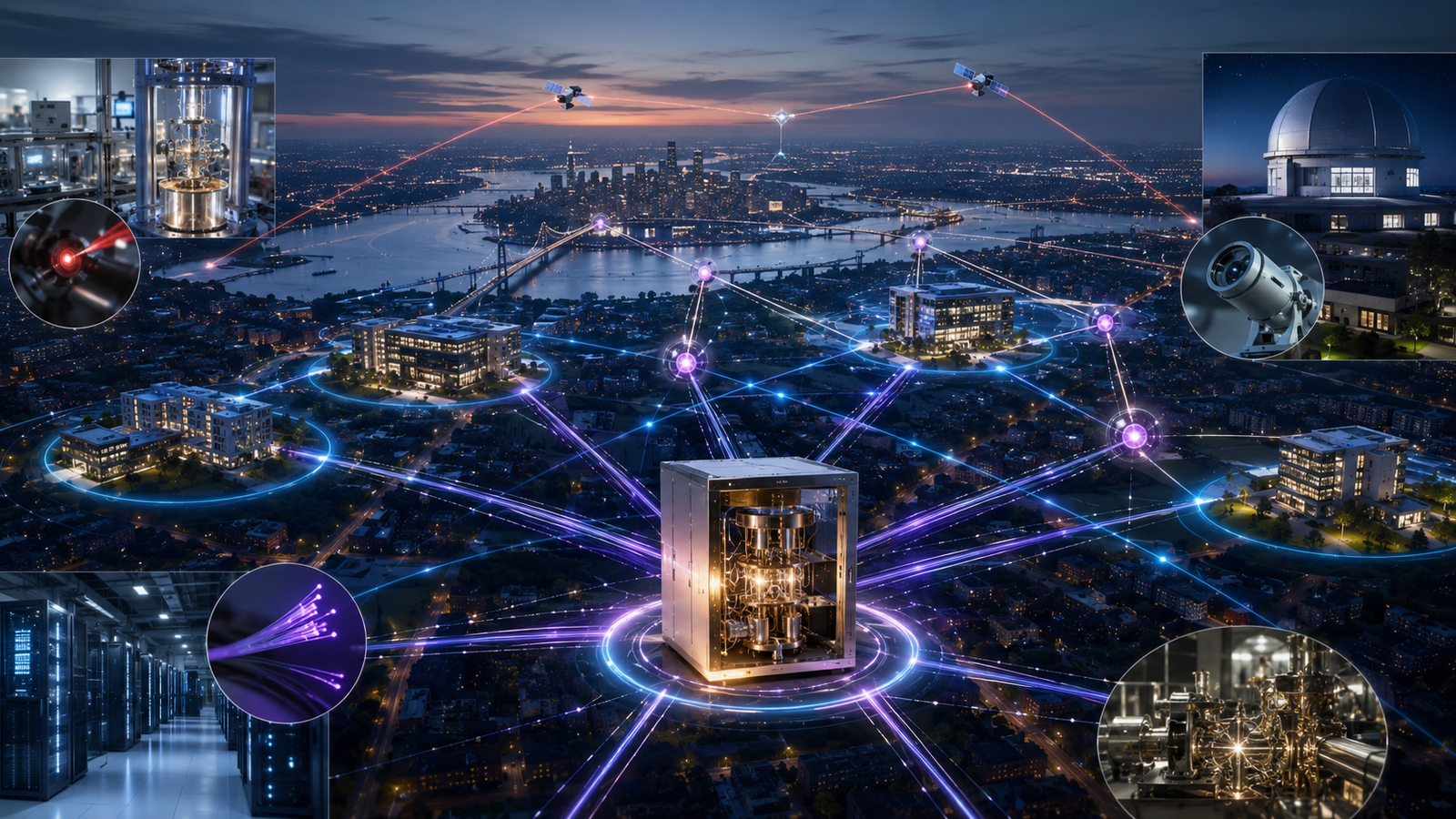
Imagine an internet where the connected devices are not only ordinary computers. Quantum computers could share quantum information across cities, quantum sensors could work together as distributed measurement systems, and communication systems could use quantum states as part of their security architecture.
Quick Answers
- Short answer: A quantum internet would be a network that distributes quantum information and entanglement between quantum devices, using photons, quantum memories, repeaters, and a classical control network. [1]
- What it would not do: It would not replace today’s internet, make websites load faster, or allow faster-than-light communication.
- Where things stand: Experimental networks exist, including a 2026 field trial that teleported quantum states over 30 km of commercial fiber in Berlin, but a global quantum internet is still a research goal. [5]
Instead of networking only ordinary digital information, such a network could distribute entanglement, one of the most important resources in quantum communication. This is the idea behind the quantum internet. But a quantum internet would not simply be a faster version of today’s internet. Today’s internet is designed primarily to move classical information, while a quantum internet would allow quantum information to be distributed between distant quantum devices. That difference changes almost everything about the network.
The technology is still being developed. Researchers are working on quantum links, repeaters, memories, switches, routers, entanglement distribution, error correction, and the classical control systems needed to make these components work together. NIST’s quantum networking research describes these building blocks and the challenges involved. So what would such a network actually look like?
What Is the Quantum Internet?
The simplest definition is a network designed to distribute quantum information between quantum devices. Those devices could include quantum computers, quantum sensors, quantum key distribution systems, and other quantum communication equipment. The network could use photons traveling through optical fibers or through free space, and it could also require quantum memories, repeaters, switches, routers, and systems capable of distributing entanglement. [1]
The quantum internet would therefore operate alongside today’s internet rather than replace it. Classical networks would still handle ordinary digital communication, network management, synchronization, routing information, measurement results, and other control functions, so the future system would likely be hybrid, with classical networking coordinating the quantum network. To understand why that architecture is necessary, it helps to start with the basic unit of quantum information.
What Is a Qubit?
A classical bit has a value of zero or one. A qubit follows the rules of quantum mechanics: before measurement, it can exist in a superposition of basis states, and qubits can also become entangled. These properties create possibilities that do not exist in conventional classical networking, and they also create unusual engineering problems.
A classical computer can copy digital information, but an unknown quantum state cannot be perfectly copied. This principle is known as the no-cloning principle, and it has major consequences for quantum communication. A classical network can copy and regenerate information when a signal becomes degraded, but a quantum network cannot simply take an unknown quantum state, make a perfect duplicate, and use that duplicate to replace the original. This is one of the reasons building a quantum network is fundamentally different from extending a conventional data network.
Why Is Quantum Entanglement Important?
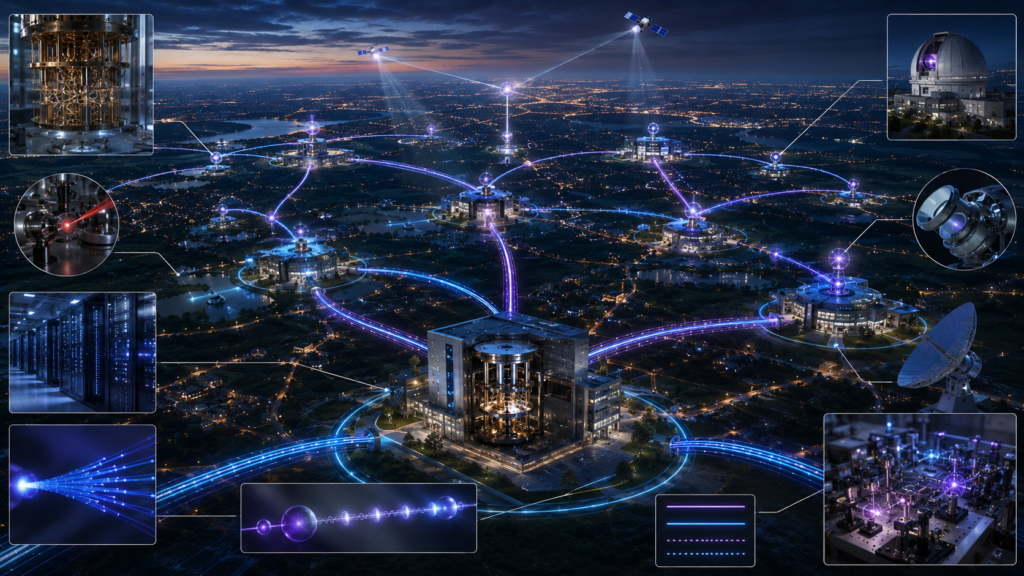
Entanglement occurs when quantum systems become correlated in a way that cannot be described as two completely independent states. Two quantum systems can become entangled and then separated, and measurements of the two systems can still show correlations associated with their shared quantum state. Entanglement could become an important networking resource.
But there is a critical misconception to avoid: entanglement does not allow ordinary information to travel instantly, and it does not permit faster-than-light communication. Many quantum protocols still require classical communication between the participants. The quantum internet would therefore not break the speed of light. It would use quantum correlations in ways that conventional networks cannot reproduce.
Why Is Quantum Information So Fragile?
Quantum states are sensitive to their environment. Noise, loss, unwanted interactions, imperfect equipment, and other disturbances can reduce the quality of quantum information, a loss of quantum coherence associated with decoherence. The problem becomes more serious as quantum information travels farther. Imagine trying to preserve a delicate object while transporting it across a long distance: every additional step creates another opportunity for something to go wrong. Photons can be lost, quantum states can degrade, measurements can introduce errors, and quantum memories can lose coherence. A useful quantum network therefore needs technologies designed specifically to manage these problems.
How Can Photons Carry Quantum Information?
Photons are particles of light, and they are central to many approaches to quantum networking. They can carry quantum information through optical fibers or through free-space links. Optical fiber provides a practical communication medium, but it is not perfectly transparent, and some photons are lost during transmission. As distance increases, accumulated loss becomes increasingly important, which creates one of the central problems of long-distance quantum networking. A classical communication system can receive and regenerate a signal, but quantum information cannot simply be copied and regenerated in the same way. So what can replace the classical repeater?
What Is a Quantum Repeater?
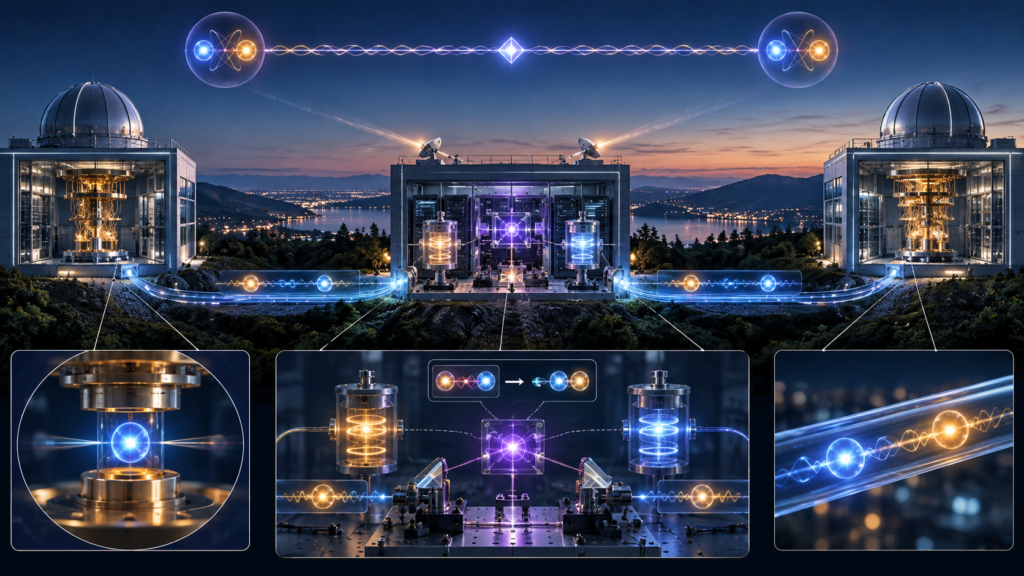
A quantum repeater is a network component designed to help extend the distance over which quantum entanglement can be distributed. NIST explains quantum memories and repeaters in the context of long-distance quantum networking. Instead of trying to create one direct quantum connection across a very long distance, the network can divide the route into shorter segments. Entanglement can be established across individual segments, and intermediate nodes can then perform operations that extend the entanglement across the larger network. One important operation is entanglement swapping.
How Does Entanglement Swapping Work?
Imagine three stations: A, B, and C. A and B share an entangled pair, and B and C share another entangled pair. Station B performs an appropriate joint measurement, and the result can establish entanglement between A and C. The two distant stations did not initially share the same entangled pair, and the intermediate operation effectively extends the quantum connection. Entanglement swapping is therefore a fundamental mechanism in many proposed quantum repeater architectures. But it does not make long-distance networking easy, because every additional link introduces more opportunities for loss and error.
What Is a Quantum Memory?
A quantum network may need to temporarily store quantum information. This is the role of a quantum memory. A conventional computer stores classical information in memory, but a quantum memory has to preserve the relevant quantum state long enough for the network to use it. That is difficult because the stored state can lose coherence. A useful quantum memory needs to receive quantum information, preserve it, and release it when required while maintaining sufficient quality, which is why quantum memories are important components in many proposed long-distance quantum networking architectures. They can help coordinate operations between different parts of the network.
What Are Quantum Routers and Switches?
Today’s internet uses routers and switches to manage conventional data traffic. A quantum network would require related networking functions, but the resources being managed would be different. It could need to manage available entangled connections, link quality, fidelity, loss, timing, quantum memories, and intermediate network nodes. Quantum switches could connect different components, and quantum routers could help direct quantum connections between parts of the network. This means the quantum internet is not simply quantum hardware connected by cables. It requires a genuine networking architecture.
Would the Quantum Internet Replace Today’s Internet?
No. This is one of the most important points to understand. The quantum internet would work alongside conventional networks, and classical communication would still be needed for control information, synchronization, network management, routing information, measurement results, error-correction feedback, and ordinary application data. A future quantum network would therefore combine quantum and classical communication: the quantum layer would provide capabilities associated with quantum information, while the classical layer would coordinate and manage the system. [1]
The two layers would be complementary rather than competing versions of the same network. The quantum internet would not make ordinary web browsing faster, and it would not automatically improve video streaming, email, or Wi-Fi. Its purpose would be to enable new forms of quantum communication, computing, sensing, and security.
How Does Quantum Teleportation Work?
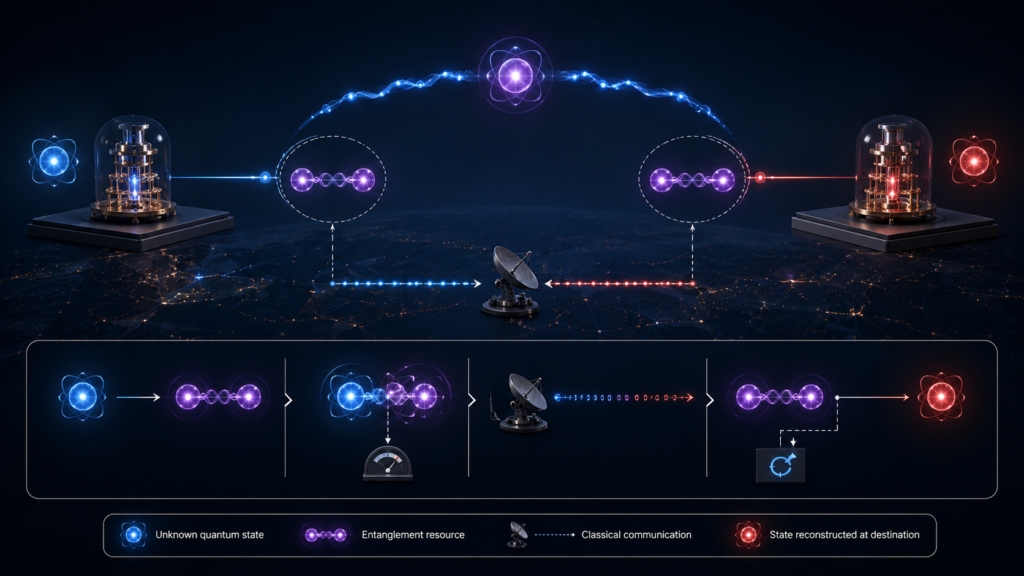
The phrase “quantum teleportation” sounds like science fiction. It is actually a real quantum information protocol, but it does not teleport people or physical objects. Quantum teleportation transfers an unknown quantum state from one location to another using shared entanglement and classical communication. The original quantum state is not simply copied: a teleportation protocol uses measurements and shared entanglement so that the corresponding state can be reconstructed at the destination, and the physical particle carrying the original state does not need to travel across the entire network. This could become an important mechanism for quantum networking, for example between two distant quantum computers that share an entangled resource.
Does Quantum Teleportation Break the Speed of Light?
No. Quantum teleportation still requires classical communication, and classical information cannot travel faster than light, so it does not provide instantaneous ordinary communication. Its importance is different: it provides a method for transferring quantum states using shared entanglement, which could become useful when quantum computers and other quantum devices need to exchange quantum information across a network.
Could the Quantum Internet Improve Security?
One potential application is quantum key distribution, or QKD. QKD allows two parties to establish cryptographic keys using quantum states, and NIST’s overview of quantum cryptography explains how quantum properties can support this type of key distribution. Under appropriate assumptions, an eavesdropper interacting with the quantum system can introduce detectable disturbances, which creates security properties based on quantum mechanics.
But QKD does not automatically make an entire communication system secure. Authentication is still necessary, classical cryptographic systems remain involved, endpoints can still be compromised, and implementation weaknesses can still create vulnerabilities. Quantum communication therefore does not eliminate cybersecurity problems. It provides specific security properties for particular protocols.
What Happens If Someone Intercepts a Quantum Channel?
Suppose an attacker attempts to interact with quantum states traveling between two legitimate users. That interaction can disturb the quantum system, and the legitimate parties can perform measurements and statistical tests to determine whether the expected quantum properties have been disturbed. If the observed disturbance is too high, the communication session can be rejected. This is one of the principles behind QKD: the security comes from the physical behavior of quantum systems combined with the protocol and its implementation.
Could Quantum Computers Work Together?
One potential application is distributed quantum computing. A future quantum computer does not necessarily have to exist as one enormous processor, because multiple quantum processors could potentially connect through a quantum network. If they can share quantum information and entanglement, they could cooperate on certain computations, with classical networking coordinating the overall process while the quantum network provides the quantum connections. This remains a future capability, and significant technical challenges must be solved before large-scale distributed quantum computing becomes practical.
Could Quantum Networks Connect Quantum Sensors?
Quantum networking could also support distributed quantum sensing. Quantum sensors can exploit quantum phenomena to make extremely sensitive measurements of quantities such as magnetic fields, electric fields, time, gravity, and temperature. Now imagine several quantum sensors distributed across a region: a quantum network could connect them so their measurements can be combined, and shared quantum resources could potentially enable sensing strategies that are difficult to achieve using independent sensors. Potential applications include scientific research, navigation, geophysics, precision measurement, and fundamental physics. This is another reason the quantum internet is about more than communication. It could become infrastructure for distributed quantum technologies.
Could Satellites Become Part of the Quantum Internet?
Optical fiber is not the only possible communication medium, because quantum signals can also travel through free space. Satellites could potentially connect distant ground stations and help extend quantum networking across regions where long fiber connections are difficult or expensive. A future large-scale quantum network could therefore combine optical fiber, free-space links, and satellite links, although the exact architecture remains under research.
Why Is Long-Distance Quantum Networking So Difficult?
Distance magnifies almost every problem. Photons are lost during transmission, quantum states can decohere, equipment introduces imperfections, entanglement can degrade, and quantum memories can lose coherence. A classical network can regenerate a damaged digital signal, but a quantum network cannot simply copy an unknown quantum state. Long-distance quantum networking therefore requires technologies such as quantum repeaters, quantum memories, entanglement generation, entanglement swapping, entanglement purification, error management, and sophisticated network control. These components must work together reliably, and that is the real engineering challenge.
Is the Quantum Internet Already Being Built?
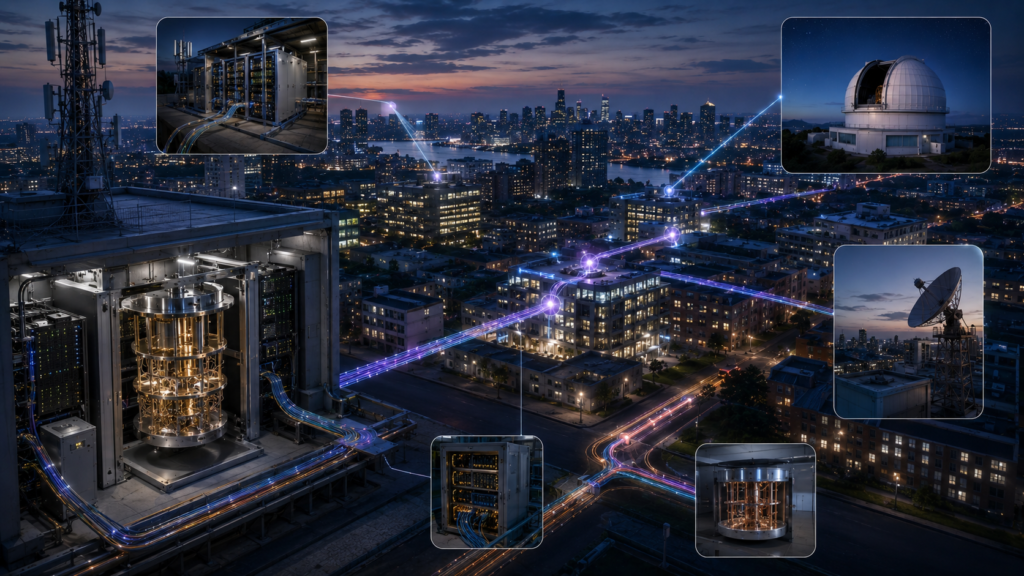
The global quantum internet does not yet exist, but researchers are building experimental networks and testing quantum communication over metropolitan distances. In January 2026, Deutsche Telekom’s T-Labs and Qunnect carried out a field trial in Berlin and reported it in February, demonstrating quantum teleportation over a 30-kilometer loop of commercial fiber with an average teleportation fidelity of 90%, while classical traffic was also carried on the network. [5] The teleported states came from a weak coherent light source rather than a quantum computer, and the results were published as a preprint. [6] Read the Deutsche Telekom report on the Berlin field trial.
These demonstrations are important because they move quantum networking beyond isolated laboratory experiments. But a metropolitan demonstration is very different from a large, fault-tolerant, globally interconnected quantum internet. The technology is progressing, but the final system remains a research and engineering goal.
Could Existing Fiber Networks Be Used?
Potentially. This is an important direction because building an entirely separate global physical network would be enormously difficult and expensive, so researchers are investigating how quantum signals could use existing telecommunications infrastructure. But ordinary telecommunications signals and quantum signals have very different requirements. Classical optical signals can be much stronger than quantum signals, and quantum states are extremely sensitive to noise and interference, so the network has to manage wavelengths, loss, interference, and coexistence carefully. Using existing infrastructure may be possible in some environments, but it does not remove the underlying engineering challenges.
Why Is Quantum Error Correction Important?
Quantum information is vulnerable to errors: noise can change a quantum state, transmission can introduce loss, and quantum operations can be imperfect. Quantum error correction provides methods for protecting logical quantum information from physical errors. This is different from simply copying quantum information, because unknown quantum states cannot be perfectly duplicated. Quantum error correction can require many physical qubits to create a more reliable logical qubit, so a scalable quantum internet may require substantial error-correction capability.
Why Is Scalability So Difficult?
Connecting two quantum devices is already challenging, and connecting hundreds or thousands would be much harder. A large-scale network would require reliable quantum memories, efficient photon sources, high-quality detectors, quantum repeaters, routers and switches, standardized interfaces, synchronization, error management, scalable manufacturing, and control software.
The network would also need different quantum platforms to communicate effectively. Quantum computers themselves are not all built using the same technology: some use superconducting circuits, while others use trapped ions, neutral atoms, or photonic systems. Connecting these different platforms to an optical quantum network may require specialized interfaces or transducers, and preserving quantum information during that conversion is itself a difficult research problem.
What Could a Future Quantum Internet Enable?
The potential applications extend beyond one field. A quantum network could support quantum key distribution, distributed quantum computing, distributed quantum sensing, precision timing, quantum cloud services, interconnected quantum data centers, and advanced quantum communication. Some future applications may not be obvious today, which is common with foundational technologies: the original internet was developed around specific networking requirements, while many of its most important applications emerged later. Quantum networking could follow a similar path.
The Architecture of a Quantum Internet
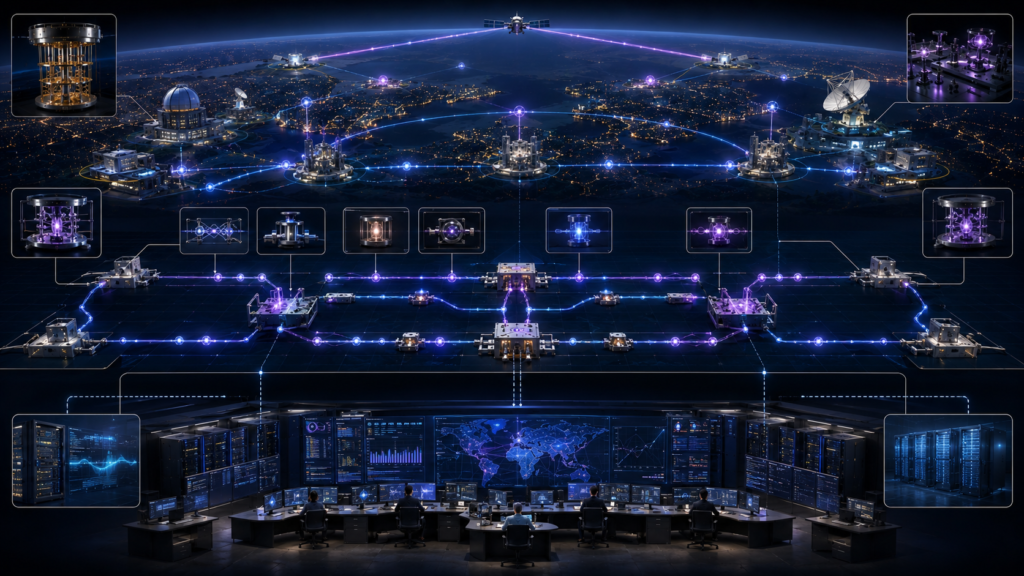
Now bring the pieces together. At the edge of the network could be quantum computers, quantum sensors, and quantum communication devices. Between them could be optical fiber, free-space links, and potentially satellite connections, and network nodes could contain quantum memories, repeaters, switches, and routers. Photons could carry quantum states, quantum memories could temporarily preserve fragile states, repeaters could help extend entanglement across longer distances, and teleportation could transfer quantum states using shared entanglement and classical communication. A classical control layer would coordinate synchronization, routing, measurement results, network management, and error correction.
This layered architecture is one of the clearest ways to understand the quantum internet. It is not a replacement for conventional networking. It is an additional networking capability built around quantum information. The final architecture is still uncertain, but the direction is becoming clearer: quantum computers, quantum sensors, and quantum communication technologies are all developing, and eventually these systems may need a network.
Key Takeaways
- The quantum internet would distribute quantum information and entanglement between quantum devices, and it would complement today’s internet rather than replace it.
- Qubits are the basic units of quantum information, and unknown quantum states cannot be perfectly copied, which makes quantum networking very different from classical networking.
- Entanglement does not allow faster-than-light communication.
- Photons are important carriers for many approaches, and quantum repeaters, entanglement swapping, and quantum memories could help extend quantum connections over long distances.
- Quantum teleportation transfers quantum states using shared entanglement and classical communication.
- Potential applications include secure quantum communication, distributed quantum computing, distributed sensing, and precision timing.
- Experimental networks, including a 2026 metropolitan fiber trial in Berlin, show progress, but a global quantum internet remains a future research and engineering goal.
Conclusion
The quantum internet is not simply the next version of Wi-Fi. It is a proposed networking infrastructure for quantum information, built on unusual properties of quantum mechanics: superposition, entanglement, measurement, and the no-cloning principle. Around those principles, researchers are developing photonic links, quantum memories, repeaters, switches, routers, quantum processors, quantum sensors, error-correction systems, and classical control networks. The pieces are gradually coming together, and current demonstrations show that quantum communication can operate over real telecommunications infrastructure.
But a global, fault-tolerant quantum internet remains far beyond today’s systems. The biggest challenge is not creating one successful quantum connection. It is making thousands or millions of delicate quantum operations work together reliably across a large network. If that challenge can be solved, the quantum internet could become infrastructure for a new generation of quantum technologies. The classical internet connected computers, and a quantum internet could connect quantum computers, quantum sensors, and other quantum devices.
Explore more evidence-based explanations of quantum computing, artificial intelligence, emerging technologies, and the scientific ideas behind the systems that may shape the future in CAVELYRA’s Science Explained collection.
References
- Wehner S, Elkouss D, Hanson R. Quantum internet: a vision for the road ahead. Science. 2018;362(6412):eaam9288. doi:10.1126/science.aam9288
- NIST. “Quantum Communications and Networks.” nist.gov
- NIST. “Quantum Memory and Repeaters.” nist.gov
- NIST. “What Is Quantum Cryptography?” nist.gov
- Deutsche Telekom. “Teleportation via fiber optics in Berlin.” Press release, February 2026. telekom.com
- Borowska ZA, et al. Bichromatic quantum teleportation of weak coherent polarization states on a metropolitan fiber. Preprint, 2026. arXiv:2602.16613