
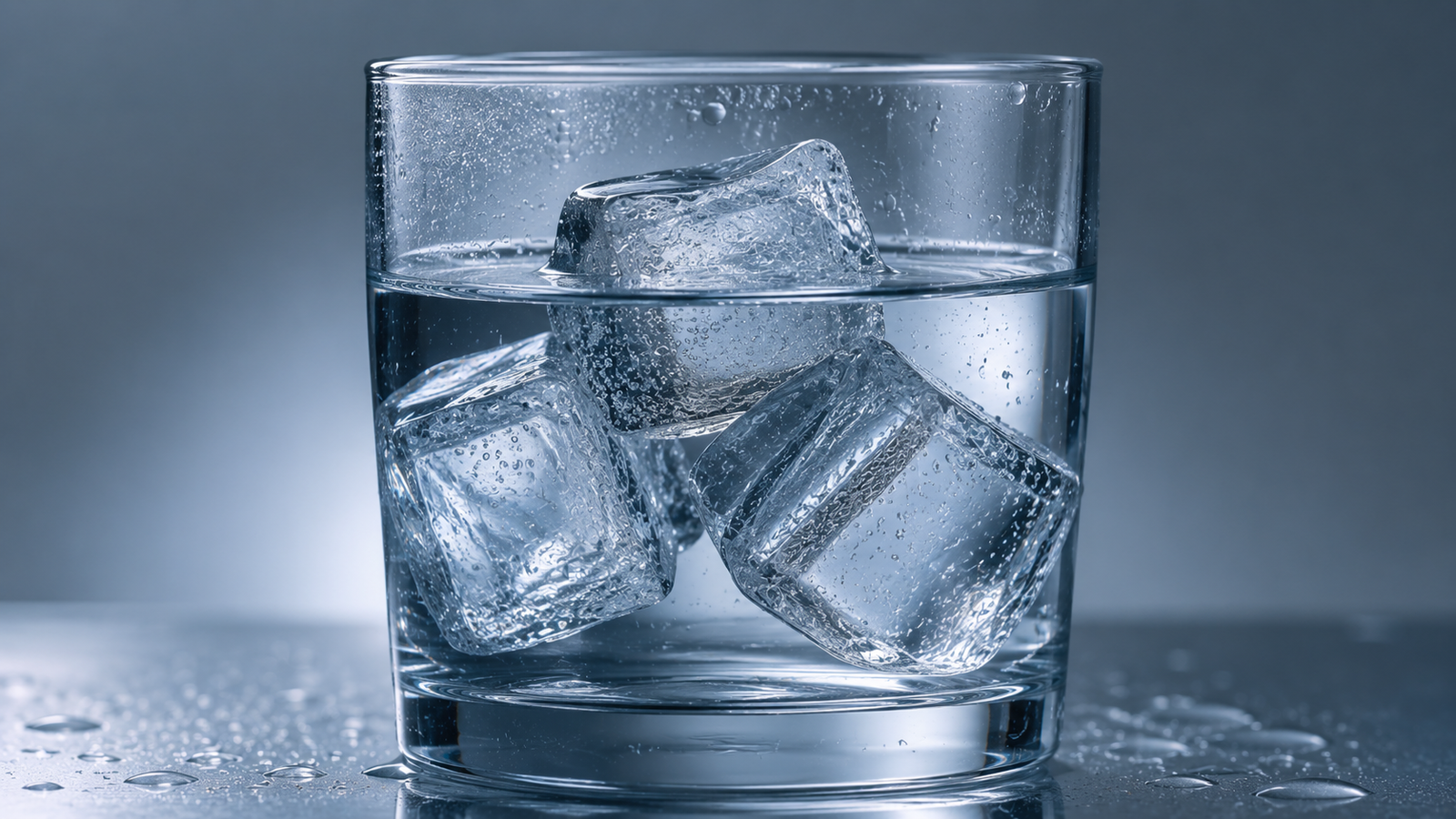
Drop an ice cube into a glass of water. It does something that seems completely ordinary: it floats. But look more closely and the result is actually unusual.
Quick Answers
- Short answer: Ice floats because it is less dense than liquid water, roughly 90 percent as dense under ordinary conditions. [1]
- Why: When water freezes, hydrogen bonds organize the molecules into an open crystalline structure that takes up more space, which lowers the density.
- Why it matters: Lakes freeze from the surface downward, and floating ice insulates the liquid water beneath it, which helps aquatic life survive winter.
So, why does ice float? For most substances, the solid form is denser than the liquid form, because when a material freezes its particles usually become more tightly packed. Water behaves differently. When water freezes, its molecules arrange themselves into a more open structure that takes up more space than the molecular arrangement in liquid water. As a result, ice is less dense than liquid water and floats. The U.S. Geological Survey notes that freezing reduces the density of water by about 9 percent. [1]
That simple fact has enormous consequences. Ice floats on ponds, lakes freeze from the surface downward, and aquatic ecosystems can survive cold winters. The unusual behavior of water is therefore closely connected to life on Earth.
What Does Density Have to Do With Floating?
Before looking at molecules, we need one simple idea. Density describes how much mass is contained within a given volume, and if an object is less dense than the liquid around it, it can float. If it is denser, it tends to sink. A piece of wood floats because its average density is lower than that of water, and a stone sinks because its density is higher. Ice follows the same basic rule, and the important difference is that solid water is less dense than liquid water.
The density of ice is roughly 90 percent that of liquid water under ordinary conditions, though it can vary because ice can contain air. [1] That is why an ice cube can remain at the surface while part of it extends below the waterline.
Why Does Ice Float? The Molecular Explanation
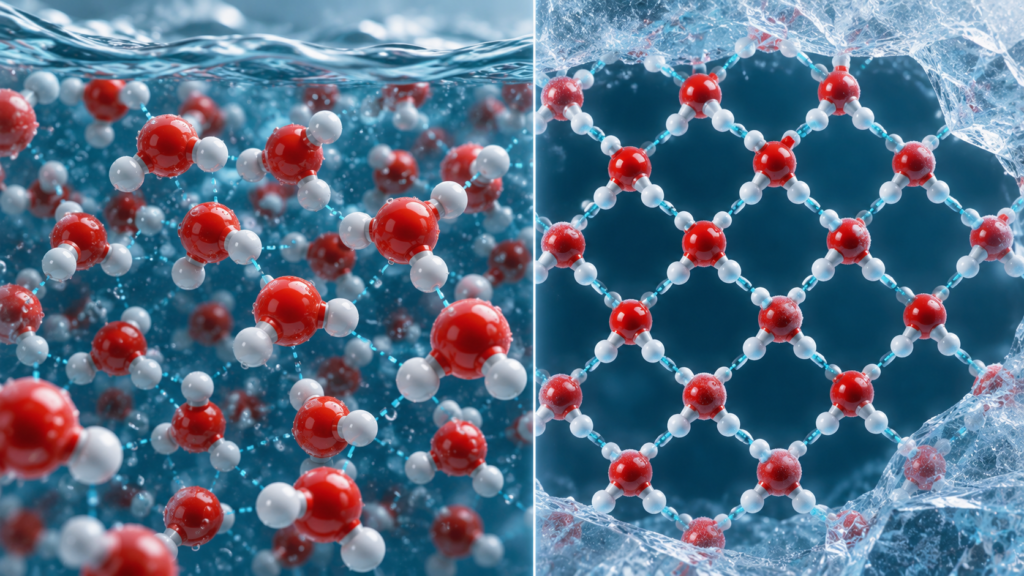
The answer begins with the structure of a water molecule. A water molecule contains two hydrogen atoms bonded to one oxygen atom, and the molecule has an uneven distribution of electrical charge, which makes water molecules interact strongly with one another. One important interaction is the hydrogen bond, and hydrogen bonds help determine how water molecules arrange themselves. In liquid water, molecules are constantly moving, and their hydrogen bonds continually form, break, and rearrange, so the molecules can move relatively close together.
When water freezes, however, the molecules become organized into a more stable crystalline structure. That structure leaves more open space between molecules, so the solid occupies more volume for the same amount of water, and more volume means lower density.
What Happens to Water Molecules When Water Freezes?
Imagine liquid water at temperatures above freezing. The molecules are constantly moving and remain connected through hydrogen bonding, but those connections are continually changing. As the water cools, molecular motion decreases. Near the freezing point, the molecules can become organized into a crystalline arrangement, in which each water molecule is connected through hydrogen bonds in a pattern that leaves empty space within the lattice. This arrangement is less compact than the constantly shifting structure of liquid water, and when enough molecules adopt it, the water becomes solid ice.
The molecules themselves have not become larger. The structure has changed, and that distinction explains why freezing water expands.
Why Does Water Expand When It Freezes?
Put water in a container and freeze it, and the ice can occupy more space than the liquid water did. This seems strange because cooling usually causes materials to contract, and water does contract as it cools through much of its liquid range. But near freezing, its behavior changes: as the molecules become organized into the open crystalline structure of ice, the average spacing between them increases, and the volume therefore increases. The USGS explains that the lattice arrangement lets water molecules be more spread out than in a liquid, which is why ice is less dense than water. [1] This is also why completely filling a rigid container with water before freezing can create a problem, because the expanding ice needs more space.
Why Is Water Densest at About 4°C?
Water has another unusual property: liquid freshwater reaches its maximum density at about 4°C. As water cools from warmer temperatures toward 4°C, it becomes denser and sinks, but as it cools below about 4°C, its density begins to decrease. [1] The colder water therefore becomes more likely to remain near the surface, and eventually it freezes. This creates an important pattern in lakes: the water near the surface cools first, water at about 4°C is denser and tends to sink, and as the surface water cools below 4°C it becomes less dense and remains near the top. When it reaches the freezing point, ice forms at the surface, and that ice then floats.
Why Do Lakes Freeze From the Top?
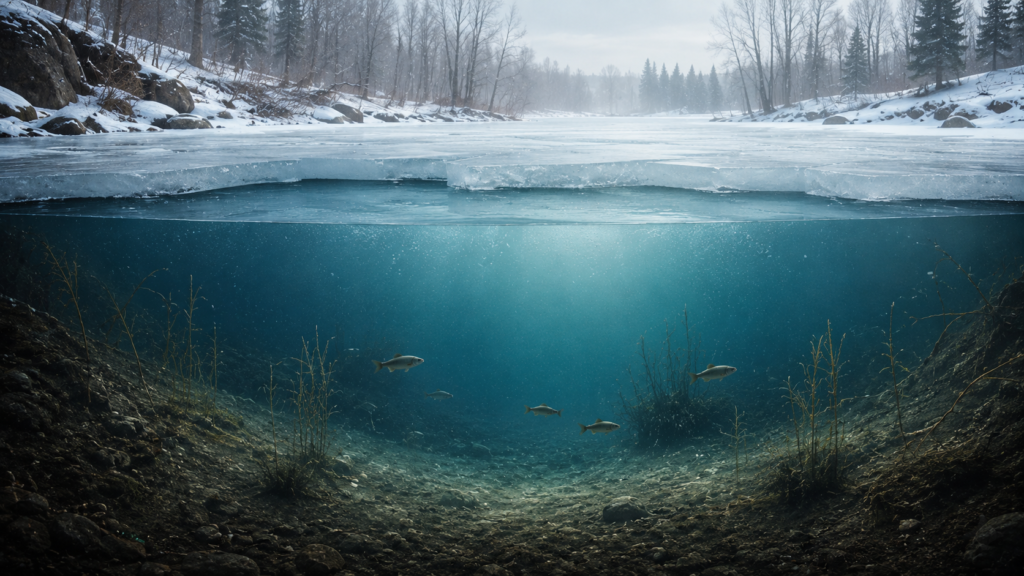
This is one of the most important consequences of floating ice. Imagine a lake during winter. The air becomes colder and the surface water loses heat. Initially, the cooling water becomes denser and sinks, which allows colder surface water to mix downward. But once the surface water cools below about 4°C, it becomes less dense, stays near the surface, and eventually freezes. The ice remains at the top because it is less dense than the liquid water beneath it, so the result is a layer of ice covering the surface while liquid water remains below. That is very different from a lake freezing completely from the bottom upward.
How Does Floating Ice Help Aquatic Life?
The floating ice layer acts as a barrier between the cold atmosphere and the liquid water below. Ice is also a relatively poor conductor of heat compared with many common materials, so the ice layer helps slow further heat loss from the water beneath it, and the deeper water can remain liquid even while the surface is frozen. NASA notes that if ice sank, whole bodies of water could freeze solid. [3] This unusual property of water therefore helps create stable environments for organisms living in lakes and ponds during cold seasons.
Why Doesn’t the Entire Lake Freeze?
A frozen surface does not mean the entire lake has reached the freezing point, and water beneath the ice can remain liquid. The maximum-density behavior of water helps produce this layered structure, because water near 4°C is denser than colder surface water and tends to remain deeper, while the ice at the top acts as an insulating layer. Together, these effects make complete freezing less likely in many freshwater lakes, and large, deep lakes can retain liquid water beneath their winter ice. The exact conditions depend on factors such as depth, water movement, temperature, wind, and dissolved substances.
Why Is This Property So Unusual?
Most substances become denser when they transition from liquid to solid, because their particles generally become more organized and packed more closely. Water is different because its hydrogen-bonded crystal structure creates additional open space, so the solid occupies more volume than the corresponding liquid. The unusual behavior is therefore rooted in molecular structure. Water is not breaking the rules of physics. It is following them in a way that produces an unusual result because of the specific interactions between its molecules.
Does All Ice Have the Same Density?
No. The density of ice can vary depending on its structure, temperature, pressure, and whether it contains trapped air or other substances. Ordinary ice under familiar Earth conditions is less dense than liquid freshwater, and there are also different crystalline forms of ice that can exist under different pressure and temperature conditions. The simple ice cube in your drink is only one form of solid water, but for everyday life the important point remains the same: ordinary ice is less dense than liquid water.
Why Do Icebergs Float?
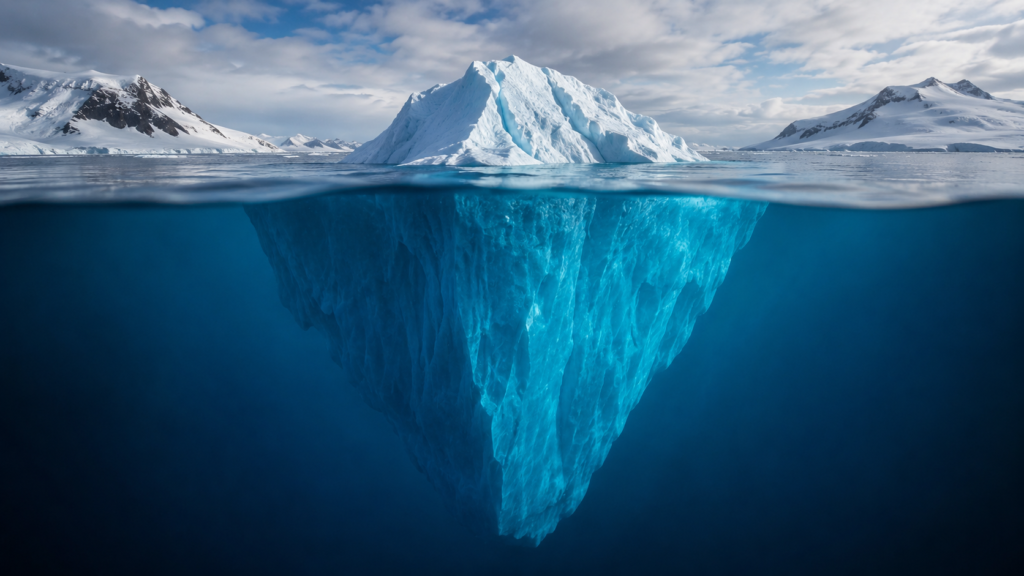
An iceberg is simply a large mass of floating ice, and the same density principle applies: ice is less dense than seawater, so an iceberg can remain afloat. But only part of the iceberg appears above the surface. Because ice is roughly 90 percent as dense as water, about nine-tenths of an iceberg’s volume sits below the waterline, and roughly a tenth is above it, although the exact amount varies with the densities involved. This is why the visible portion of an iceberg can give a misleading impression of its total size.
Does Salt Water Change the Story?
Yes. Seawater contains dissolved salts and is generally denser than freshwater, which changes the relationship between ice and the surrounding liquid. Sea ice still floats because the ice formed from seawater is generally less dense than the surrounding seawater. However, the formation process is more complicated, because much of the salt is excluded from the ice crystal structure, and the density of seawater also changes the way the ocean responds to cooling and freezing. This is one reason ocean freezing behaves differently from the freezing of a freshwater lake.
What Happens to Salt When Seawater Freezes?
When seawater freezes, most of the dissolved salt does not fit easily into the growing ice crystal structure, and much of it is rejected into the surrounding liquid water. This leaves newly formed sea ice relatively fresh compared with the original seawater, although sea ice can retain some salt in concentrated brine pockets. The surrounding water can therefore become saltier and denser, which affects ocean circulation as well as the formation and movement of sea ice. The simple ice cube in a glass and the formation of sea ice are therefore related but not identical processes.
Can Ice Ever Sink?
Under ordinary conditions, normal ice floats in normal water, but unusual forms of water can behave differently. For example, “heavy ice,” made from heavy water in which hydrogen is replaced by the heavier isotope deuterium, is about 10.6 percent denser than normal water and can sink in it. [2] This does not change the ordinary rule you observe in a glass. It simply demonstrates that floating depends on density, not on the word “ice” itself.
What Would Happen If Ice Sank?
Imagine the opposite world. Ice would sink instead of float, and during a prolonged cold period, newly formed ice could move downward and more water could freeze. The process could continue from the bottom upward, and the insulating surface layer created by floating ice would not form in the same way. Cold regions could therefore experience much more extensive freezing of freshwater environments, and NASA highlights this as one reason the unusual density behavior of water matters for life as we know it. [3]
The consequences of floating ice reach well beyond ice cubes. It affects lakes, rivers, oceans, and aquatic ecosystems, and because water’s density changes with temperature, those changes also contribute to the movement and layering of water in natural environments. The fact that ice floats gives freshwater ecosystems a protective surface layer during winter, which makes the unusual molecular structure of water an important part of Earth’s living environment.
The Simple Science Behind Floating Ice
The explanation can be reduced to a sequence. Water molecules form hydrogen bonds, and in liquid water those bonds continually rearrange, so the molecules can remain relatively close together. When water freezes, the molecules become organized into an open crystalline structure that occupies more space, so the same amount of water has a larger volume and its density decreases. Because ice is less dense than liquid water, it floats. Floating ice then forms a surface layer on lakes, that layer slows heat loss, liquid water remains beneath it, and aquatic life can survive cold seasons.
Key Takeaways
- Ice floats because it is less dense than liquid water, roughly 90 percent as dense under ordinary conditions.
- Water molecules interact through hydrogen bonds: liquid water has a relatively flexible, constantly changing structure, while ice forms a more open crystalline structure that occupies more volume for the same amount of water.
- Water reaches its maximum density at about 4°C.
- Lakes therefore tend to freeze from the surface downward, and floating ice helps insulate the liquid water beneath it.
- This behavior helps aquatic ecosystems survive cold conditions, and if ice sank, bodies of water could freeze from the bottom up.
- About nine-tenths of an iceberg’s volume is below the waterline, and sea ice forms differently from freshwater ice because of salt.
- Ice density depends on the type of ice and the surrounding liquid, but ordinary ice floats in ordinary water.
Conclusion
Ice floats because water behaves differently from most substances when it freezes. As liquid water cools, its molecules become increasingly organized, and near freezing, hydrogen bonding allows them to form an open crystalline structure. That structure takes up more space, so the density of the solid becomes lower than the density of the liquid, and ice floats.
That simple property changes entire ecosystems: it allows lakes to develop an insulating layer of ice while liquid water remains underneath, it helps aquatic organisms survive winter, and it contributes to the unusual physical behavior that makes water so important to life on Earth. The reason ice floats begins at the molecular scale, and its consequences reach the scale of entire ecosystems. The next time you drop an ice cube into a glass, you are seeing a small demonstration of one of water’s most remarkable properties.
Explore more evidence-informed explanations of the science behind ordinary things in CAVELYRA’s Science Explained collection.
References
- U.S. Geological Survey. “Water Density.” Water Science School. usgs.gov
- U.S. Geological Survey. “Heavy Ice.” usgs.gov
- NASA Science. “10 Interesting Things About Water.” science.nasa.gov