

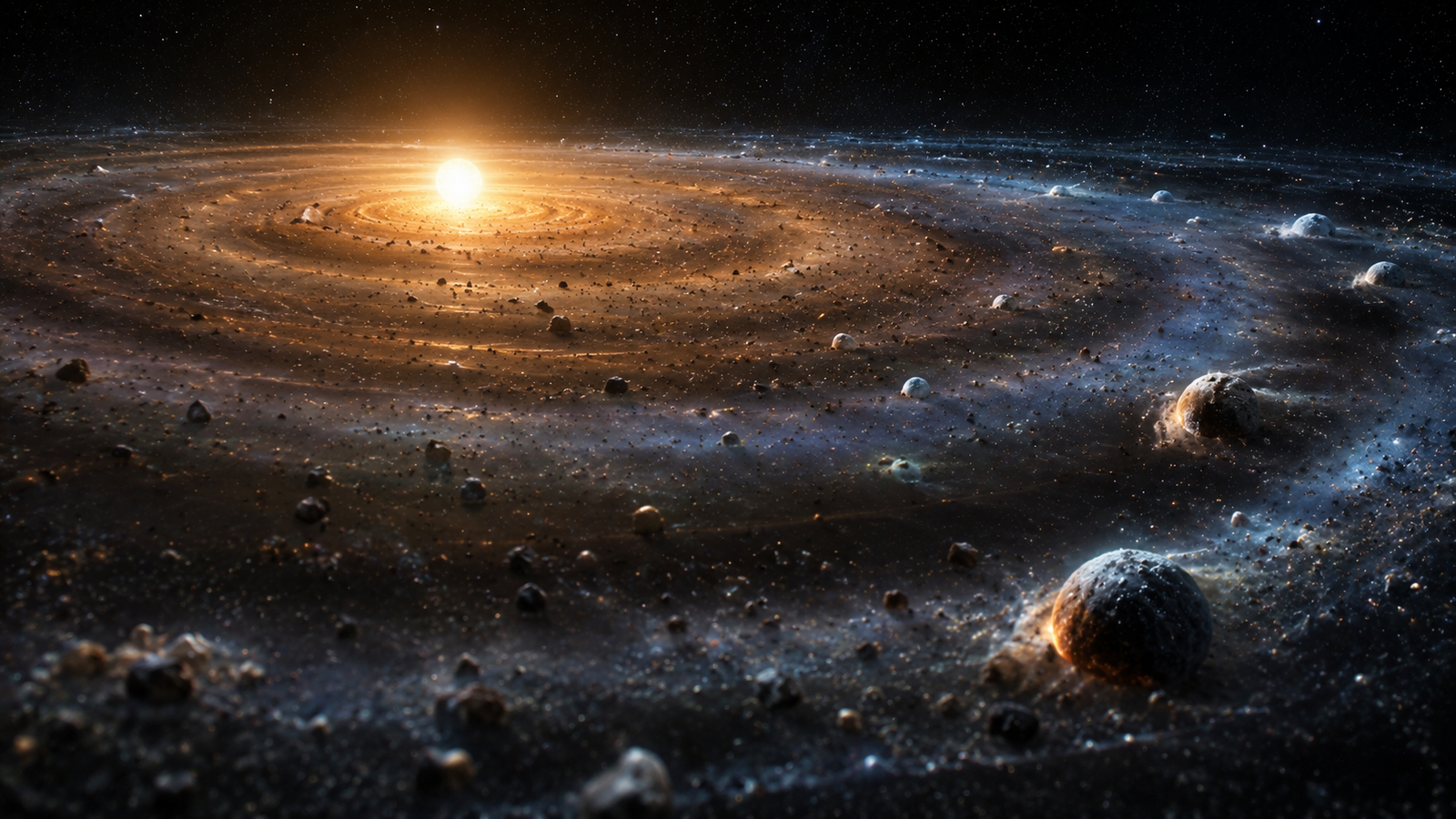
Planets begin as tiny particles inside the disks surrounding young stars. Over millions of years, collisions, gravity, accretion, and orbital dynamics can transform that material into planetary worlds.
Quick Answers
- How planets form: Planets develop from gas, dust, rock, and ice in disks around young stars.
- Why planets differ: Temperature and material availability across a disk influence which kinds of planets can develop.
- How astronomers study formation: Telescopes observe disks around young stars, while meteorites preserve evidence about the early Solar System.
Look at Earth.
The continents seem permanent. The oceans seem endless. Mountains rise above the surface.
But Earth was not always a planet.
About 4.5 billion years ago, there was no Earth as we know it. There were no continents, oceans, or Moon. There was material moving through a young planetary system.
So how can tiny particles of dust become a world?
The answer begins with the birth of a star.
Where Do Planets Come From?
When a young star forms, material surrounding it can organize into a rotating disk called a protoplanetary disk.
The disk contains gas, dust, rock, ice, and other particles. These are the raw materials from which planets can develop.
Our Solar System formed from such a disk around the young Sun.
The disk is not uniform. Temperature, density, chemical composition, and orbital conditions vary across it. Material is constantly moving, while gravity and collisions influence what happens next.
At first, the building blocks are remarkably small.
They are dust grains.
How Does Dust Become a Planet?
Dust may sound like an unlikely starting point for a planet, but these tiny grains contain the materials needed to build larger bodies.
Some contain silicate minerals and carbon-rich material. Farther from a young star, ice can become an important component.
When dust grains collide under suitable conditions, they can stick together. Small aggregates form, and those aggregates can collide with additional particles.
This process is called coagulation.
But growth is not always smooth.
As objects become larger, collisions can become more energetic. Some bodies can fragment rather than merge.
Eventually, gravity becomes increasingly important.
A sufficiently massive body has stronger gravitational attraction. It can gather additional material and grow further.
Over time, objects large enough to serve as major planetary building blocks develop.
These are called planetesimals.
What Are Planetesimals and Planetary Embryos?
Planetesimals are solid bodies that can range from kilometers across to much larger sizes. They orbit the young star and interact gravitationally with one another.
Some collisions are destructive.
Others allow growth.
Their orbits can also change through gravitational interactions.
As the largest bodies collect more material, they become planetary embryos.
A planetary embryo is a large developing body that can eventually contribute to a planet.
At this stage, the system has moved far beyond microscopic dust. The growing bodies now have enough mass for their own gravity to strongly influence their development.
Embryos can collide, merge, compete for material, and alter one another’s orbits.
Over millions of years, these interactions begin to shape the planetary system.
Why Do Rocky Planets Form Closer to Their Stars?
Distance from the star matters because temperature changes across the protoplanetary disk.
Close to the young star, temperatures are high. Many volatile substances cannot easily condense into solids there.
Rock and metal are more resistant to heat, so these materials become important building blocks in the hotter inner regions.
Farther from the star, temperatures are lower.
Water and other volatile compounds can freeze into ice.
This difference helps explain why our Solar System has relatively small, rocky planets in the inner region and much larger planets farther out.
Mercury, Venus, Earth, and Mars are the terrestrial planets.
Jupiter, Saturn, Uranus, and Neptune occupy the colder outer regions.
This temperature structure is one important part of the story, although planetary systems can develop in many different ways.
What Is the Snow Line?
The region where water and other volatile compounds can exist as ice is often discussed in terms of the snow line, or frost line.
Its exact location changes as a young star and its disk evolve.
The important idea is that colder regions contain additional solid material in the form of ice.
That gives growing planetary cores access to a larger reservoir of material.
This can create conditions favorable for the formation of giant planets.
The snow line therefore helps explain why planetary composition can change with distance from a star.
How Do Gas Giants Form?
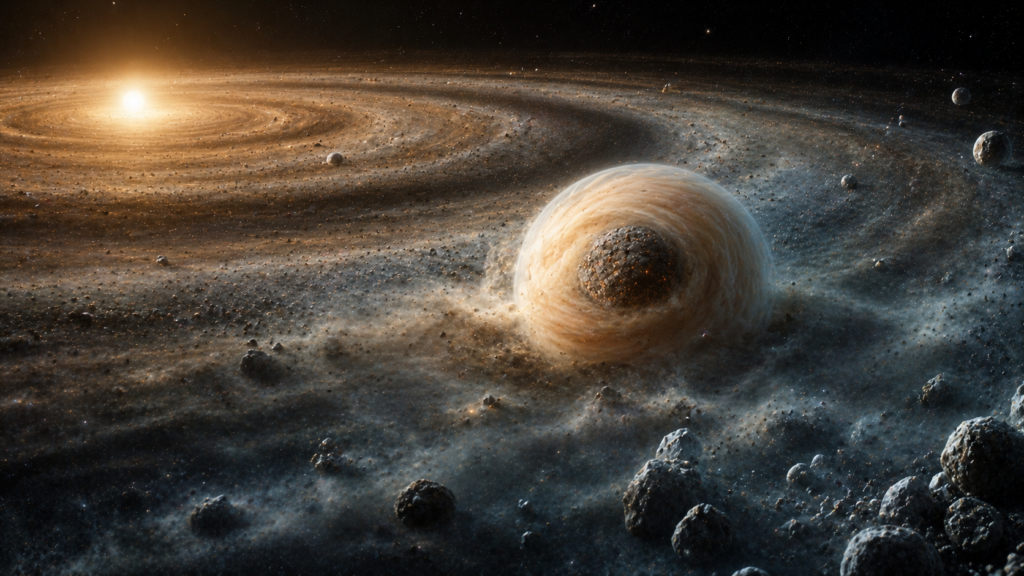
Jupiter did not begin as a fully formed giant planet.
In the outer Solar System, a growing solid core or rapidly assembling planetary body could accumulate material. As it became sufficiently massive, its gravity could attract gas from the surrounding protoplanetary disk.
Hydrogen and helium accumulated.
The planet grew rapidly.
Eventually, the surrounding gas disk disappeared, ending the major supply of gas.
Jupiter remained as a massive gas giant.
Saturn followed a broadly similar formation pathway, while Uranus and Neptune have different formation histories and present compositions.
This illustrates an important point about planet formation.
The process depends on location, temperature, material availability, timing, orbital dynamics, and the interactions among growing bodies.
How Did Earth Form?
Earth formed roughly 4.5 billion years ago through repeated accumulation and collisions among smaller bodies.
The growing Earth was much hotter than the planet we know today.
Impacts released enormous amounts of energy, while radioactive elements contributed additional heat.
As Earth evolved, dense materials moved toward its center and lighter materials remained closer to the surface.
This helped produce the planet’s layered structure, including the core, mantle, and crust.
Earth’s early history was also marked by enormous impacts.
One leading impact hypothesis proposes that a Mars-sized body collided with the young Earth and that debris from the collision eventually formed the Moon.
The exact details remain an area of scientific research.
Why Was the Early Solar System So Chaotic?
The young Solar System was not a calm collection of finished planets.
Objects collided. Orbits changed. Planets grew. Some bodies merged. Others were destroyed or ejected.
The final architecture of the Solar System emerged from this long period of gravitational evolution.
Asteroids and comets are important remnants of that history.
Many asteroids are rocky or metallic bodies that never became planets. Comets contain substantial amounts of ice and volatile material and preserve information about the colder outer regions of the early Solar System.
Studying these objects gives scientists clues about the material from which planets formed.
Can Planets Move After They Form?
A planet does not necessarily remain where it originally developed.
A young planet can interact gravitationally with the surrounding gas disk. These interactions can gradually change its orbit.
This process is called planetary migration.
Migration helps explain why some exoplanets are found extremely close to their host stars.
Hot Jupiters are giant planets orbiting very close to their stars. Under the simplest formation picture, it is difficult for such large planets to form in their current locations.
One possible explanation is that they formed farther away and later migrated inward.
Orbital resonances can also influence planetary systems.
Two planets can develop relationships between their orbital periods that affect the long-term architecture of the system.
Gravity therefore continues shaping planetary systems after individual planets begin to form.
Why Don’t All Planetary Systems Look Like Ours?
Planet formation is not identical everywhere.
Astronomers have discovered thousands of exoplanets orbiting other stars, and these systems display remarkable diversity.
Some contain hot giant planets extremely close to their stars.
Others contain several rocky worlds in compact arrangements.
Some contain planets larger than Earth but smaller than Neptune.
Some planets orbit two stars.
These discoveries show that different starting conditions can produce very different planetary architectures.
The amount of material available, the temperature of the disk, the timing of growth, the lifetime of the gas disk, neighboring planets, and gravitational interactions can all influence the final result.
How Do Astronomers Study Planets While They Form?
For a long time, planet formation was mainly studied through models and evidence preserved in our own Solar System.
Modern telescopes have changed that.
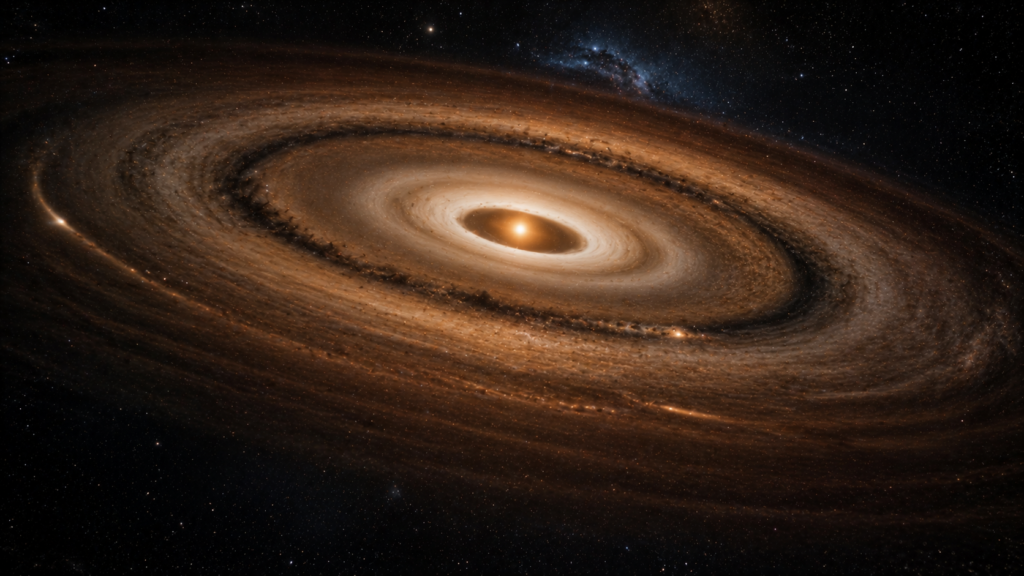
Astronomers can observe disks around young stars and examine their rings, gaps, asymmetries, and other structures.
A developing planet can interact gravitationally with the disk around its star. Its presence may influence the surrounding material.
The Atacama Large Millimeter/submillimeter Array, or ALMA, can observe cold dust and gas in protoplanetary disks. Some disks show concentric rings, gaps, and asymmetries that provide clues about the physical processes occurring within them.
The James Webb Space Telescope adds another perspective through infrared observations. Infrared wavelengths can reveal chemical information in young planetary systems and help scientists study materials such as water and carbon-bearing molecules.
We can therefore study some planetary systems while their worlds are still developing.
What Can Planets Tell Us About Their Past?
A planet is a record of its own formation.
Its composition can provide clues about where it formed.
Its atmosphere records part of its later history.
Its surface preserves evidence of impacts and geological processes.
Its moons can reveal gravitational interactions.
Its orbit records the dynamics of its planetary system.
Earth itself contains evidence from its early history in rocks, minerals, meteorites, and the Moon.
Meteorites are especially valuable because some contain material that formed very early in Solar System history.
By studying and dating such material, scientists can estimate when the Solar System formed.
That age is approximately 4.6 billion years.
What Does Planet Formation Tell Us About Other Worlds?
Planet formation is not unique to the Solar System.
Young stars elsewhere in the galaxy also form with disks of gas and dust.
Within those disks, the same broad physical ingredients can operate.
Dust can grow.
Larger bodies can form.
Gravity can become increasingly important.
Planetesimals can develop.
Planetary embryos can emerge.
Some bodies can capture large amounts of gas.
Others can remain rocky.
The final result depends on the conditions within each system.
This is why exoplanet discoveries are so important. They give scientists other planetary systems with which to compare our own.
Earth may be one particular outcome of planet formation, rather than the only possible one.
From Dust to Worlds
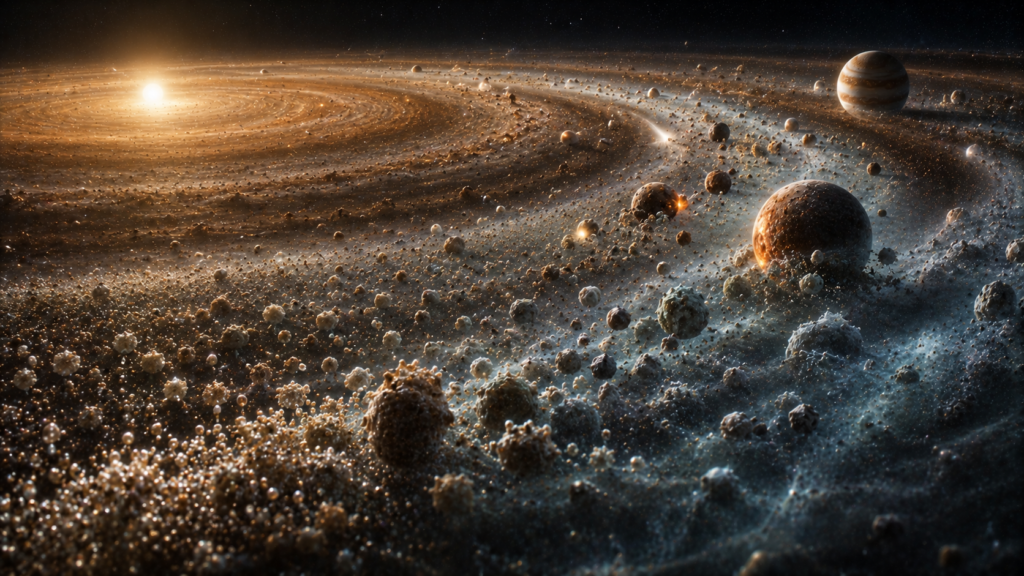
Return to the young Solar System.
The Sun has formed.
A disk surrounds it.
Dust grains orbit within that disk.
Some collide and stick.
Larger aggregates develop.
Gravity becomes increasingly important.
Planetesimals form.
Planetary embryos emerge.
The embryos collide and merge.
Some bodies grow large enough to become planets.
Others remain as asteroids, comets, or smaller remnants.
The process takes millions of years.
It is not perfectly smooth. Collisions can destroy as well as build. Orbits can change. Material can be lost from the system.
Yet over time, a planetary system emerges from the original disk.
That is how a world begins.
Not as a planet.
As material.
Related Reading
- How Are Stars Born?
- How Did the Universe Begin?
- How Do Galaxies Form?
- Science Explained
Key Takeaways
- Planets form from material contained in protoplanetary disks around young stars.
- Dust and ice grains can collide, stick together, and gradually form larger aggregates.
- Planetesimals are important solid building blocks in the later stages of planet formation.
- As bodies become larger, gravity increasingly helps them gather additional material and form planetary embryos.
- Temperature changes across a protoplanetary disk influence which materials can remain solid.
- Rocky planets generally develop in hotter inner regions, while colder outer regions provide conditions favorable to giant planet formation.
- Gas giants can grow when sufficiently massive planetary cores attract gas from the surrounding disk.
- Planetary migration and gravitational interactions can change the locations and architecture of developing planetary systems.
- Asteroids, comets, meteorites, and observations of young stellar disks provide evidence about how planetary systems form.
- Exoplanets show that planet formation can produce planetary systems very different from our own.
Conclusion
A planet does not appear fully formed around a young star.
It begins with material.
Dust, rock, ice, and gas occupy a rotating disk around a newborn star. Dust grains can combine into larger bodies. Planetesimals develop. Gravity strengthens their growth. Planetary embryos emerge, collide, and merge.
Temperature determines which materials can remain solid in different regions of the disk. This helps shape the difference between rocky worlds near a star and larger planets in colder regions.
But planet formation does not follow one perfectly predictable path.
Collisions can destroy as well as build. Orbits can change. Planets can migrate. Neighboring bodies can interact. The gas disk eventually disappears, leaving behind the planetary system and its remaining debris.
Our own Solar System is one result of this long process.
Other stars have produced very different systems.
When you look at Earth, you are therefore looking at the end result of billions of years of cosmic history. The planet beneath your feet began as material moving around a newborn star.
A world begins with material.
Gravity organizes it.
Time transforms it.
And eventually, a planet emerges.
Explore more evidence-based explanations of astronomy, space, and the science behind how planetary systems form in CAVELYRA‘s Science Explained collection.