


You wake up tired.
You struggle through the afternoon. You rely on caffeine. Your sleep is poor. You feel stressed and begin wondering whether your body has finally reached its limit.
Search for an explanation and you may encounter a familiar term: adrenal fatigue.
The theory sounds plausible at first.
Your adrenal glands produce cortisol, one of the body’s major stress-related hormones. You experience prolonged stress. Eventually, the theory claims, your adrenal glands become exhausted and can no longer produce enough cortisol.
There is one major problem.
Adrenal fatigue is not an established medical condition.
The Endocrine Society states that there is no scientific proof supporting adrenal fatigue as a true medical disorder, and there is no validated test that can diagnose it. A systematic review likewise found no substantiation for adrenal fatigue as a distinct medical condition.
That does not mean the symptoms people experience are imaginary.
Fatigue is real.
Poor sleep is real.
Stress is real.
Difficulty concentrating is real.
The important question is what is actually causing those symptoms.
One possibility, although quite different from adrenal fatigue, is adrenal insufficiency.
First, What Do the Adrenal Glands Actually Do?
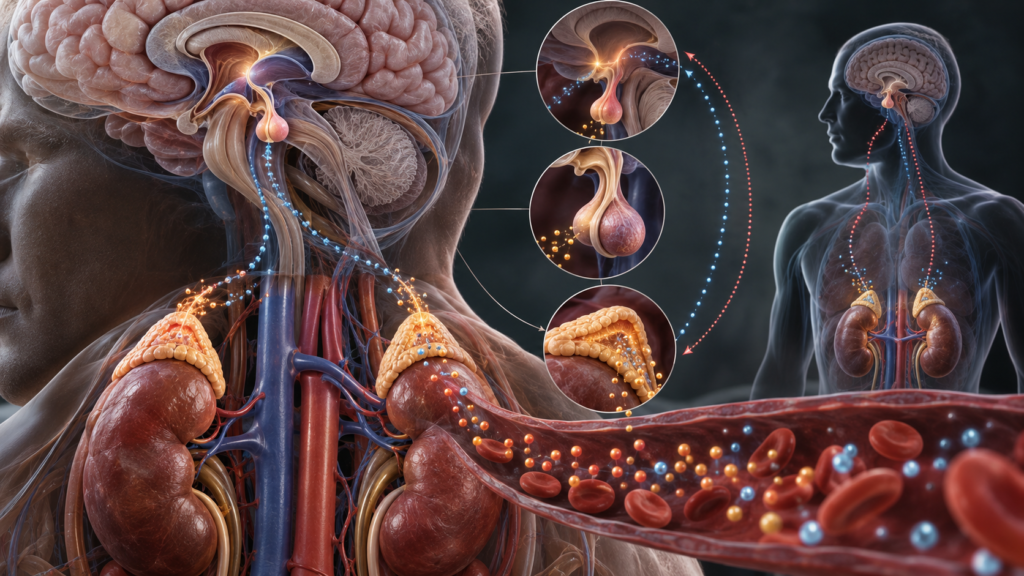
The adrenal glands are two small endocrine glands located above the kidneys.
Despite their size, they produce several important hormones.
One of the best known is cortisol. It helps regulate metabolism, immune activity, blood pressure, and the body’s response to stress.
The adrenal glands also produce aldosterone, which helps regulate sodium, potassium, and fluid balance, along with other steroid hormones.
Their activity is controlled as part of a larger system called the hypothalamic-pituitary-adrenal axis, or HPA axis.
When the body needs more cortisol, the brain and pituitary gland send hormonal signals that stimulate the adrenal glands. As cortisol levels rise sufficiently, feedback mechanisms reduce further stimulation.
This is a regulated biological system.
It is not simply an engine that becomes permanently “used up” after too much stress.
Where Did the Idea of Adrenal Fatigue Come From?
The term adrenal fatigue has been used to describe a collection of symptoms supposedly caused by prolonged physical, emotional, or psychological stress.
The proposed explanation is that continuous stress repeatedly activates cortisol production. Eventually, according to the theory, the adrenal glands supposedly become unable to keep up.
People may then be told that they have “burned out” their adrenal glands.
But this proposed disease mechanism has not been demonstrated as a distinct medical condition.
A systematic review examining the available evidence found conflicting results and major methodological problems. It concluded that there was no substantiation for adrenal fatigue as an actual medical condition.
The Endocrine Society reaches the same basic conclusion.
There is no validated diagnostic test for adrenal fatigue, and there is no established mechanism showing that ordinary chronic stress causes the adrenal glands to become exhausted in the way the theory proposes.
That distinction matters because stress physiology is real even when the adrenal fatigue explanation is not.
So, Does Stress Affect Cortisol?
Yes.
But that is different from saying that stress causes adrenal fatigue.
Stress activates biological systems, including the HPA axis. Cortisol levels naturally change throughout the day and also respond to physiological demands.
Chronic stress can influence the regulation of these systems. Researchers have studied altered cortisol patterns in connection with chronic stress, burnout, depression, sleep problems, and other health states.
But observing changes in cortisol regulation does not establish a disease called adrenal fatigue.
The more accurate picture is that the stress-response system is dynamic.
It can change with physiological demands, recovery, illness, medication, sleep, and other factors.
It is not a battery that simply runs down because someone has experienced too much stress.
What Is Adrenal Insufficiency?

Adrenal insufficiency is different.
It is a recognized endocrine disorder in which the body cannot produce enough cortisol.
In primary adrenal insufficiency, the problem involves the adrenal glands themselves. They may be damaged or otherwise unable to function adequately.
Addison’s disease is a form of primary adrenal insufficiency.
In secondary adrenal insufficiency, the problem occurs higher in the hormonal control system, usually involving inadequate stimulation from the pituitary gland.
The adrenal glands may still be structurally capable of producing cortisol, but they are not receiving enough ACTH, the hormone that normally stimulates cortisol production.
This is fundamentally different from the adrenal fatigue theory.
The adrenal glands do not simply become tired because someone has experienced too much emotional stress.
There is an identifiable disturbance in the endocrine system.
What Can Cause Adrenal Insufficiency?
There are several possible causes.
Primary adrenal insufficiency can result from autoimmune destruction of the adrenal cortex. Other causes can include infections, certain medications, adrenal hemorrhage, genetic conditions, or other forms of adrenal damage.
Secondary adrenal insufficiency can occur when the pituitary gland or hypothalamus does not provide adequate hormonal stimulation.
Long-term treatment with glucocorticoid medications is another important cause because prolonged exposure to external steroids can suppress the body’s own HPA axis.
The 2024 joint guideline from the European Society of Endocrinology and Endocrine Society specifically addresses glucocorticoid-induced adrenal insufficiency.
So when someone has genuine adrenal insufficiency, there is a medical reason their cortisol production is inadequate.
Why the Symptoms Can Be Confusing
One reason these conditions are easily confused is that some symptoms overlap.
Symptoms commonly attributed to adrenal fatigue include:
- Fatigue
- Poor sleep
- Difficulty concentrating
- Feeling stressed
- Needing caffeine
- Salt cravings
- Low energy
But these symptoms are not specific to adrenal disorders.
They can occur with sleep deprivation, depression, anxiety, iron deficiency, thyroid disease, sleep apnea, medication effects, chronic infections, nutritional problems, and many other conditions.
Adrenal insufficiency can also cause fatigue, but it may produce a more characteristic clinical pattern.
Possible symptoms include:
- Muscle weakness
- Weight loss
- Reduced appetite
- Low blood pressure
- Dizziness
- Nausea or vomiting
- Abdominal pain
- Diarrhea
- Salt craving, particularly in primary adrenal insufficiency
- Darkening of the skin in primary adrenal insufficiency
The exact presentation varies.
That is why symptoms alone cannot establish the diagnosis.
Why Symptoms Alone Are Not Enough
Imagine two people who both feel exhausted.
One has been sleeping five hours a night because of work.
The other has an endocrine disorder causing inadequate cortisol production.
Their fatigue may feel similar.
The underlying problems are completely different.
Treating both people as though they have the same condition would make little sense.
This is the central problem with using adrenal fatigue as a catch-all explanation. It can make a broad collection of nonspecific symptoms appear to have one cause.
But symptoms are clues.
They are not diagnoses.
The more useful question is not, “Do my adrenal glands feel exhausted?”
It is, “What is causing my symptoms?”
That shift changes the direction of the investigation.
What About Cortisol Tests Sold Online?
You may encounter saliva tests, urine tests, or commercial packages advertised as ways to measure “adrenal fatigue.”
The issue is not whether cortisol can be measured.
It can.
The issue is whether a particular test has been validated for diagnosing the proposed condition.
The Endocrine Society states that there is no scientifically validated test for adrenal fatigue and warns that some blood or saliva testing marketed for this purpose is not supported by good scientific evidence.
This distinction is crucial.
A test can accurately measure a biological substance without being capable of diagnosing the disease someone claims it diagnoses.
For example, measuring cortisol at a particular time does not automatically demonstrate that chronic stress has “exhausted” the adrenal glands.
Clinical test results need to be interpreted within the appropriate physiological and medical context.
How Is Real Adrenal Insufficiency Evaluated?

When adrenal insufficiency is suspected, clinicians can use established medical tests.
The initial evaluation may include morning cortisol and ACTH measurements, depending on the clinical situation.
Other blood tests can assess electrolytes and additional hormones.
When necessary, a corticotropin stimulation test, also called an ACTH stimulation test, can assess whether the adrenal glands respond appropriately to stimulation.
The Endocrine Society recommends the short corticotropin stimulation test as the standard confirmatory test for primary adrenal insufficiency when feasible.
Interpretation is not always straightforward.
Timing matters.
The patient’s clinical condition matters.
Medications can matter.
The specific laboratory assay matters.
Different forms of adrenal insufficiency can also require different approaches.
This is why endocrine testing should be interpreted by qualified clinicians rather than through an isolated commercial result.
What Does the ACTH Stimulation Test Do?
The basic principle is straightforward.
ACTH normally stimulates the adrenal glands to produce cortisol.
During an ACTH stimulation test, a synthetic form of ACTH is administered. Cortisol is then measured to see how the adrenal glands respond.
If the response is inadequate in the appropriate clinical setting, adrenal insufficiency becomes more likely.
This is fundamentally different from an “adrenal fatigue” test.
The ACTH stimulation test evaluates a recognized physiological function.
It is not designed to measure whether someone has been stressed for too long.
Are Your Adrenal Glands Really “Burned Out”?
The phrase sounds intuitive.
Biologically, however, it gives the wrong picture.
Your adrenal glands do not work like a battery that becomes permanently empty after too much use.
Cortisol production is controlled by a dynamic feedback system.
Stress can activate that system.
Recovery can alter it.
Disease can disrupt it.
Medication can suppress it.
But chronic psychological stress alone is not established as a cause of the adrenal glands physically “wearing out.”
That is an important distinction between genuine changes in stress physiology and the unsupported concept of adrenal fatigue.
What If You Feel Exhausted After Long-Term Stress?
The symptoms are still real.
Someone who has spent months under intense stress may genuinely feel exhausted. They may sleep poorly, experience headaches, struggle to concentrate, feel emotionally depleted, notice appetite changes, develop muscle tension, or feel constantly overwhelmed.
None of this requires an adrenal fatigue diagnosis.
Chronic stress can affect sleep, mood, behavior, cardiovascular function, and quality of life.
Burnout can produce substantial symptoms.
Depression can produce fatigue.
Anxiety can produce exhaustion.
Sleep disorders can produce severe daytime fatigue.
The appropriate response is not to dismiss these experiences.
It is to identify the actual cause.
Why the Adrenal Fatigue Label Can Be Harmful

An incorrect label can delay appropriate care.
Imagine someone whose persistent fatigue is caused by sleep apnea. If they are told they have adrenal fatigue, they may purchase supplements instead of seeking evaluation for their sleep disorder.
Someone with hypothyroidism could similarly have an underlying thyroid disorder that remains untreated.
And someone with genuine adrenal insufficiency could be dealing with a potentially serious condition requiring appropriate medical treatment.
The problem is therefore not simply terminology.
It can affect medical decision-making.
An attractive explanation is not necessarily an accurate explanation.
What About “Adrenal Support” Supplements?
Products marketed for “adrenal support” may contain combinations of vitamins, minerals, herbs, glandular extracts, or other ingredients.
But a supplement being marketed for adrenal health does not mean it has been proven to treat adrenal insufficiency or adrenal fatigue.
There is an even more important concern with taking actual adrenal hormones without a medical indication.
Unnecessary adrenal hormone treatment can suppress the body’s own adrenal function and potentially leave someone vulnerable to adrenal crisis when the medication is stopped.
This is very different from ordinary lifestyle advice.
A balanced diet, appropriate physical activity, adequate sleep, avoiding tobacco, and moderating alcohol can support general health.
But these habits should not be presented as treatments for an invented endocrine disease.
What If You Are Tired All the Time?
This is where the conversation should move away from the adrenal glands.
Persistent fatigue has many possible explanations.
These can include:
- Sleep deprivation
- Sleep apnea
- Depression
- Anxiety
- Anemia
- Thyroid disorders
- Medication effects
- Chronic infection
- Nutritional deficiencies
- Metabolic disease
- Chronic pain
- Other endocrine disorders
A clinician can determine which possibilities are relevant based on your symptoms, medical history, examination, and risk factors.
The better clinical question is therefore not:
“How do I fix my exhausted adrenal glands?”
It is:
“Why am I persistently fatigued?“
That is a much more useful starting point.
When Should Fatigue Be Evaluated?
Fatigue that persists, interferes with daily activities, or occurs alongside other unexplained symptoms deserves medical attention.
Evaluation becomes particularly important when fatigue occurs with symptoms such as:
- Unexplained weight loss
- Persistent dizziness or low blood pressure
- Recurrent nausea or vomiting
- Abdominal pain
- Significant weakness
- Changes in skin pigmentation
- Fainting
- Persistent loss of appetite
- Major changes in sleep
- Other unexplained physical symptoms
These symptoms do not prove adrenal insufficiency.
They simply make clinical evaluation more important.
A clinician can determine whether endocrine testing or another form of investigation is appropriate.
When Is It an Emergency?
Severe adrenal insufficiency can progress to adrenal crisis, a medical emergency.
Possible features include severe weakness, vomiting, abdominal pain, dehydration, very low blood pressure, confusion, loss of consciousness, or other signs of circulatory collapse.
Someone with known adrenal insufficiency who develops severe symptoms should follow their emergency treatment plan and seek urgent medical care.
The important distinction is that genuine adrenal insufficiency is not a wellness concept.
It is a potentially serious endocrine disorder.

Persistent fatigue has many possible causes, making accurate clinical evaluation more useful than an unsupported diagnosis. (CAVELYRA Visual Archive)
Stress Does Not Need a Fake Diagnosis to Be Real

There is an important middle ground between two extremes.
One extreme says:
“Stress is harmless. Nothing is wrong.”
The other says:
“Stress has exhausted your adrenal glands.”
Neither provides a good explanation.
Chronic stress can genuinely affect sleep, mood, behavior, cardiovascular health, and quality of life.
Someone experiencing prolonged stress may need meaningful changes involving workload, sleep, physical activity, relationships, psychological support, or other aspects of their environment.
None of that requires the adrenal fatigue concept.
We can take stress seriously while still using accurate medical terminology.
Key Takeaways
- Adrenal fatigue is not an established medical diagnosis.
- There is no scientifically validated test that can diagnose adrenal fatigue.
- The adrenal glands produce important hormones, including cortisol and aldosterone.
- Cortisol is regulated through the HPA axis, a dynamic feedback system that does not simply “wear out” from ordinary stress.
- Chronic stress can affect cortisol regulation and many other aspects of health, but this does not establish adrenal fatigue as a disease.
- Adrenal insufficiency is a genuine endocrine disorder involving inadequate cortisol production.
- Adrenal insufficiency can have different causes, including autoimmune adrenal damage, pituitary or hypothalamic problems, medications, infections, and other conditions.
- Fatigue and other symptoms associated with adrenal fatigue are nonspecific and can have many causes.
- Established clinical testing, including appropriate cortisol, ACTH, and stimulation testing, is used when adrenal insufficiency is suspected.
- Persistent fatigue is better approached by asking what is causing it rather than assuming that the adrenal glands are “burned out.”
Conclusion
“Adrenal fatigue” sounds like a medical explanation for a familiar experience.
You feel exhausted.
You are under stress.
Your energy is low.
Your sleep is poor.
Your concentration is worse.
It is tempting to imagine that your adrenal glands have simply become exhausted.
But current evidence does not support adrenal fatigue as an established medical condition. There is no validated diagnostic test for it, and the symptoms attributed to it are nonspecific.
Adrenal insufficiency is different.
It is a genuine endocrine disorder involving inadequate cortisol production and, in some cases, inadequate production of other adrenal hormones. It can be evaluated using established clinical methods and requires appropriate treatment.
So if you are persistently exhausted, do not stop at the question:
“Are my adrenal glands fatigued?”
Ask the more useful question:
“What is causing my fatigue?“
That shift matters.
It moves the conversation away from an attractive but unproven wellness explanation and toward evidence-based medical evaluation.
Your stress may be real.
Your exhaustion may be real.
Your symptoms may deserve attention.
But you do not need an invented diagnosis to take them seriously.
Explore more evidence-based explanations of hormones, health, and the human body with CAVELYRA‘s Body & Health collection.