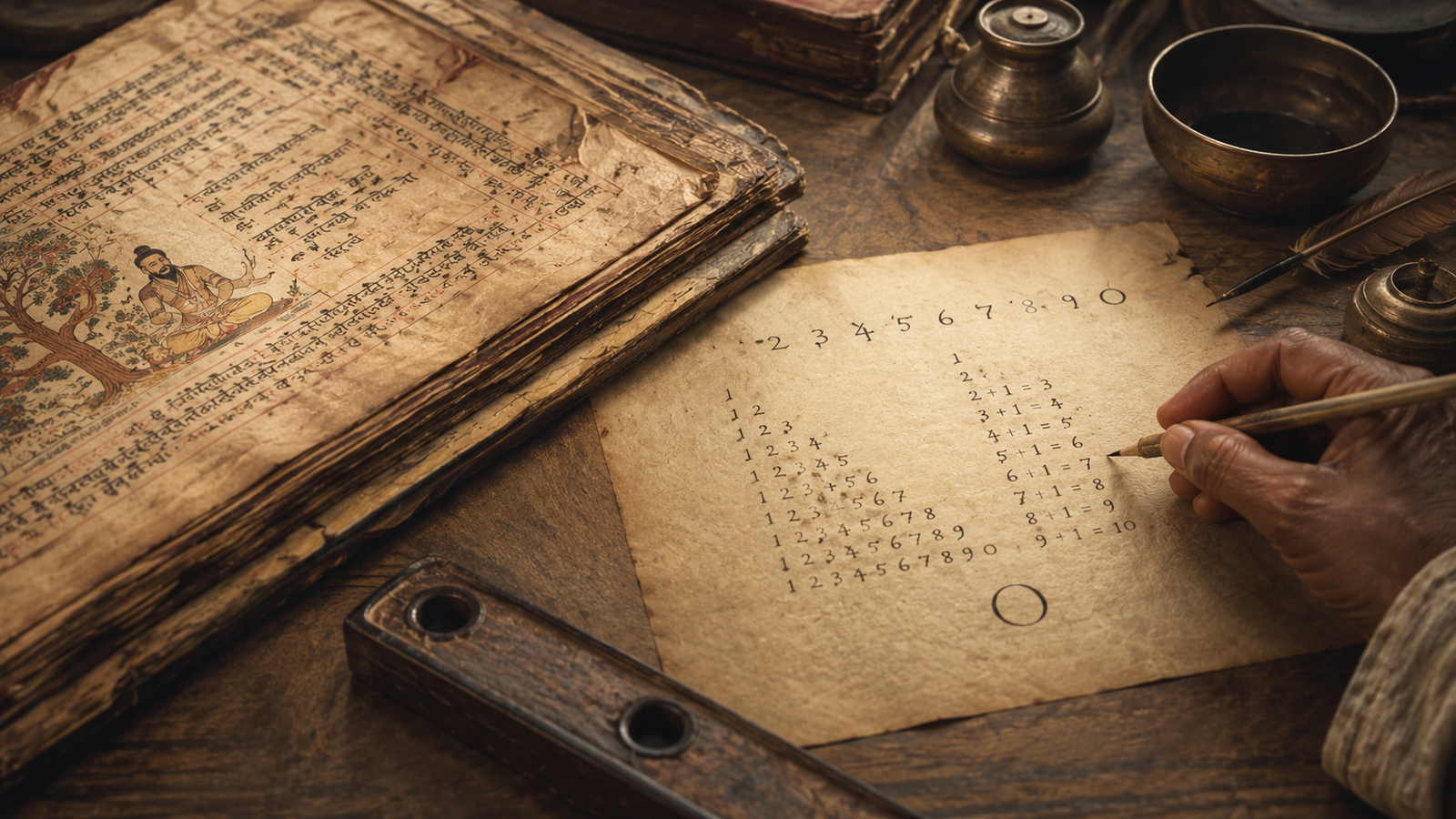
Try to imagine mathematics without zero.
You could count one apple.
Two apples.
Ten apples.
But how would you write a number such as 105?
Without a symbol representing an empty place, positional notation becomes difficult.
Zero solved that problem.
But zero did not appear suddenly.
Different civilizations developed ways to represent an empty position in numbers. The idea gradually evolved from a placeholder into something much more powerful.
The major breakthrough came in India, where mathematicians eventually treated zero as a number and developed rules for calculating with it.
In the seventh century, the Indian mathematician Brahmagupta gave systematic arithmetic rules involving zero and negative numbers in his Brahmasphutasiddhanta. This was a major conceptual step because zero was being treated as a mathematical quantity, not merely as an empty position. (Maths History)
The zero you use today is therefore the result of a long mathematical history.
Zero developed through several stages, from representing an empty position to becoming a number that could be used in arithmetic.
Why Did Humans Need Zero?
Early counting systems did not necessarily need a symbol for zero.
If you have three objects, you can count them as three.
If you have ten objects, you can represent ten using whatever number system your culture has developed.
The problem becomes more complicated when numbers are written using place value.
In a place-value system, the position of a symbol determines its value.
Consider the numbers 15 and 105.
The 1 has a different value in each number because its position is different.
The zero in 105 tells you that there are no tens.
Without some way to mark that empty position, the number could become ambiguous.
Zero therefore began as an important tool for representing absence within a positional number system.
Did One Civilization Invent Zero?
The history is more complicated than a single invention.
Ancient civilizations developed different ways of representing empty positions.
Babylonian mathematicians used positional notation and developed symbols that could indicate an empty place in certain contexts.
The ancient Maya also developed a sophisticated numeral system that included a zero-like symbol.
But these developments did not all lead to the modern mathematical concept of zero in the same way.
The crucial distinction is between a placeholder and zero as a number.
A placeholder tells you that a particular position is empty.
A number can be used in calculations and mathematical statements.
The transition between these ideas was historically important.
How Did Ancient Babylonian Mathematics Use Zero?
Babylonian mathematics used a base-60 positional system.
This system was extremely sophisticated.
A positional system means that the meaning of a symbol depends partly on its position.
Babylonian scribes eventually used special signs to help indicate an empty position.
This was useful.
But their zero was not yet functioning in exactly the same way as the modern number zero.
The symbol mainly helped distinguish positions.
This shows that the idea of representing absence within a number system is much older than the modern numeral 0.
What Did the Ancient Maya Do?
The Maya developed another independent mathematical tradition.
Their civilization used a base-20 positional numeral system.
They also used a symbol representing zero.
Zero played an important role in their calendar calculations and numerical notation.
This is a remarkable example of mathematical development occurring independently in another part of the world.
But the Maya system followed its own historical path.
The modern mathematical treatment of zero developed through the Indian mathematical tradition and later spread through the Islamic world into Europe.
What Changed in India?
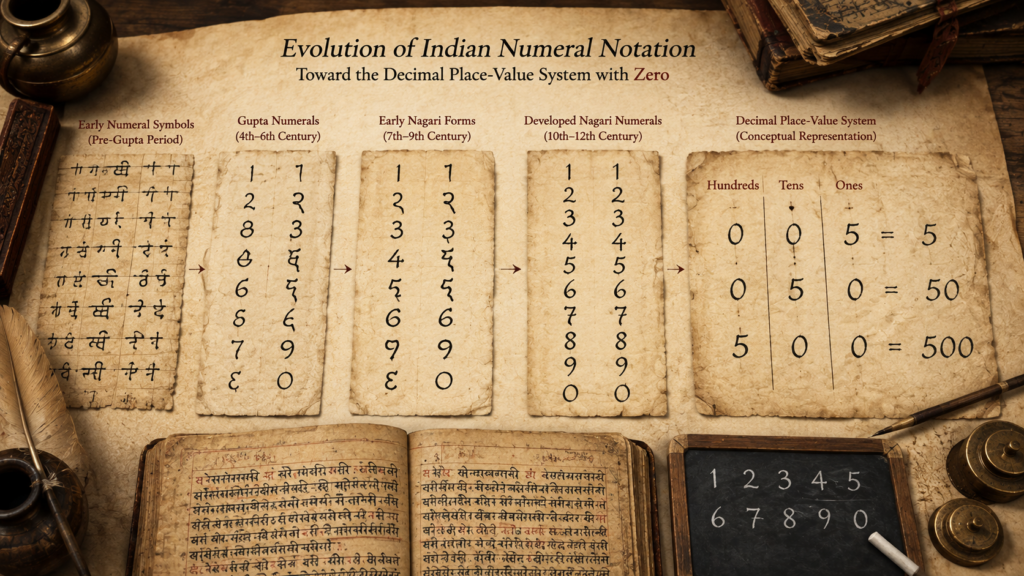
Indian mathematicians developed a positional decimal numeral system that became the foundation of the modern Hindu-Arabic numeral system.
The system used ten symbols, including zero.
The power of the system came from combining place value with a consistent symbol for zero.
This allowed numbers to be written compactly and calculations to be performed efficiently.
The development occurred over centuries.
It was not the work of a single mathematician.
The Indian mathematical tradition gradually developed the notation and arithmetic framework that made zero a fully useful part of mathematics. MacTutor notes that the numerals, including zero, originated in India and became part of a place-value system. (Maths History)
The Indian decimal place-value tradition provided the foundation for the numeral system used throughout much of the modern world.
What Was the Big Conceptual Breakthrough?
The major breakthrough was treating zero as a number.
A placeholder answers one question.
“What is missing from this position?”
A number answers another.
“How much?”
Zero can answer the second question.
It represents a quantity of none.
That sounds simple today.
It was not simple historically.
Once zero became a number, mathematicians could formulate general rules involving it.
This transformed arithmetic.
Who Was Brahmagupta?

Brahmagupta was an Indian mathematician and astronomer who lived from about 598 to 670 CE.
He worked in a period when Indian mathematics and astronomy were developing rapidly.
His major work, the Brahmasphutasiddhanta, was completed in 628 CE. (Maths History)
Brahmagupta is especially important in the history of zero because he gave explicit rules for arithmetic involving zero and positive and negative numbers.
This was a major step toward treating zero as a genuine mathematical object.
What Rules Did Brahmagupta Give for Zero?
Brahmagupta described operations involving zero.
For example, he stated that adding zero to a number leaves the number unchanged.
He also recognized that multiplying a number by zero produces zero.
He treated zero minus zero as zero.
These ideas may seem obvious today.
But formalizing them was an important development in mathematical thought.
Brahmagupta also attempted to describe division involving zero.
His treatment of division by zero was not correct by modern standards.
That is important because it shows that mathematical ideas can develop gradually.
A mathematician can establish correct rules in one area while still struggling with another.
(Maths History)
Why Is Division by Zero Different?
You can divide 10 by 2.
The answer is 5.
You can divide 10 by 5.
The answer is 2.
But what would 10 divided by zero mean?
Division asks a reverse multiplication question.
If 10 divided by 2 equals 5, then 5 multiplied by 2 equals 10.
For 10 divided by zero, we would need a number that multiplied by zero produces 10.
No ordinary number can do that.
Every number multiplied by zero equals zero.
Modern mathematics therefore treats division by zero as undefined.
Brahmagupta’s attempt to handle this problem shows how difficult the concept of zero was, even after mathematicians had begun treating it as a number.
Why Did Zero Change Mathematics?
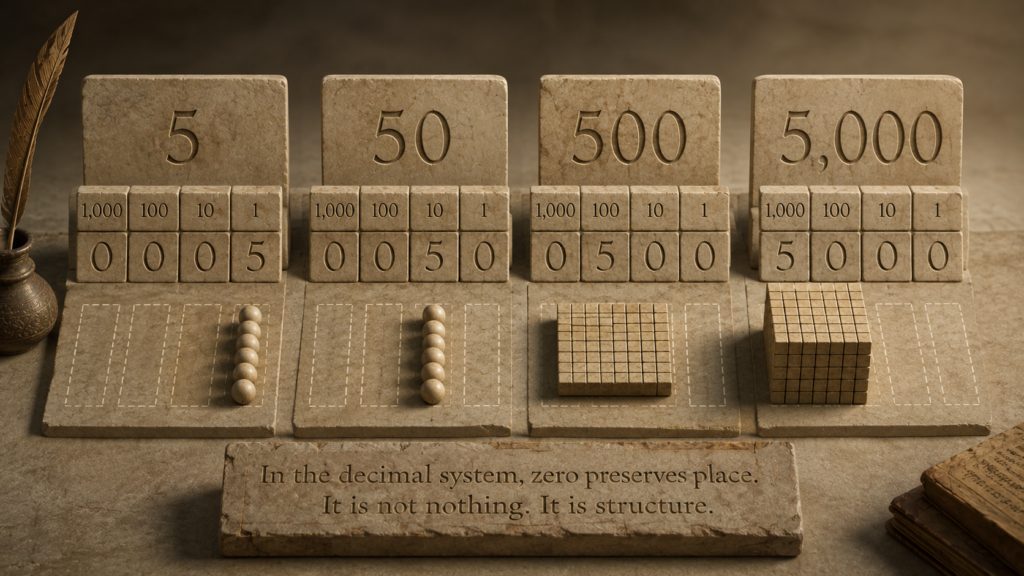
Zero transformed positional notation.
Consider the difference between 5 and 50.
The zero tells you that the 5 occupies the tens position.
Now consider 500.
Two zeros preserve two empty positions.
This makes large numbers easy to represent.
More importantly, the same system works consistently across scales.
5,000.
The position determines the value.
Zero preserves the empty positions.
That combination is extraordinarily powerful.
How Did Zero Reach the Islamic World?
Indian mathematics eventually spread westward.
Scholars in the Islamic world encountered Indian mathematical methods and incorporated them into their own mathematical traditions.
The Arabic word sifr, meaning empty or zero, became associated with the concept.
From this tradition, the numeral system eventually moved toward Europe.
The mathematical methods were developed further by scholars working in Arabic and Persian intellectual traditions.
This transmission played a major role in bringing the decimal positional system into wider use.
The modern English word “zero” ultimately has a long linguistic history connected to these developments.
How Did Zero Reach Europe?
European mathematicians encountered Hindu-Arabic numerals through contact with the Islamic world.
One important figure was Leonardo of Pisa, better known as Fibonacci.
His book Liber Abaci, published in 1202, helped introduce Hindu-Arabic numerals and their calculation methods to European readers.
The new system was more efficient for calculation than many traditional European numeral systems.
It gradually gained wider acceptance.
The process took centuries.
The symbols and methods were not immediately adopted everywhere.
But their practical advantages were difficult to ignore.
Why Were Hindu-Arabic Numerals So Powerful?
Imagine trying to perform long multiplication using Roman numerals.
The system is not designed around place value in the same way.
Now compare it with:
247 × 36.
The decimal positional system makes the calculation systematic.
Each digit has a value determined by position.
Zero preserves positions that contain no units of a particular place.
The result is a compact notation that works for both simple and extremely large numbers.
This is one reason the system became so influential.
It made calculation easier.
What Does Zero Mean Mathematically?
Today, zero has several important roles.
It represents the absence of quantity.
It acts as the additive identity.
For any number x:
x + 0 = x.
It also separates positive and negative numbers on the number line.
Numbers greater than zero are positive.
Numbers less than zero are negative.
Zero sits between them.
It also plays a central role in algebra, calculus, geometry, physics, computing, and statistics.
The simple symbol became one of the most important concepts in mathematics.
Why Is Zero So Important in Algebra?
Zero allows equations to be expressed in powerful ways.
Consider:
x + 5 = 12.
You can solve for x.
But many algebraic relationships are written by moving everything to one side:
x² – 9 = 0.
Now the equation asks which values of x make the expression equal zero.
Zero becomes a reference point.
This idea becomes even more important in higher mathematics.
Functions can have zeros.
Graphs can cross the zero line.
Polynomials can be solved by finding their roots.
The concept of zero therefore becomes a central organizing point in mathematics.
Why Is Zero Important in Calculus?
Calculus is deeply connected to quantities approaching zero.
Derivatives examine rates of change over extremely small intervals.
Limits describe what happens as a quantity approaches a particular value.
The concept of zero helps define continuity, slopes, infinitesimal behavior, and many other ideas.
Without a rigorous concept of zero, modern calculus could not exist in its current form.
The same simple number therefore appears at the foundation of advanced mathematics.
Why Is Zero Essential to Computers?

Computers use binary systems.
Binary has only two digits:
0 and 1.
Zero therefore becomes one of the fundamental symbols used to represent information electronically.
At the hardware level, digital systems encode information through physical states that can be represented using binary values.
Software, images, audio, text, and calculations are ultimately represented through enormous sequences of binary data.
The symbol that once represented “nothing” became one of the two basic digits underlying modern digital technology.
Why Is Zero More Than “Nothing”?
This is the most important conceptual lesson.
Zero represents no quantity.
But it is still a quantity in the mathematical system.
It can be added.
It can be subtracted.
It can be multiplied.
It can define positions.
It can separate positive and negative numbers.
It can appear in equations.
It can define the roots of functions.
It can form part of binary information.
Zero is therefore not simply the absence of mathematics.
It is one of mathematics’ most useful objects.
Why Did It Take So Long?
The difficulty was conceptual.
Humans could understand the idea of having nothing.
But representing “nothing” with a symbol is different.
Treating that symbol as a number is another step.
Then developing rules for calculating with it creates another layer of abstraction.
The historical development of zero therefore required several ideas to come together.
Counting.
Place value.
Symbolic notation.
Arithmetic rules.
Abstract mathematical reasoning.
The concept became powerful only when these pieces worked together.
Was Zero Invented Once?
No.
The history of zero contains several independent developments.
Different civilizations developed symbols or concepts representing empty positions or zero-like quantities.
But the modern mathematical zero developed through a long process.
Indian mathematicians played a central role in turning zero into a number within a decimal place-value system.
Brahmagupta then provided explicit arithmetic rules involving zero in the seventh century.
Later scholars expanded and transmitted the system.
The modern zero is therefore the result of cumulative mathematical development rather than one isolated invention.
The Simple History of Zero
The story can be reduced to a sequence.
Ancient societies developed number systems.
Positional notation created the need to represent empty positions.
Babylonian mathematicians developed symbols for certain empty positions.
The Maya independently developed a zero symbol within their own positional system.
Indian mathematicians developed a decimal place-value system using zero.
Zero gradually became more than a placeholder.
Brahmagupta formalized arithmetic rules involving zero in the seventh century.
Mathematical traditions in the Islamic world transmitted and developed the system.
Hindu-Arabic numerals eventually reached Europe.
The system became the foundation of modern everyday mathematics.
Zero moved from representing absence to becoming one of mathematics’ most powerful ideas.
The Strange Lesson of Zero
Zero looks insignificant.
It is a small circle.
It represents nothing.
Yet without it, modern mathematics would look completely different.
There would be no simple decimal representation of numbers such as 100, 1,000, or 10,000.
Algebra would be radically different.
Calculus would not have developed in its modern form.
Digital computing would not use the same binary notation.
The history of zero therefore reveals something important about human knowledge.
Sometimes the most powerful ideas begin with something that seems empty.
Related Reading
Key Takeaways
- Zero developed gradually rather than appearing through one single invention.
- Ancient Babylonian mathematics used symbols to indicate certain empty positions.
- The Maya independently developed a zero symbol in their positional numeral system.
- Indian mathematicians developed zero within a decimal place-value system.
- Brahmagupta gave systematic arithmetic rules involving zero in the seventh century.
- Zero became a number rather than remaining only a placeholder.
- Indian mathematical ideas spread through the Islamic world and later into Europe.
- Hindu-Arabic numerals made positional calculation highly efficient.
- Zero is central to algebra, calculus, and modern mathematics.
- Zero is also one of the two fundamental digits of binary computing.
Conclusion
Zero was not simply discovered one day.
It developed through centuries of mathematical experimentation.
Civilizations found ways to represent empty positions.
Indian mathematicians took the idea further.
They developed a decimal place-value system in which zero became an essential symbol.
Brahmagupta then gave explicit rules for calculating with zero and negative numbers.
Later mathematicians developed the system further and transmitted it across cultures.
Eventually, the concept reached Europe and became part of the numeral system used around the world today.
The result is a symbol that represents nothing while doing an enormous amount of mathematical work.
Zero separates positive from negative.
It preserves place value.
It helps define equations.
It supports calculus.
It forms the foundation of binary computing.
A tiny circle changed mathematics because humans learned to treat absence as something that could be represented, manipulated, and understood.
Explore more evidence-based explanations of important ideas, scientific thought, and the history of human knowledge in CAVELYRA’s History of Ideas collection.