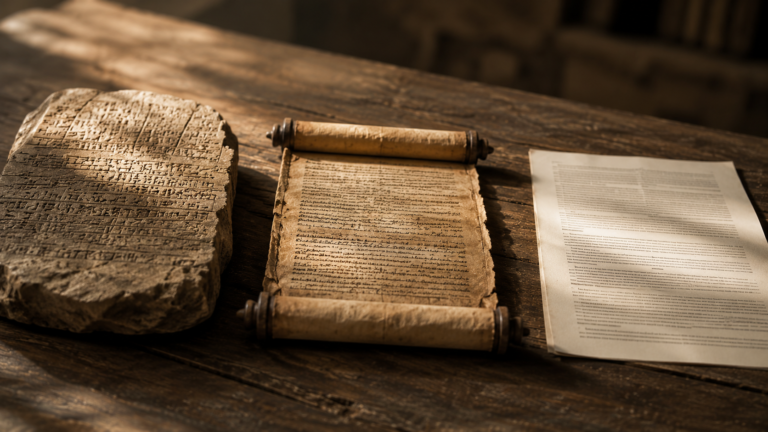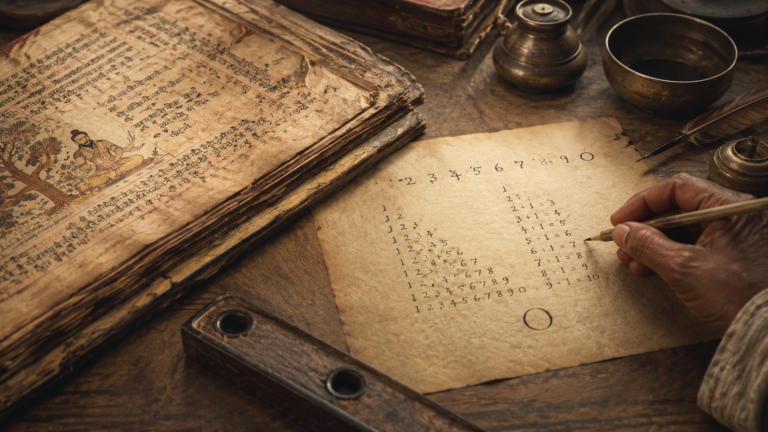
Imagine a world without money.
You grow wheat.
Your neighbor makes pottery.
You need a pot.
Your neighbor needs wheat.
The exchange seems simple.
But what happens if your neighbor does not want wheat?
You may need to find someone else who wants what you have and owns something your neighbor wants.
This is one of the problems that money eventually helped solve.
But money did not begin as coins, banknotes, or digital numbers on a screen.
It developed gradually from systems of exchange, accounting, debt, commodities, and standardized units of value.
The earliest monetary systems appeared thousands of years ago in complex societies where people needed reliable ways to record obligations, measure goods, pay workers, collect taxes, and conduct trade.
Ancient Mesopotamia provides some of the earliest written evidence of sophisticated economic accounting. Silver was also used as a unit of value in the ancient Near East, while grain and other commodities played important economic roles.
Coins appeared much later.
The first widely recognized standardized coins were produced in the kingdom of Lydia in western Anatolia during the seventh century BCE.
Paper money developed much later in China.
Modern money eventually became increasingly separated from physical commodities.
Today, most money exists as digital records.
The history of money is therefore a history of solving a practical human problem.
How can a society measure, transfer, store, and trust value?
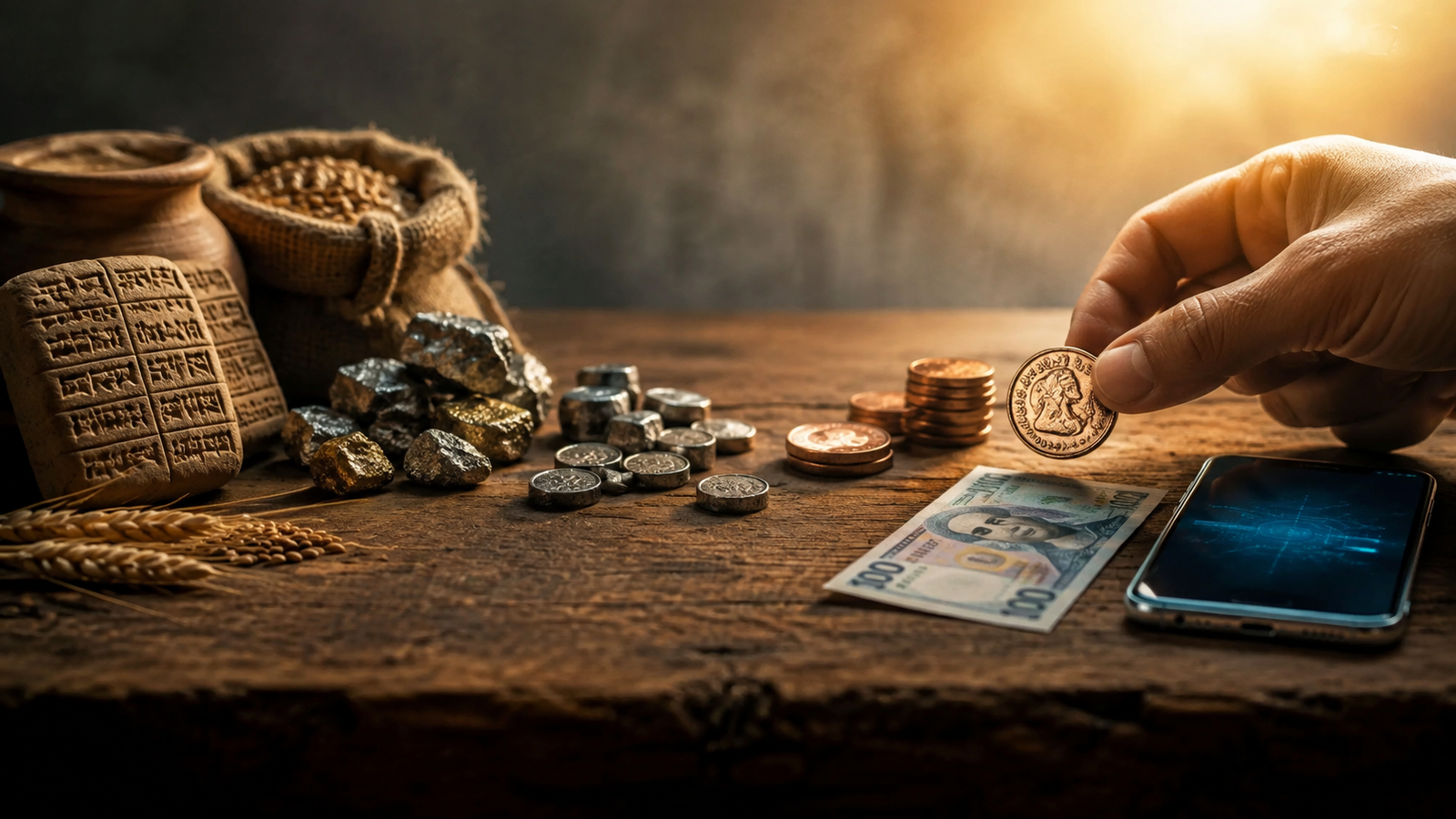
Money developed through many stages, from commodities and accounting systems to standardized coins, paper currency, and digital records.
What Is Money?
Money is more than something you use to buy food.
Economists generally describe money through three major functions.
It acts as a medium of exchange.
It provides a unit of account.
It can serve as a store of value.
These functions solve different problems.
As a medium of exchange, money allows people to trade without finding someone who wants exactly what they have.
As a unit of account, money gives prices a common measurement.
As a store of value, money allows purchasing power to be carried into the future.
A modern banknote performs all three functions.
But early forms of money did not necessarily perform them equally well.
Did Barter Come Before Money?
Direct exchange certainly existed before modern money.
People traded goods and services with one another.
But the popular idea that all early economies depended entirely on barter is too simple.
Anthropologists and economic historians have found that many early societies also relied heavily on credit, debt, redistribution, gifts, and accounting systems.
In a small community, people could keep track of obligations through social relationships.
You might provide food today and receive help later.
No physical money would need to change hands.
As societies became larger and trade became more complex, more standardized systems became useful.
Money developed within this wider economic environment.
What Problem Did Money Solve?
Imagine that you have wheat and want shoes.
The shoemaker wants food.
That looks like an easy trade.
But suppose the shoemaker already has enough wheat.
You now have a problem.
This is sometimes called the double coincidence of wants.
Both sides need to want what the other has at the same time.
Money removes much of this difficulty.
You can sell your wheat for money.
The shoemaker can accept the money even if they do not currently need wheat.
Later, they can use that money to buy something else.
Money therefore separates the act of selling from the act of buying.
That greatly expands the possibilities for trade.
What Was Used as Money Before Coins?
Many things have been used as money or money-like instruments.
Grain.
Silver.
Gold.
Copper.
Livestock.
Shells.
Beads.
Cloth.
Salt.
Other commodities have also served as units of exchange or stores of value in particular societies.
But an object does not become useful money simply because people value it.
It needs social acceptance.
People must believe that others will accept it in future transactions.
This is one of the most important features of money.
Its value depends heavily on trust and shared expectations.
Why Was Silver Important?
Silver became especially important in ancient economies because it was relatively durable, divisible, portable, and valuable.
In ancient Mesopotamia and neighboring regions, silver was used in economic transactions and could serve as a measure of value.
But silver did not always circulate as standardized coins.
It could be weighed.
This distinction matters.
Money does not require a coin.
A measured quantity of silver can perform monetary functions even when it has no standardized stamped shape.
Ancient economic records show that societies could use measured quantities of commodities to calculate prices and obligations.
How Did Mesopotamia Use Money?
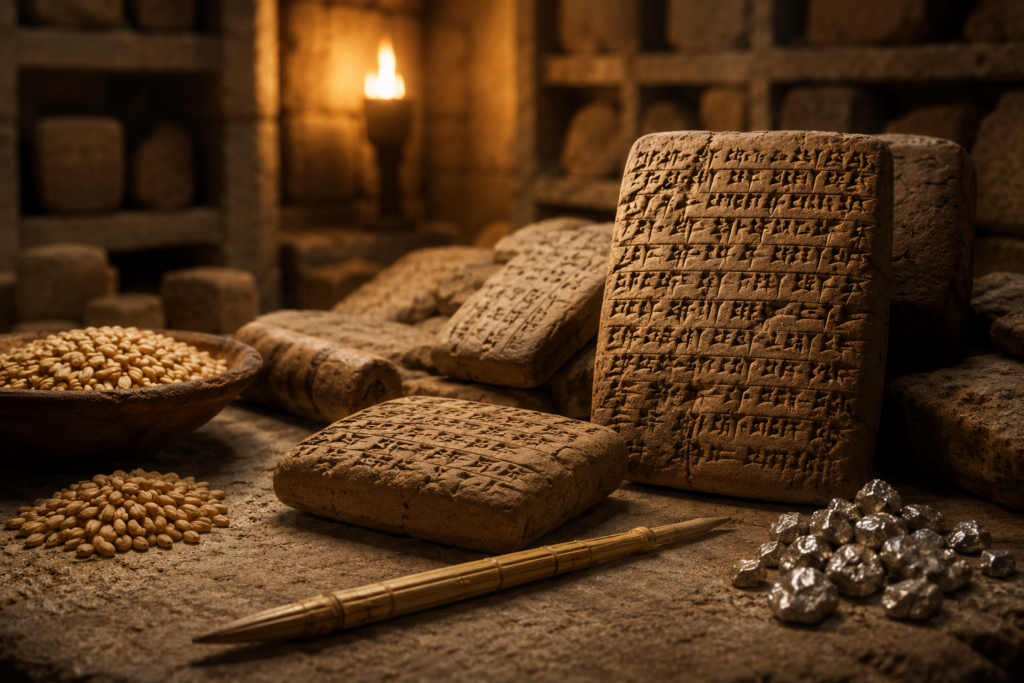
Ancient Mesopotamian societies developed sophisticated systems of accounting.
Clay tablets recorded quantities of grain, silver, livestock, labor, taxes, loans, and other economic obligations.
These records allowed institutions to track resources across large administrative systems.
Silver could serve as a standard of value.
Grain could also function as a payment or accounting unit.
The important development was not simply the presence of valuable objects.
It was the ability to measure and record economic obligations systematically.
Writing and accounting therefore played an important role in the development of monetary systems.
Ancient accounting systems allowed societies to record quantities, debts, payments, and economic obligations.
Why Did Standard Units Matter?
Imagine buying grain without a common unit.
One person says the grain is worth three jars.
Another says it is worth half a sheep.
A third uses a weight of silver.
Trade becomes difficult.
Standard units make comparison easier.
Ancient societies developed standardized measures for weight, volume, and length.
Once prices could be expressed in standardized units, economic transactions became easier to record.
Money and measurement therefore developed together.
A monetary system needs a way to answer a basic question.
How much is this worth?
When Did Coins Appear?
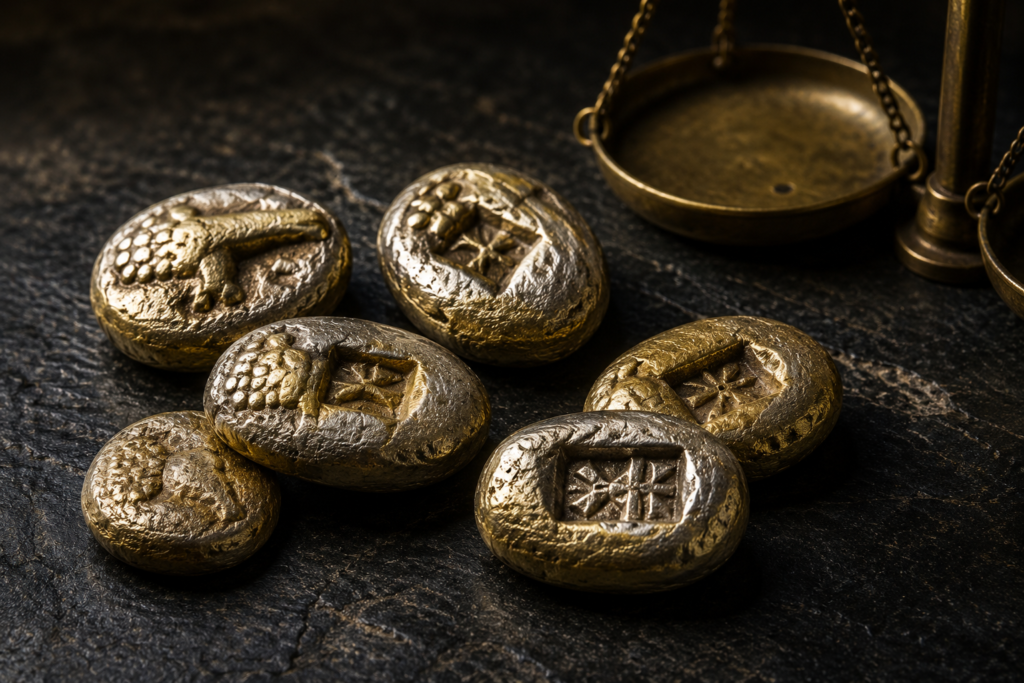
Coins appeared much later than the earliest forms of money.
The first widely recognized standardized coins emerged in Lydia, in western Anatolia, during the seventh century BCE.
Lydian rulers produced pieces of precious metal with standardized weights and official marks.
The official stamp helped communicate that the coin met a recognized standard.
This was a major practical improvement.
Instead of weighing metal every time, people could use standardized pieces.
Standardized coinage made transactions easier by combining recognized weight, material, and official authority in a single object.
Why Were Coins So Useful?
Coins solved several practical problems.
They were portable.
They could be divided into different denominations.
They had recognizable designs.
Their weight and metal content could be standardized.
Official marks could signal that the issuing authority guaranteed a particular standard.
Coins therefore reduced the need to weigh and evaluate raw metal during every transaction.
They also allowed governments to collect taxes and pay soldiers more efficiently.
Coinage became an important part of expanding economies.
Did Governments Invent Money?
Governments played an important role in standardizing and regulating money.
They could issue coins.
They could define official units.
They could collect taxes in particular forms of payment.
They could punish counterfeiting.
But money did not originate entirely from governments.
Trade, debt, accounting, commodity exchange, and social trust existed in many forms before standardized state coinage.
The history of money is therefore both economic and political.
Markets needed useful forms of exchange.
Governments could strengthen them through standardization and enforcement.
Why Did Paper Money Appear?
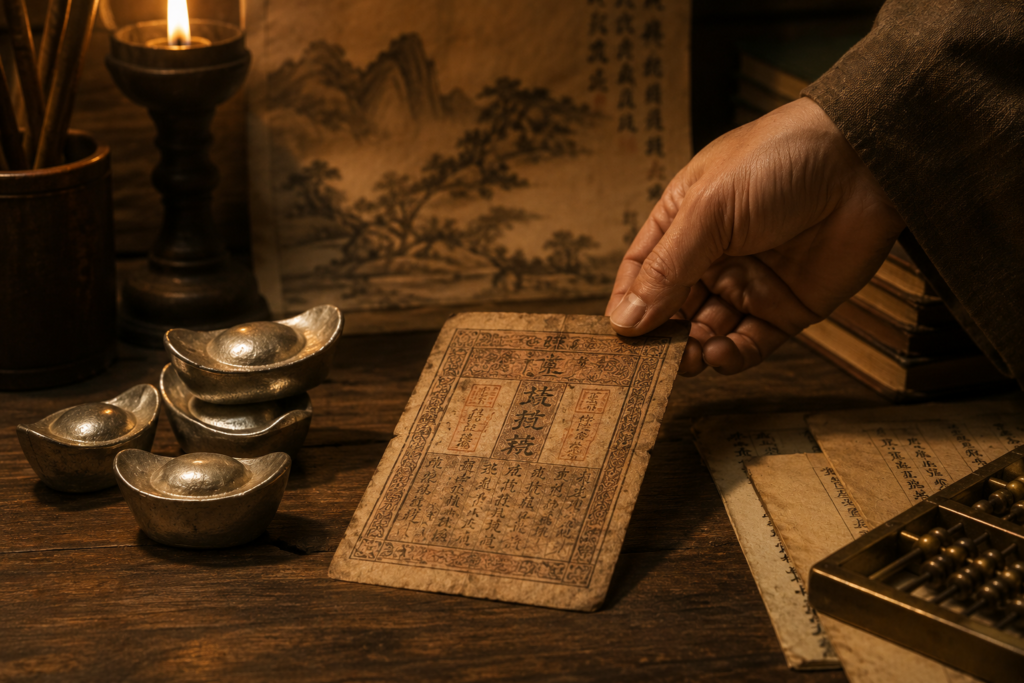
Paper money developed much later than coins.
China played a major role in this development.
Chinese merchants and governments used forms of paper payment as economic activity expanded.
By the Song dynasty, government-issued paper currency had become an important part of the monetary system.
Paper had an obvious advantage.
It was much lighter than large quantities of metal.
A valuable claim could therefore be transferred without physically moving the equivalent amount of precious metal.
This required something new.
Trust in the issuer.
Paper currency reduced the physical burden of carrying large amounts of metal while relying on trust in the issuing system.
Why Does Paper Money Have Value?
A modern banknote usually has little value as a physical object.
The paper itself is not worth the amount printed on it.
Its value comes from the monetary system that supports it.
People accept the note because they expect others to accept it.
Governments establish legal and institutional frameworks around currency.
Central banks manage monetary systems.
Banks process payments.
Economic institutions support confidence in the currency.
Money therefore depends heavily on collective trust.
What Is Fiat Money?
Modern national currencies are generally fiat money.
Fiat money has value because the monetary system recognizes it as money rather than because the physical material itself contains an equivalent intrinsic value.
A 100-dollar note does not contain 100 dollars’ worth of paper.
Its usefulness comes from its accepted monetary status and the economic system surrounding it.
Most modern currencies are therefore examples of fiat money.
Why Did Gold Become So Important?
Gold has been valued across many societies.
It is durable.
It does not easily corrode.
It is relatively scarce.
It can be divided and shaped.
It is visually distinctive.
These properties made gold useful for jewelry, wealth storage, and monetary systems.
For centuries, many governments used gold and silver in coinage.
Later, some monetary systems linked paper currencies to specific quantities of precious metals.
This became known as the gold standard.
What Was the Gold Standard?
Under a gold standard, a currency’s value was linked to a defined quantity of gold.
Depending on the specific system, governments or central banks could promise to exchange currency for gold under specified conditions.
This placed limits on the creation of currency.
But gold standards also created economic constraints.
Governments could face difficulties responding to financial crises or changing economic conditions.
During the twentieth century, major countries gradually moved away from gold-based monetary systems.
The modern global monetary system is based primarily on fiat currencies.
How Did Banks Change Money?
Banks transformed the way money moved through economies.
A bank can accept deposits.
It can make loans.
It can transfer funds between accounts.
Modern banking systems also create deposits through lending under regulated conditions.
This means much of the money people use today does not exist as physical notes and coins.
It exists as electronic records in banking systems.
The concept of money therefore became increasingly abstract.
How Did Money Become Digital?
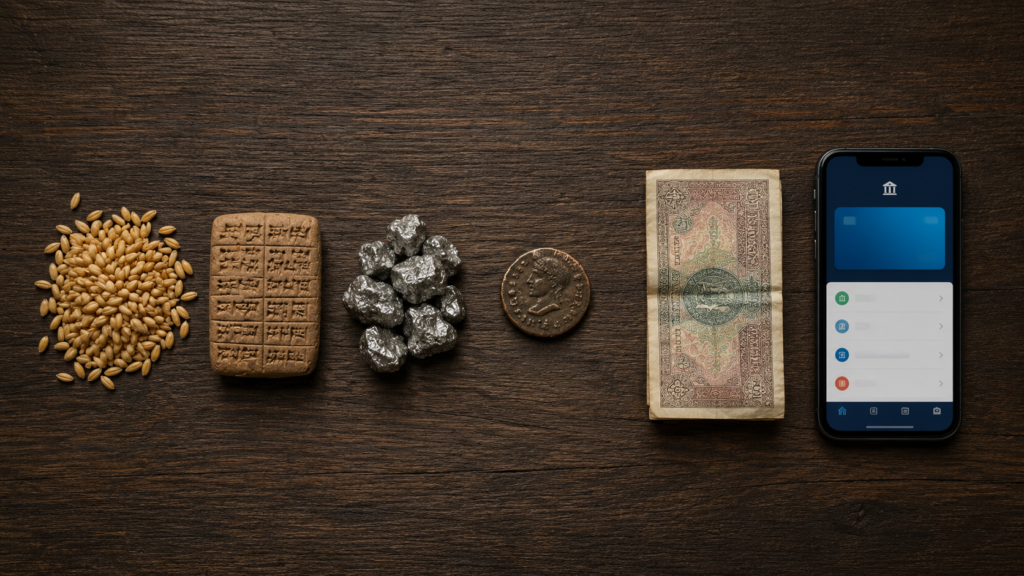
Modern money is increasingly represented electronically.
When you transfer money through a banking application, no physical banknote necessarily moves from one person to another.
The banking system updates account records.
Electronic payment networks communicate those changes.
Credit and debit cards rely on similar digital accounting.
Online commerce depends heavily on these systems.
The physical banknote remains important.
But most money in modern economies exists as electronic account balances.
What Makes Modern Money Work?
Modern money depends on several layers of trust.
People trust that a currency will be accepted.
Businesses trust payment systems.
Banks trust settlement networks.
Governments maintain legal frameworks.
Central banks manage monetary policy.
Financial institutions maintain records and process transactions.
Technology protects and transfers information.
The modern monetary system is therefore a huge network of shared expectations and institutional mechanisms.
Can Money Lose Its Value?
Yes.
Money is not automatically stable.
If prices rise rapidly, the purchasing power of a currency falls.
This is inflation.
Severe inflation can damage confidence in a currency.
People may begin searching for alternatives.
They may prefer foreign currencies, physical commodities, or other stores of value.
History contains many examples of currencies losing substantial purchasing power.
This reveals another important feature of money.
Its usefulness depends on confidence in the system supporting it.
Why Do People Accept Money?
This is perhaps the deepest question.
A banknote has value because you expect someone else to accept it.
That person accepts it because they expect someone else to accept it.
The chain continues.
Money works because society coordinates expectations.
This does not mean money is imaginary.
The purchasing power represented by money has real economic consequences.
But the physical object and the economic value are different things.
A banknote is a physical token.
The monetary value is part of a much larger institutional system.
What Happens When Trust Breaks Down?
If people lose confidence in a currency, its usefulness can deteriorate.
Businesses may raise prices rapidly.
People may try to spend currency quickly.
Savings may lose purchasing power.
Alternative forms of exchange may become more attractive.
This can happen during severe economic crises.
The lesson is clear.
A functioning monetary system requires more than physical tokens.
It requires institutions, rules, economic stability, and trust.
Why Does Money Keep Changing?
Human economies keep changing.
Trade expands.
Technology changes.
Governments change.
Financial systems become more complex.
Money adapts to these conditions.
Commodity money gave way to standardized coinage.
Coins were supplemented by paper currency.
Paper currency became linked to banking systems.
Bank balances became increasingly digital.
Electronic payments became normal.
The form changed.
The underlying problem remained.
People needed a practical way to measure, transfer, and store economic value.
Could Money Exist Without Physical Cash?
Yes.
A monetary system does not require physical objects.
Modern bank deposits already function as money for most everyday transactions.
Digital balances can be transferred electronically.
The important requirements are acceptance, accounting, transferability, and trust.
Physical cash is one form of money.
It is not the definition of money.
What About Cryptocurrencies?
Cryptocurrencies represent another stage in the history of monetary technology.
They use decentralized digital networks rather than relying entirely on traditional banking institutions.
Bitcoin, for example, uses a blockchain to record transactions.
But cryptocurrencies do not automatically function like conventional national currencies.
Their prices can be highly volatile.
Their acceptance varies.
Their economic and regulatory roles continue to develop.
They are best understood as part of the broader history of attempts to create new forms of digital value transfer.
The Simple History of Money
The development can be reduced to a sequence.
People exchanged goods and services.
Communities developed systems of credit, debt, gifts, and accounting.
Commodities such as grain and silver became important measures and stores of value.
Standardized weights made economic calculation easier.
Governments began issuing standardized coins.
Paper currency later reduced the physical burden of moving value.
Banking systems transformed deposits and lending.
Modern currencies became primarily fiat money.
Electronic records replaced much physical cash in everyday transactions.
Digital payment systems now move enormous amounts of value across the world.
The form of money keeps changing.
The underlying function remains.
Money helps humans coordinate economic exchange.
The Strange Lesson of Money
Money looks like an object.
A coin.
A banknote.
A number on a screen.
But its real power comes from the system around it.
A coin works because people recognize it.
A banknote works because people trust the monetary system.
A bank balance works because financial institutions maintain records and process transfers.
Money is therefore both a technology and a social institution.
Its history is the history of humans finding better ways to coordinate economic value.
Related Reading
Key Takeaways
- Money developed gradually rather than being invented in a single moment.
- Early economies used barter, credit, debt, gifts, redistribution, and accounting.
- Commodities such as silver and grain served important monetary functions in ancient economies.
- Standardized units made prices and obligations easier to measure.
- Standardized coins emerged in Lydia during the seventh century BCE.
- China played a major role in the development of paper currency.
- Modern national currencies are generally fiat money.
- Banks transformed money into increasingly abstract account balances.
- Most modern money exists as electronic records rather than physical cash.
- Money works because people, institutions, and economic systems trust and accept it.
Conclusion
Money did not begin as a banknote.
It did not begin as a digital balance.
It developed gradually as humans needed better ways to exchange, measure, record, and store value.
Ancient societies used commodities, weights, accounting systems, credit, and debt.
Standardized coins later made transactions easier.
Paper currency reduced the burden of transporting metal.
Banks transformed deposits and lending.
Modern financial systems turned much of money into electronic records.
The physical form keeps changing.
The underlying problem remains the same.
How can millions of people exchange value without knowing one another personally?
Money provides one answer.
It is a shared system for measuring value, transferring purchasing power, and recording economic obligations.
Its power does not come from the material of a coin or banknote.
It comes from the network of people and institutions that agree to treat it as valuable.
Explore more evidence-based explanations of ideas, history, and human thought in CAVELYRA’s History of Ideas collection.