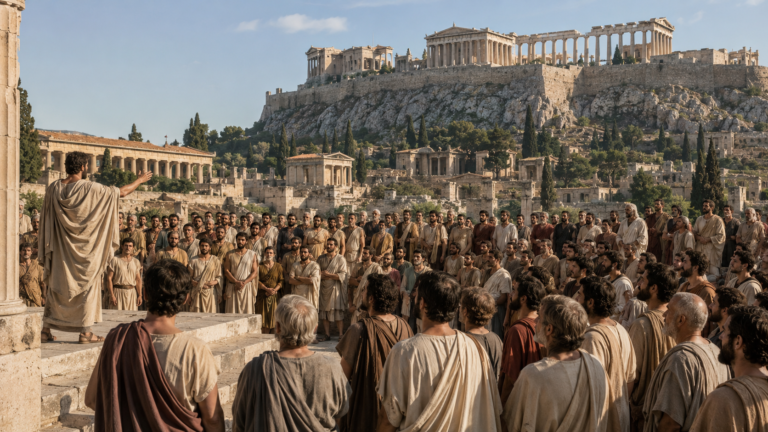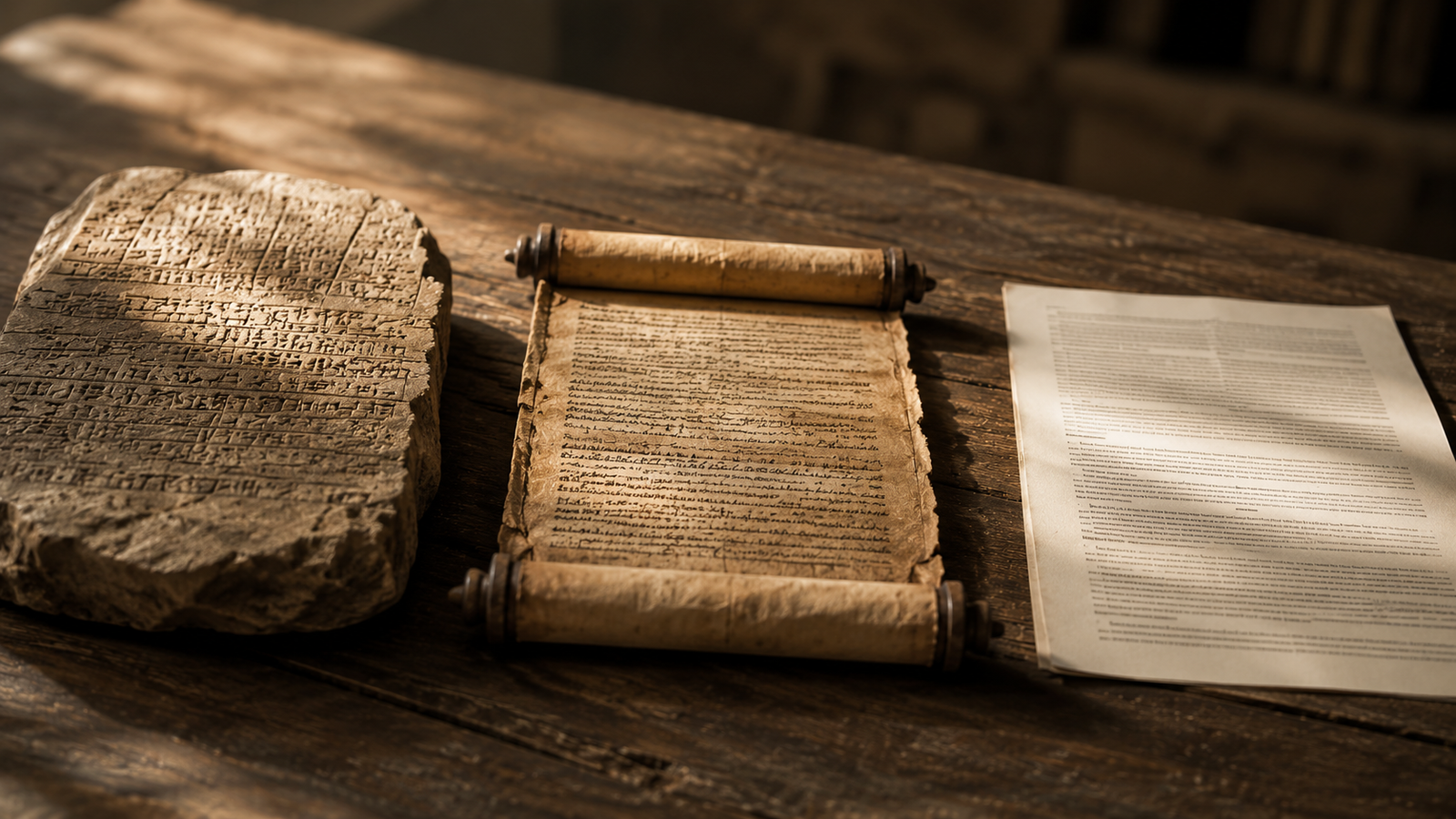
Today, the idea of human rights seems fundamental.
- You have the right to life.
- You have the right to express your views.
- You have the right to be treated with dignity.
- You have the right to freedom from discrimination.
But these ideas were not always understood as universal rights belonging to every human being.
For most of history, rights and privileges depended heavily on status.
Your position in society could depend on your family, wealth, citizenship, gender, religion, occupation, or relationship with a ruler.
The idea that every human being possesses basic rights simply because they are human developed gradually.
It did not begin with one document.
It did not belong to one civilization.
It emerged through centuries of moral philosophy, religious traditions, political struggles, legal reforms, revolutions, abolition movements, constitutional development, and international cooperation.
The modern concept took a decisive step in 1948 when the United Nations adopted the Universal Declaration of Human Rights.
The Declaration established a common international statement of fundamental rights and freedoms for all people. It was adopted in Paris on 10 December 1948 by the UN General Assembly. (United Nations)
But 1948 was not the beginning.
It was a major point in a much longer story.
The modern idea of human rights developed through centuries of debate about dignity, freedom, equality, justice, and the limits of political power.
What Are Human Rights?
Human rights are basic rights and freedoms understood to belong to human beings because they are human.
They include civil and political rights, as well as economic, social, and cultural rights.
Examples include the right to life, freedom of expression, freedom from torture, equality before the law, education, work, and social security.
The modern international system recognizes that these rights apply universally, regardless of nationality, gender, religion, language, ethnicity, or other status. (United Nations)
This principle creates a powerful question.
If a person has basic rights simply because they are human, where do those rights come from?
The answer has changed across history.
Did Human Rights Begin in 1948?
No.
The idea of human dignity and duties toward other people is much older.
Many civilizations developed moral and legal traditions concerning justice, human dignity, responsibilities, and the treatment of others.
The United Nations notes that traditions related to human dignity and human obligations can be found across cultures and religions long before the modern human rights system. (Search Library)
Ancient texts and legal traditions addressed questions about justice, duties, punishment, property, family relationships, and social responsibilities.
But there is an important distinction.
Having ancient ideas about justice does not mean those societies possessed modern universal human rights.
Many historical societies accepted slavery, social hierarchy, unequal legal status, and discrimination.
The idea of universal rights developed much later.
What Was the Golden Rule?
One recurring idea in human moral history is the principle that people should treat others as they would want to be treated.
Versions of this principle appear in different religious and philosophical traditions.
It does not create a modern human rights system by itself.
But it reflects an important moral insight.
Other human beings possess moral significance.
Their suffering matters.
Their treatment should be governed by principles rather than unlimited power.
This type of moral reasoning contributed to the broader intellectual history from which later ideas about human dignity and rights emerged.
Why Was Law Important?
Moral ideas become more powerful when societies turn them into rules.
- Laws can restrict rulers.
- They can define procedures.
- They can protect property.
- They can establish rights for particular groups.
- They can limit arbitrary punishment.
This does not automatically create universal human rights.
But legal limits on political authority became an important part of the story.
Over time, people increasingly asked whether rulers themselves should be subject to law.
That question would become central to later constitutional government.
What Was the Magna Carta?

The Magna Carta was issued in England in 1215.
It emerged from a conflict between King John and rebellious barons.
The document was not a declaration of universal human rights.
Its protections were limited and reflected the social structure of medieval England.
Women, peasants, and many other groups did not receive equal political status.
Yet the Magna Carta became historically important because it contributed to the idea that the ruler's power could be constrained by law.
That principle later influenced constitutional thought.
What Were Natural Rights?

A major conceptual change occurred with the development of natural rights theory.
Natural rights are rights understood to belong to people by nature rather than being granted by a government.
This idea became particularly influential in European political philosophy during the seventeenth and eighteenth centuries.
Thinkers such as John Locke argued that individuals possess fundamental rights that governments are supposed to protect.
This changed the relationship between the individual and the state.
If rights exist before government, then government does not create all rights.
It has responsibilities toward them.
Why Was the Enlightenment Important?
The Enlightenment produced intense debate about reason, political authority, individual liberty, law, and equality.
Thinkers questioned inherited political structures.
They asked why kings should possess unlimited authority.
They examined whether governments derive legitimacy from the consent of the governed.
They debated the rights of individuals.
These ideas helped transform political philosophy.
But Enlightenment societies remained deeply unequal.
Slavery continued.
Women lacked political equality.
Colonial populations were subjected to imperial rule.
The development of rights was therefore full of contradictions.
The language of universal freedom existed alongside systems that excluded millions of people.
What Was the English Bill of Rights?
The English Bill of Rights was enacted in 1689 after the Glorious Revolution.
It placed important limits on royal authority and strengthened Parliament.
It addressed issues such as parliamentary proceedings, taxation, elections, and protection from certain forms of governmental abuse.
It was an important step in constitutional development.
But it was not a universal human rights document.
Its protections existed within a particular political system and did not establish equal rights for all human beings.
The distinction matters.
Constitutional rights and universal human rights are related.
They are not identical.
What Happened in the American Revolution?
The American Revolution produced powerful statements about individual rights and political legitimacy.
The Declaration of Independence in 1776 argued that people possess inherent rights and that governments derive their legitimacy from the consent of the governed.
The United States Bill of Rights, ratified in 1791, then protected specific freedoms within the American constitutional system.
These developments became influential examples of rights-based constitutional government.
But they also had major limitations.
Slavery continued.
Women did not have equal political rights.
Indigenous peoples were excluded from the political system.
The language of universal rights therefore existed alongside significant exclusions.
What Happened During the French Revolution?
The French Revolution produced another major rights document.
The Declaration of the Rights of Man and of the Citizen was adopted in 1789.
It proclaimed principles of liberty and equality and asserted that political authority should be connected to the nation and its citizens.
The document became one of the most influential statements of rights in modern political history.
Yet again, practice did not immediately match principle.
Women were excluded from political equality.
Colonial slavery remained a major issue.
The history of human rights is therefore also a history of people challenging the limits of supposedly universal principles.
Why Did Abolition Matter?
The abolition of slavery became one of the major human rights struggles of the modern era.
- Enslaved people resisted slavery themselves.
- Abolitionists developed moral and political campaigns.
- Religious groups opposed slavery.
- Political movements demanded legal change.
- Economic and political conditions also changed.
The abolition movement demonstrated that the concept of human dignity could be used to challenge institutions that had previously been treated as normal.
It also revealed a recurring pattern.
Rights often expand when excluded groups organize and demand that universal principles actually apply to them.
Why Did Women's Rights Become Central?
Early rights documents often used universal language while excluding women from political participation.
Women themselves challenged this contradiction.
- Education.
- Property rights.
- Legal equality.
- Political participation.
- Voting rights.
- Equal citizenship.
These movements gradually transformed laws and political institutions in many countries.
The history of human rights therefore did not simply move forward because governments voluntarily expanded rights.
People who lacked rights often had to organize to demand them.
Why Did Human Rights Become International?
For much of history, rights were primarily matters of domestic law.
A government decided which rights its citizens possessed.
The twentieth century changed this dramatically.
Two world wars demonstrated the devastating consequences of mass violence, persecution, and state power.
The Holocaust showed how catastrophic the consequences could become when governments stripped groups of their rights and treated human beings as less than human.
After the Second World War, the international community sought stronger principles for protecting human dignity.
The United Nations Charter, adopted in 1945, placed human rights among the organization's core purposes. (United Nations)
The next major step was the creation of the Universal Declaration of Human Rights.
Who Created the Universal Declaration of Human Rights?
The Declaration was produced through international cooperation.
The UN Commission on Human Rights began its work in 1947.
Eleanor Roosevelt chaired the drafting committee.
Other important contributors included René Cassin of France, Charles Malik of Lebanon, Peng Chun Chang of China, and John Humphrey of Canada. (United Nations)
The drafting process involved representatives from different political, cultural, legal, and religious backgrounds.
That diversity mattered.
The goal was to create a statement broad enough to gain international acceptance.
Why Was the Universal Declaration Important?
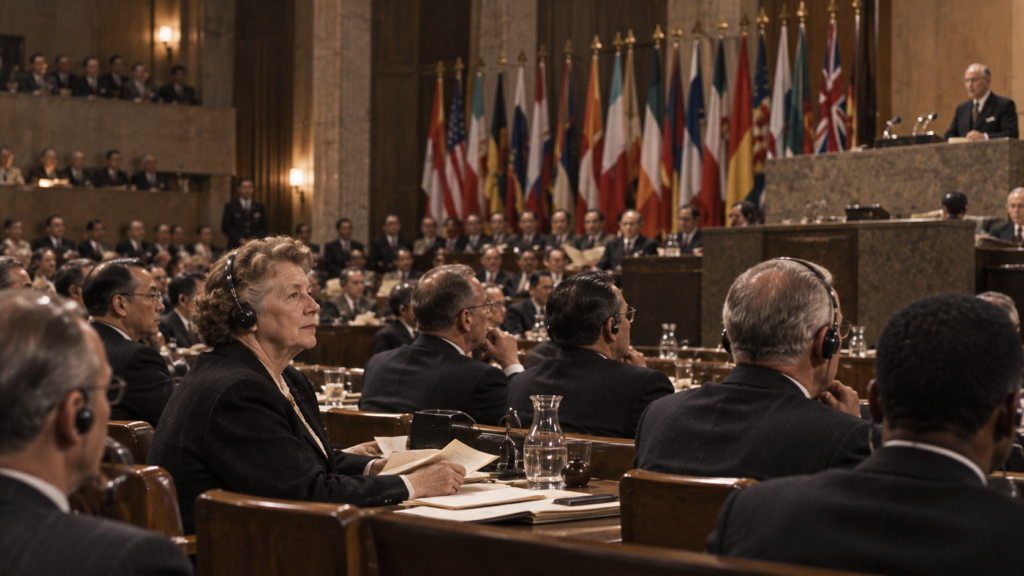
The Universal Declaration was adopted on 10 December 1948.
It set out a broad collection of fundamental rights and freedoms intended to apply to all human beings.
The document contains 30 articles.
It addresses rights including life and liberty, equality before the law, freedom of expression, freedom of religion, education, work, social security, and other fundamental freedoms. (United Nations)
Its importance was conceptual as well as political.
It established a global standard.
Human rights were no longer only a matter of what one government decided to recognize.
The international community had articulated a common framework.
Was the Universal Declaration Legally Binding?
The Declaration itself was adopted as a General Assembly resolution rather than as a treaty.
It therefore did not function as a binding treaty in the same way later human rights conventions do.
But its influence became enormous.
It inspired constitutions, national laws, international treaties, and human rights institutions.
The United Nations describes it as the foundation of modern international human rights law. (United Nations)
Later treaties transformed many of its principles into binding international legal obligations for states that ratified them.
What Happened After 1948?
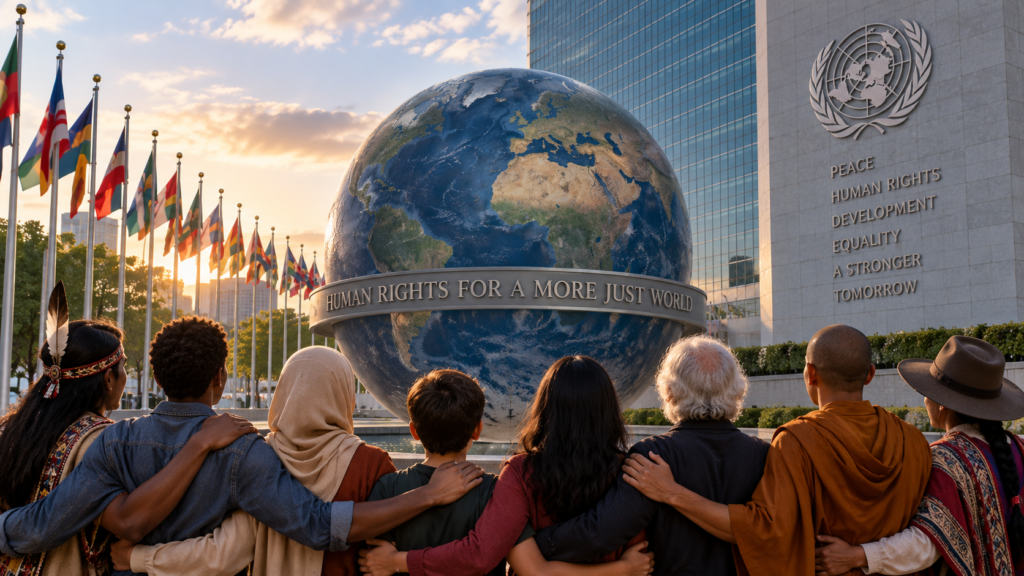
The international human rights system continued to expand.
In 1966, the United Nations adopted the International Covenant on Civil and Political Rights and the International Covenant on Economic, Social and Cultural Rights.
Both entered into force in 1976.
Together with the Universal Declaration, they form the International Bill of Human Rights. (United Nations)
Later treaties addressed specific forms of discrimination and abuse.
These included protections concerning racial discrimination, torture, enforced disappearance, women, children, persons with disabilities, migrants, minorities, and Indigenous peoples. (United Nations)
The concept of human rights therefore continued to become more specific.
Did Human Rights Develop Equally Everywhere?
No.
Countries developed different constitutional systems, laws, and political institutions.
Some expanded rights rapidly.
Others resisted.
Some governments adopted international treaties while violating rights in practice.
The history of human rights is therefore not a simple story of continuous progress.
- It includes advances.
- It also includes reversals.
Rights can be recognized in law and still be denied in practice.
Why Is Enforcement Difficult?
Human rights depend partly on institutions.
- Courts need independence.
- Laws need enforcement.
- Governments need accountability.
- Citizens need mechanisms for challenging abuses.
International treaties can establish obligations, but enforcement depends on national and international institutions.
This creates a persistent problem.
A right written on paper is not automatically a right enjoyed in everyday life.
The practical protection of rights requires functioning legal and political systems.
What Is the Central Idea Behind Human Rights?
The central idea is human dignity.
A person should not lose their basic worth because of their nationality, social position, wealth, gender, religion, ethnicity, or political beliefs.
The Universal Declaration expressed this principle by recognizing the inherent dignity and equal rights of all members of the human family. (United Nations)
This is the conceptual shift that separates modern human rights from many earlier systems of privilege.
Rights are attached to the person.
They are not supposed to depend entirely on status.
The Simple History of Human Rights
The development can be reduced to a sequence.
- Ancient societies developed moral and legal traditions concerning justice and human dignity.
- Medieval legal developments placed some limits on political authority.
- Natural rights philosophy argued that individuals possess rights by nature.
- Enlightenment thinkers developed ideas about liberty, equality, and government legitimacy.
- The American and French revolutions produced influential rights declarations.
- Abolition and women's rights movements challenged exclusions from supposedly universal principles.
- The twentieth century brought international human rights institutions.
- The United Nations adopted the Universal Declaration in 1948.
- Later treaties transformed many principles into international legal obligations.
- The idea continued expanding to address new forms of discrimination and vulnerability.
The Strange Lesson of Human Rights
Human rights can seem like permanent truths.
Historically, they are also products of struggle.
People argued about who counted as a rights-holder.
They argued about which freedoms mattered.
They challenged governments.
They challenged social hierarchies.
They demanded that universal principles actually become universal.
The language of human rights became powerful partly because it could be used against the people and institutions that had originally limited it.
That is why the history of human rights is not simply the history of documents.
It is the history of people expanding the meaning of human dignity.
Related Reading
Key Takeaways
- Human rights did not begin with the United Nations.
- Ancient and religious traditions developed ideas about justice, dignity, duties, and the treatment of others.
- Medieval legal developments helped establish the principle that rulers could be subject to law.
- Natural rights theory argued that people possess fundamental rights by nature.
- Enlightenment thought strengthened ideas about liberty, equality, and political legitimacy.
- The American and French revolutions produced influential rights declarations.
- Abolition and women's rights movements challenged major exclusions.
- The Second World War transformed the international approach to human rights.
- The United Nations adopted the Universal Declaration of Human Rights in 1948.
- Later treaties developed the international human rights system further.
Conclusion
Human rights were not invented in one place or at one moment.
The idea developed through centuries of moral reasoning, legal change, political conflict, and social movements.
Ancient traditions explored justice and human dignity.
Legal reforms began placing limits on political authority.
Natural rights philosophy argued that individuals possess fundamental rights by nature.
Enlightenment thinkers developed ideas about liberty and equality.
Revolutionary declarations gave those ideas political form.
Abolitionists and women's rights movements exposed the gap between universal language and actual exclusion.
Then the devastation of the Second World War pushed the international community toward a global framework.
In 1948, the United Nations adopted the Universal Declaration of Human Rights.
It did not end human rights abuses.
It did something different.
It established a common language for judging how human beings should be treated.
The idea continues to evolve.
And its central question remains remarkably simple.
What does every human being deserve simply because they are human?
Explore more evidence-based explanations of ideas, history, and human thought in CAVELYRA's History of Ideas collection.