Today, democracy feels familiar.
People vote.
Governments are elected.
Citizens have political rights.
But none of this was inevitable.
For most of human history, political power was concentrated in the hands of kings, aristocrats, military leaders, or small ruling groups.
Then, more than 2,500 years ago, a different political idea began taking shape in the Greek city-state of Athens.
The basic question was simple.
Who should have the power to govern?
The Athenians did not suddenly invent modern democracy in a single moment. The system developed through political conflicts, reforms, experiments, and changes in the way citizens participated in government.
Solon introduced important reforms in the early sixth century BCE. Later, around 508 BCE, Cleisthenes reorganized Athens’ political structure and greatly expanded citizen participation. Over the following decades, Athenian democracy became increasingly direct. (World History Encyclopedia)
The result was one of history’s most influential experiments in government.
But it was also very different from democracy today.
What Does the Word Democracy Mean?
The word democracy comes from the ancient Greek term demokratia.
It combines demos, meaning the people or citizen body, with kratos, meaning rule or power.
The basic idea was therefore rule by the people. (World History Encyclopedia)
But we need to be careful with the word “people.”
In ancient Athens, democracy did not mean political equality for everyone living in the city.
Women could not participate as citizens.
Enslaved people had no political rights.
Foreign residents were excluded.
Political participation was primarily available to male citizens.
This makes Athenian democracy fundamentally different from modern democratic ideals.
Yet it introduced a revolutionary principle.
Ordinary citizens could directly participate in political decisions.
What Was Government Like Before Democracy?
Ancient societies had many forms of government.
Kings ruled some states.
Aristocratic families controlled others.
Some cities developed oligarchies, where political power was concentrated among a relatively small group.
Athens itself experienced periods of aristocratic rule and tyranny.
The problem was not simply that Athens lacked government.
It had government.
The problem was who controlled it.
Political power was heavily influenced by wealthy families and powerful elites.
Conflicts over wealth, debt, political influence, and social status created pressure for reform.
That pressure helped create the conditions in which new political arrangements became possible.
Who Was Solon?
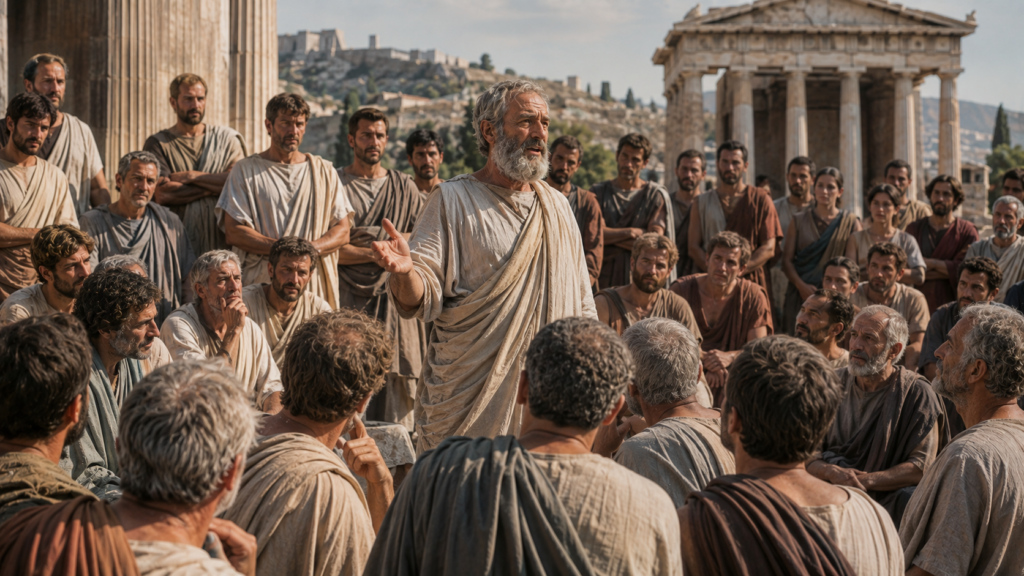
One important step came from Solon, an Athenian statesman who carried out reforms around 594 BCE.
Solon’s reforms did not create democracy in its later Athenian form.
But they changed the political system and weakened some of the advantages held by the traditional aristocracy.
He also helped establish broader legal and political participation among citizens. Later democratic reforms built on this earlier foundation. (World History Encyclopedia)
Solon’s importance lies partly in what his reforms demonstrated.
Political institutions could be changed.
The distribution of political power did not have to remain fixed.
Government could be redesigned through laws and institutions.
That idea would become increasingly important.
Why Didn’t Solon Create Full Democracy?
Solon’s reforms still preserved significant differences between social groups.
Political participation was not yet based on the principle that every citizen should have an equal role in government.
Athens continued to experience political conflict.
Eventually, periods of tyranny followed.
This shows something important about the development of democracy.
Democracy was not created because one leader designed a perfect system.
It emerged through repeated attempts to solve political problems.
One reform created new possibilities.
Another political crisis exposed weaknesses.
Another reform followed.
The process continued.
What Happened After the Tyrants?
Athens eventually experienced a struggle between competing political groups.
One important figure was Cleisthenes.
Around 508 BCE, Cleisthenes introduced major reforms that reorganized the political structure of Athens.
He reduced the influence of traditional family and aristocratic networks by reorganizing citizens into new political units called demes and tribes. (World History Encyclopedia)
This was a major change.
Political identity became less dependent on traditional aristocratic groupings.
More ordinary citizens gained a meaningful role in the political system.
Cleisthenes is therefore widely associated with the establishment of Athenian democracy.
How Did Cleisthenes Change Athens?
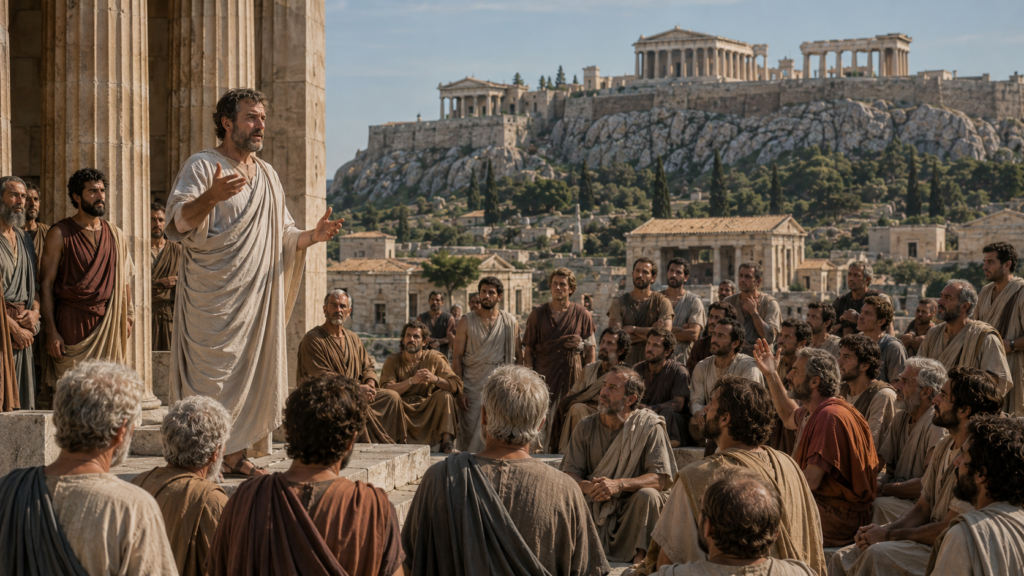
The reforms changed how citizens were organized.
Athens was divided into local units called demes.
These demes were organized into larger political groupings.
The new system reduced the power of traditional clan structures and created a broader political organization across the population.
Cleisthenes also helped establish institutions that gave citizens greater influence over political decisions. (World History Encyclopedia)
The important change was structural.
Instead of political power depending primarily on aristocratic family connections, the system gave the citizen body a much larger role.
This helped establish the foundation for direct democracy.
What Did Athenian Citizens Actually Do?
Athenian democracy was direct.
Citizens did not simply elect representatives who would make most political decisions for them.
They could participate themselves.
The main democratic body was the Assembly.
Citizens could attend, speak, debate proposals, and vote on important decisions.
The Assembly dealt with issues including legislation, military decisions, finances, treaties, and other matters affecting the city. (World History Encyclopedia)
This was radically different from most modern democratic systems.
A modern citizen usually votes for representatives.
An Athenian citizen could participate directly in the decision-making process.
Where Did the Assembly Meet?
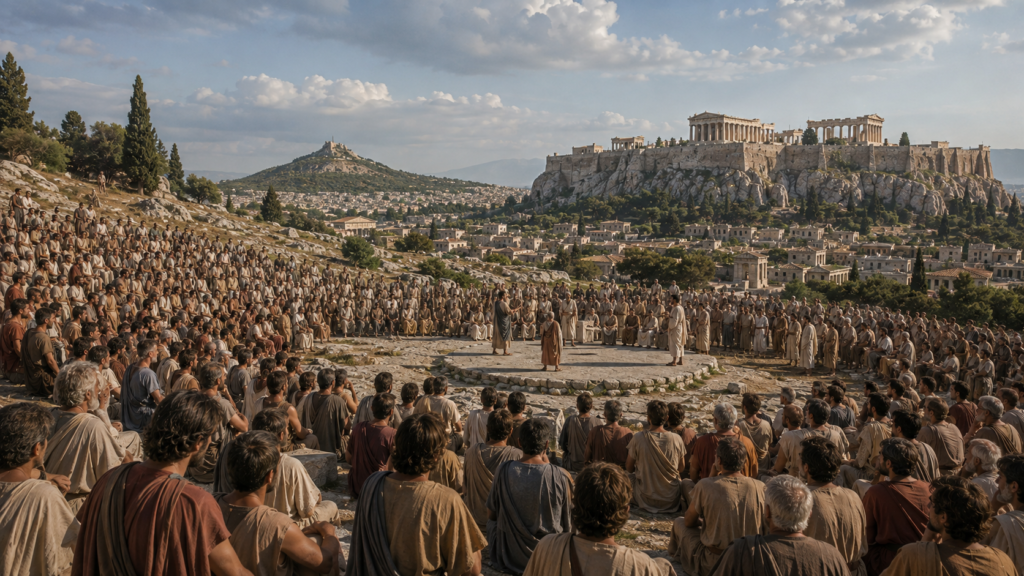
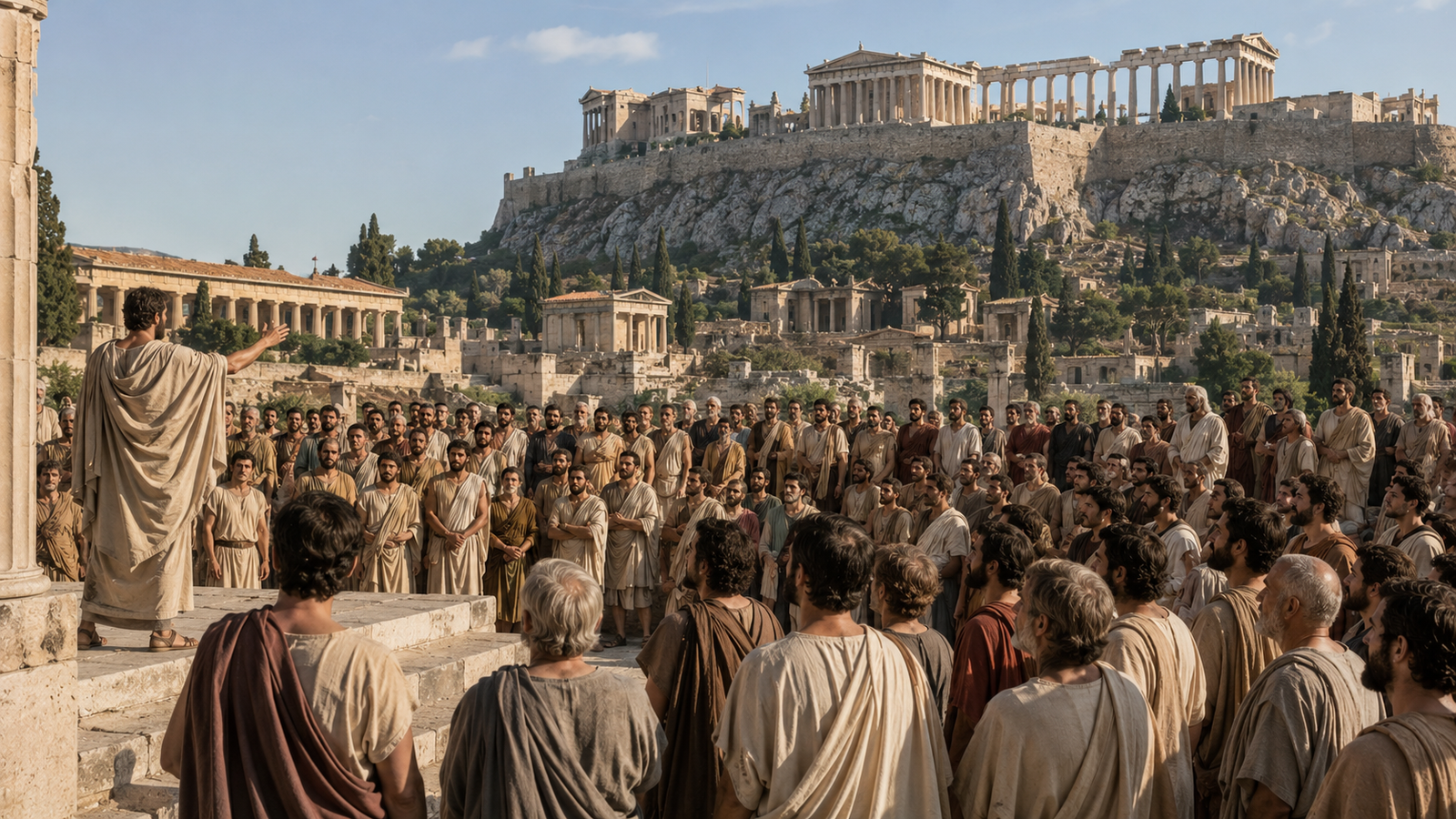
The Assembly met on the Pnyx, a hill in Athens.
Thousands of citizens could gather there.
Citizens could speak before the Assembly and vote on decisions.
The majority determined the outcome.
This created a political environment in which public speaking, persuasion, debate, and civic participation became important skills. (World History Encyclopedia)
Political power was therefore something citizens were expected to exercise directly.
Government was not simply something done to them.
They were expected to participate in it.
Did Every Citizen Have Equal Political Power?
Within the citizen body, Athenian democracy pursued political equality.
But the citizen body itself represented only a portion of the total population.
Women were excluded from political participation.
Enslaved people were excluded.
Foreign residents were excluded.
Therefore, ancient Athenian democracy was democratic within a restricted political community.
That distinction is essential.
Calling Athens the birthplace of democracy does not mean Athens practiced modern universal democracy.
It means Athens developed one of the earliest well-documented systems in which a substantial body of citizens directly exercised political power.
Why Was Random Selection Used?
Athenian democracy used an unusual method for filling many public positions.
Officials could be selected by lot.
Instead of allowing elections to determine every position, citizens were sometimes chosen randomly.
The reasoning was important.
If wealthy or powerful individuals could dominate every office, political equality would weaken.
Random selection gave ordinary citizens a chance to participate directly in government.
The Council was also selected through mechanisms involving citizen groups and lot selection. Many magistrates and jurors were chosen by lot during the mature democratic period. (The Metropolitan Museum of Art)
This idea is very different from modern elections.
But it reflected a central Athenian concern.
Government should not become the permanent possession of a political elite.
What Was Ostracism?
Athens developed another unusual political institution called ostracism.
Citizens could vote to exile a person considered dangerous or excessively powerful.
The purpose was partly to protect the political system from individuals who might threaten the balance of power.
The practice is associated with the reforms of Cleisthenes, although its exact early development is debated in the historical sources. (World History Encyclopedia)
Ostracism shows how seriously Athenians considered the danger of concentrated political power.
The system was designed around participation.
But it also contained mechanisms intended to prevent an individual from becoming too dominant.
How Did Democracy Continue to Develop?
Cleisthenes established the foundation.
The system continued changing afterward.
During the fifth century BCE, further reforms expanded the direct character of Athenian democracy.
Pericles became one of the most influential political figures of this period.
By the middle of the fifth century BCE, Athens had developed a system in which citizens participated extensively in political decision-making. (The Metropolitan Museum of Art)
The result was not a fixed constitution created at one moment.
It was a developing political system.
Institutions changed.
Political participation expanded.
Citizens gained more direct control over public affairs.
Why Was This Idea So Revolutionary?
The revolutionary part was not simply voting.
The deeper change was the idea that political authority could belong to ordinary citizens.
Government did not have to be the private property of a ruling family.
It did not have to belong permanently to a king.
It did not have to remain controlled by a small aristocratic group.
Citizens could collectively exercise political power.
That changed the relationship between the individual and the state.
A citizen was no longer simply someone governed by political authorities.
A citizen could become part of the governing process.
Was Athenian Democracy Perfect?
No.
It had serious limitations.
Large parts of the population were excluded.
Enslaved people had no political rights.
Women could not participate in the Assembly.
Foreign residents were excluded from citizenship.
The system could also make decisions that modern observers would consider deeply problematic.
The execution of Socrates in 399 BCE is one famous example of a decision made by the Athenian political system. (World History Encyclopedia)
Democracy therefore does not automatically guarantee wise decisions.
It creates a mechanism for distributing political power.
How that power is used depends on the institutions, information, culture, and judgment of the people participating.
Did Democracy Spread Immediately?
No.
Athenian democracy was one example among several political experiments in the ancient Greek world.
Other city-states also developed democratic forms of government, including Argos, Syracuse, Rhodes, and Erythrai. (World History Encyclopedia)
Athens became especially important because its democratic institutions were relatively well documented and developed into a substantial direct political system.
Its influence was therefore greater than its geographic size might suggest.
What Happened to Athenian Democracy?
The system did not remain stable forever.
Athens experienced periods of political crisis and oligarchic rule.
In 411 BCE, an oligarchic government replaced the democracy.
Democracy was restored in 403 BCE after the rule of the Thirty Tyrants. (World History Encyclopedia)
This reveals another important feature of the history of democracy.
Democracy is not necessarily permanent.
Political institutions can change.
Power can move toward broader participation.
It can also move back toward concentrated rule.
The survival of democratic institutions depends on political structures and the willingness of citizens to defend them.
How Did Ancient Democracy Influence Later Ideas?
The Athenian experiment became an important reference point for later thinkers and political systems.
The idea that citizens could participate directly in government survived in political philosophy and historical writing.
Centuries later, political thinkers studying government continued to examine the successes and failures of Athens.
Modern democracy is not simply ancient Athens copied into the present.
Modern systems developed through many different historical traditions, including representative government, constitutional law, political rights, and ideas about individual liberty.
But the Athenian experiment provided an important early demonstration.
Political power could be organized around citizen participation.
What Is the Biggest Difference Between Ancient and Modern Democracy?
The biggest difference is representation and inclusion.
Athens relied heavily on direct participation.
Modern democracies usually rely on elected representatives.
Modern democratic systems also generally define citizenship and political rights much more broadly than ancient Athens did.
Women and other groups excluded from Athenian citizenship now participate in many democratic systems.
The political philosophy has therefore changed substantially.
But one basic question remains.
Who should have the power to make decisions about the community?
That question connects ancient Athens to modern political life.
The Simple History of Democracy
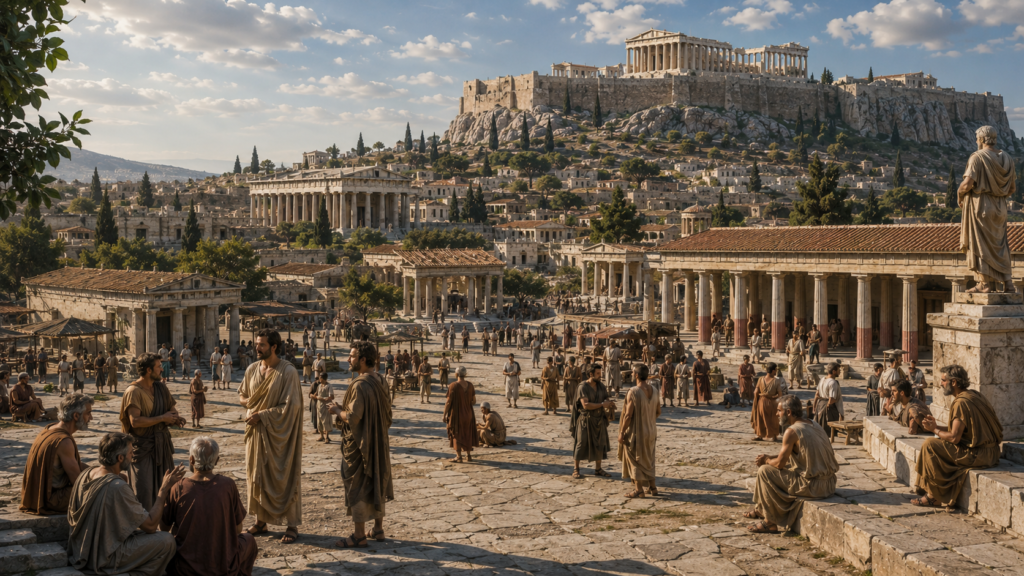
The development can be reduced to a sequence.
Athens experienced political inequality and conflict.
Solon introduced important reforms.
Tyranny and political struggles continued.
Cleisthenes reorganized the political structure around broader citizen participation.
The Assembly became central to political decision-making.
Citizens participated directly in public affairs.
Later reforms expanded democratic institutions.
The system survived crises, periods of oligarchy, and restoration.
Over time, the Athenian experiment became one of history’s most influential examples of citizen government.
It was incomplete.
It was restricted.
It was sometimes unstable.
But it introduced an idea that would continue to influence political thought for centuries.
The Strange Lesson of Democracy
Democracy did not begin as a finished system.
It emerged from conflict.
People disagreed about who should have power.
Political institutions changed.
Some reforms succeeded.
Others created new problems.
The Athenians experimented with different ways of distributing political authority.
The result was a political system in which citizens could directly participate in government.
That system excluded many people.
It also made serious mistakes.
Yet its central idea was powerful.
Political authority does not have to belong permanently to a small group.
Citizens can participate in deciding how their community is governed.
That idea would survive long after ancient Athens disappeared.
Related Reading
Key Takeaways
- Democracy developed gradually rather than appearing in a single moment.
- Solon’s reforms in the sixth century BCE helped weaken some traditional aristocratic advantages.
- Cleisthenes’ reforms around 508 BCE established the foundation of Athenian democracy.
- Athenian democracy relied heavily on direct citizen participation.
- The Assembly allowed citizens to debate and vote on major political decisions.
- Many public positions were filled through selection by lot.
- Ostracism allowed citizens to remove individuals considered dangerously powerful.
- Athenian democracy excluded women, enslaved people, and foreign residents from political participation.
- The system experienced periods of oligarchy before democracy was restored.
- The Athenian experiment became an important influence on later thinking about citizen government.
Conclusion
Democracy did not begin with a single declaration.
It developed through political conflict, reform, experimentation, and institutional change.
Solon helped weaken parts of the old aristocratic system.
Cleisthenes reorganized Athenian political life and greatly expanded citizen participation.
Later reforms developed the system further.
For the citizens who were included, government became something they could participate in directly.
That was the revolutionary idea.
Political power did not have to remain permanently concentrated in the hands of a king, aristocratic family, or small ruling group.
Citizens could govern themselves.
Ancient Athens did not create modern democracy.
Its system excluded much of its population and operated under assumptions very different from those of contemporary democratic societies.
But it demonstrated something historically important.
The way a society distributes political power can be changed.
And once people begin asking who should have the right to govern, the idea of democracy can become much larger than the city where it first took shape.
Explore more evidence-based explanations of ideas, institutions, and the history of human knowledge in CAVELYRA’s History of Ideas collection.