You step outside on a cold morning.
A chill moves across your skin.
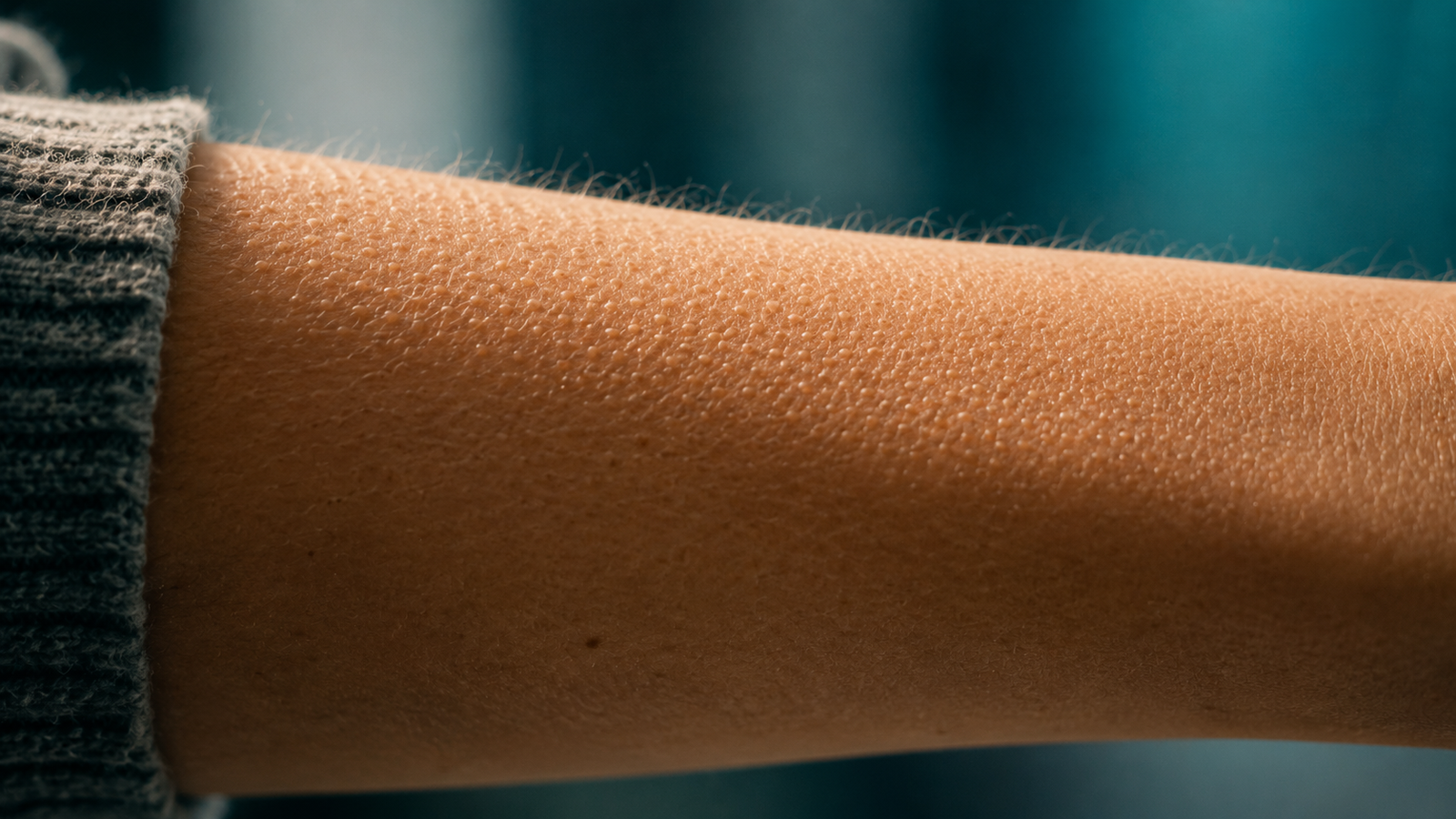
Suddenly, tiny bumps appear on your arms.
Why do we get goosebumps when we are cold, scared, or emotionally moved? The answer involves your nervous system, tiny muscles in your skin, and the hair follicles beneath the surface.
Or perhaps you hear a piece of music that gives you chills. You feel a powerful emotional moment, and the same thing happens.
Your skin changes almost instantly.
These are goosebumps, also called piloerection.
Goosebumps occur when tiny muscles attached to hair follicles contract and pull the hairs upright.
The reaction looks simple, but it involves your nervous system, tiny muscles in your skin, hair follicles, and changes in your body’s response to the environment.
In humans, goosebumps can appear because of cold, touch, and strong emotional or sensory experiences. Recent research suggests that human piloerection is more complex than simply being an evolutionary leftover from our hairier ancestors.
Goosebumps occur when tiny muscles attached to hair follicles contract and pull the hairs upright.
What Actually Causes Goosebumps?
Each hair on your body grows from a structure called a hair follicle.
Attached to many of these follicles is a tiny smooth muscle called the arrector pili muscle.
When this muscle contracts, it pulls the hair follicle into a more upright position.
The surrounding skin is pulled slightly upward.
That creates the small raised bumps you see on the surface.
The process is called piloerection.
It is controlled mainly by the sympathetic branch of your autonomic nervous system, which regulates many functions that occur without conscious control.
You do not normally tell these muscles to contract.
Your nervous system does it automatically.
Why Do We Get Goosebumps When We Are Cold?

Cold is one of the clearest triggers.
When your body detects a drop in temperature, thermoregulatory systems begin responding.
Blood vessels in the skin can constrict.
Your body reduces heat loss from the surface.
Your nervous system can also activate the muscles around hair follicles, producing goosebumps.
In mammals with thick fur, raising the hair creates a layer of trapped air that can improve insulation.
Humans have much less body hair, so this effect is limited.
The response remains, but it no longer provides the same level of insulation that it would in a heavily furred animal.
cold activates thermoregulatory responses that can include piloerection.
Why Would Raising Your Hair Keep You Warm?
Imagine an animal with thick fur.
When its hairs stand upright, the fur can change the layer of air next to the skin.
That trapped air can provide additional insulation.
This makes piloerection useful as part of the cold response in many mammals.
Humans evolved with far less body hair.
As a result, goosebumps have little practical effect on keeping us warm.
The reflex remains because the underlying nervous and muscular system is still present.
This is one reason goosebumps are often described as a vestigial thermoregulatory response in humans.
But that description needs some qualification.
Recent research has found that human piloerection responds to environmental changes and may have biological effects beyond simply raising body hair.
Why Do We Get Goosebumps When We Are Scared?

Cold is not the only trigger.
Fear can also produce goosebumps.
Imagine walking through a dark room and suddenly hearing an unexpected sound.
Your body may react before you consciously decide what the sound means.
The sympathetic nervous system becomes active during many forms of emotional arousal.
Heart rate can change.
Breathing can change.
Sweating can increase.
Blood flow can shift.
Piloerection can occur as part of the same broad autonomic response.
This is why goosebumps can appear when you are frightened or intensely alert.
The skin response is part of a larger physiological reaction.
Fear can activate the sympathetic nervous system and produce goosebumps alongside other physical responses.
Why Does Music Give Some People Goosebumps?
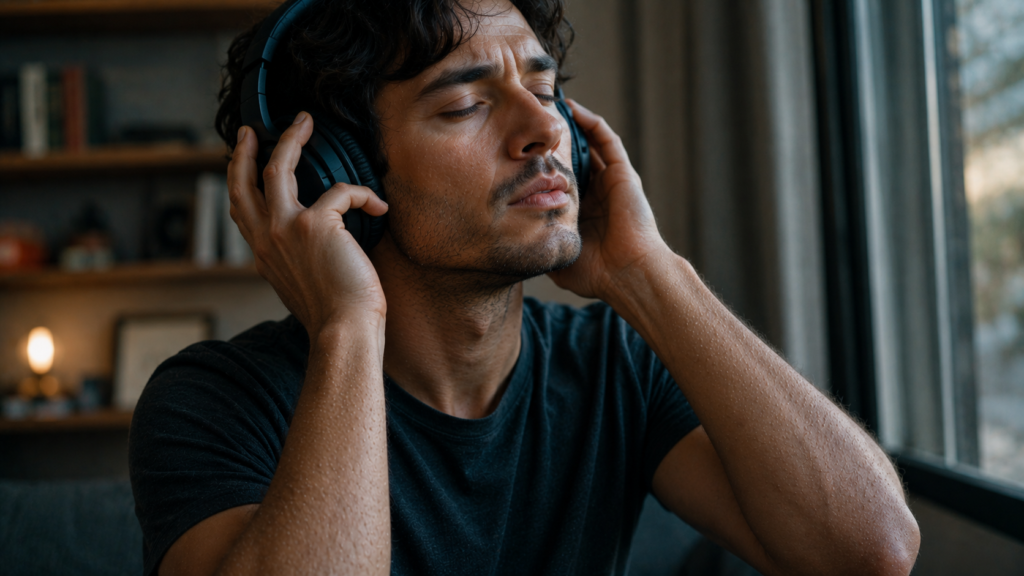
This is one of the most interesting forms of piloerection.
You hear a particular song.
A familiar voice enters.
The music builds toward a powerful moment.
Suddenly, you feel a chill.
The hairs on your arms rise.
Research has shown that emotionally powerful music and film can trigger measurable piloerection in some people. Emotional goosebumps have been associated with increased physiological arousal and the subjective experience of being deeply moved.
The response is not simply about whether a piece of music is loud.
It can be connected to anticipation, surprise, emotional meaning, memories, and the way a person responds to the experience.
That is why the same song can produce goosebumps in one person but have little physical effect on another.
Are Goosebumps Always About Fear?
No.
This is an important distinction.
Goosebumps can accompany fear, but they can also occur during positive or emotionally powerful experiences.
A moving piece of music.
A powerful scene in a film.
A speech.
A reunion.
A moment of awe.
These experiences can produce strong physiological responses.
Research on emotional piloerection has found associations with states of being moved or emotionally touched, rather than fear alone.
Your body does not have a separate skin response for every emotion.
Different emotional experiences can activate overlapping physiological systems.
That is why a feeling of awe and a feeling of fear can sometimes produce similar physical signs.
What Does the Sympathetic Nervous System Have to Do With It?
The sympathetic nervous system is part of your autonomic nervous system.
It helps regulate automatic responses to changes in your environment and internal state.
When sympathetic signals reach the muscles attached to hair follicles, those muscles contract.
The hairs become more upright.
The skin around them rises.
Goosebumps appear.
The same general nervous system can also influence heart rate, sweating, blood vessel diameter, and other physiological responses.
This means goosebumps are not an isolated skin event.
They are one visible expression of activity occurring throughout the body.
Why Does the Skin Look Bumpy?
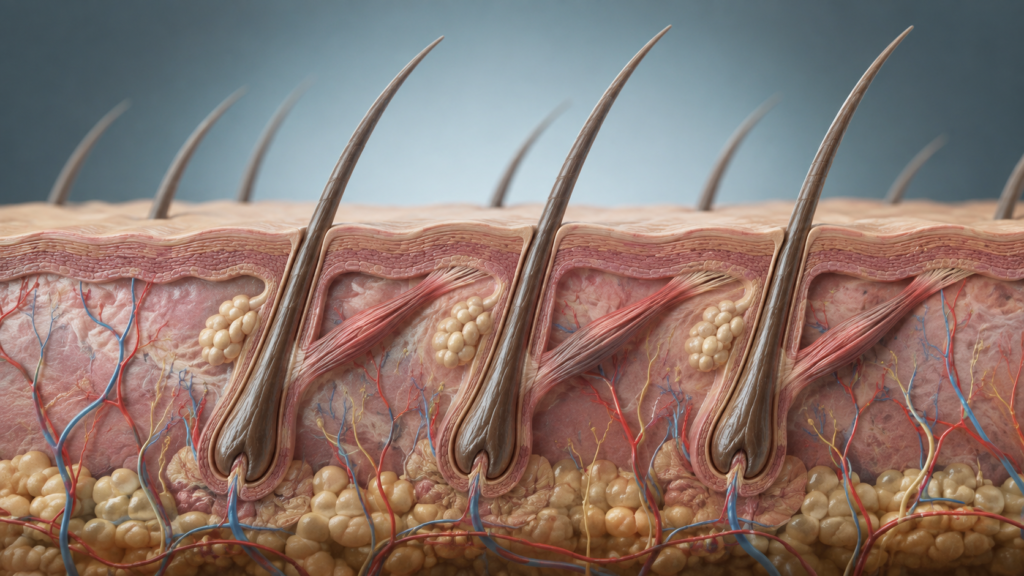
The bumps are created by the anatomy of the hair follicle.
When the arrector pili muscle contracts, it pulls on the follicle.
That changes the angle of the hair and creates a small elevation in the surrounding skin.
Because you have many hair follicles across areas of your body, thousands of tiny contractions can produce the familiar rough appearance.
The bumps are therefore not caused by the skin itself suddenly growing.
They are caused by small muscles changing the position of the structures beneath the skin.
Why Do Goosebumps Disappear?
The response does not usually last very long.
Once the triggering stimulus changes, sympathetic activity can decrease.
The arrector pili muscles relax.
The hairs return toward their normal position.
The raised skin gradually disappears.
If you are cold, however, goosebumps may continue while the thermoregulatory response remains active.
The same applies to emotional triggers.
A powerful experience can produce repeated or sustained episodes of piloerection while the emotional response continues.
Can Touch Cause Goosebumps?
Yes.
Goosebumps are not limited to cold and emotion.
Recent research has found that tactile stimulation can also produce piloerection in humans, showing that the response can be triggered by different types of environmental input.
This finding is important because it challenges the idea that human goosebumps are purely a leftover cold response.
The skin is an active sensory organ.
It constantly receives information about temperature, touch, pressure, and other environmental changes.
The nervous system can translate some of those signals into an automatic physiological response.
Are Goosebumps Completely Useless in Humans?
Not necessarily.
For a long time, scientists viewed human piloerection primarily as a remnant of an older thermoregulatory system.
Humans no longer have enough body hair for raised hairs to provide substantial insulation.
But recent work suggests that human piloerection can respond to thermal, tactile, and audiovisual stimuli and may be associated with measurable changes in autonomic activity and skin temperature.
That does not mean goosebumps have a single hidden function that scientists have now discovered.
It means the response may be more biologically active than the simple “vestigial reflex” explanation suggests.
The exact functional significance of human goosebumps remains an area of research.
Can You Get Goosebumps Without Being Cold?
Yes.
You can experience goosebumps while sitting in a warm room.
A frightening sound can trigger them.
A piece of music can trigger them.
A strong memory can accompany them.
A powerful emotional experience can produce them.
These reactions demonstrate that goosebumps are connected to more than temperature regulation.
They are part of the body’s broader response to environmental and emotional signals.
Why Do Goosebumps Feel Like a Sudden Wave?
You may notice goosebumps spreading across your skin rather than appearing everywhere simultaneously.
This happens because the underlying autonomic response can develop across different regions of the body.
Hair follicles are distributed throughout the skin, and their associated muscles respond to sympathetic signals.
The result can feel like a wave moving across your arms, neck, back, or scalp.
The sensation may be especially noticeable when a strong emotional stimulus produces a rapid physiological response.
When Should Goosebumps Concern You?
Ordinary goosebumps caused by cold, emotion, or other familiar triggers are normal.
They do not usually indicate a problem.
The situation is different if unexplained episodes occur repeatedly alongside other neurological symptoms, unusual sensations, confusion, loss of awareness, or other concerning changes.
Rare neurological conditions can involve piloerection as part of an abnormal autonomic response. For example, pilomotor seizures are an uncommon seizure manifestation associated with episodes of goosebumps.
The important point is context.
Goosebumps by themselves are usually a normal body response.
Unexplained recurrent episodes combined with other unusual symptoms deserve appropriate medical evaluation.
The Evolutionary Story Behind Goosebumps
Goosebumps offer a small window into evolution.
An animal covered in thick fur can benefit from raising that fur when cold or threatened.
The response can increase insulation or make the animal appear larger during certain social or defensive situations.
Humans lost most of that body hair over evolutionary time.
But the underlying neural circuitry and tiny muscles attached to hair follicles remained.
The result is a response that looks almost pointless when viewed only from the human perspective.
Yet the system is still biologically connected to temperature regulation and autonomic responses.
Evolution does not necessarily remove every mechanism when its original advantage becomes smaller.
Sometimes the machinery remains.
The Strange Lesson of Goosebumps
Goosebumps look like a simple reaction on the surface of the skin.
But they reveal a much larger system.
A change in temperature can trigger the response.
A sudden emotional experience can trigger it.
Music can trigger it.
Touch can trigger it.
The sympathetic nervous system sends signals.
Tiny muscles contract.
Hair follicles change position.
Your skin rises.
Then the response fades.
For humans, goosebumps no longer provide the same insulation they can provide to furry mammals.
But the underlying system remains active.
And every time you get chills from cold or emotion, you are seeing the nervous system communicate with your skin in real time.
Key Takeaways
- Goosebumps are called piloerection.
- Tiny arrector pili muscles attached to hair follicles create the raised appearance.
- The sympathetic nervous system controls this response.
- Cold is a common trigger.
- Fear and other strong emotions can also produce goosebumps.
- Music and emotionally powerful experiences can trigger piloerection in some people.
- Touch can also produce the response.
- Goosebumps have a clear thermoregulatory role in furry mammals, while their functional significance in humans is more limited and still being studied.
- Human piloerection is more complex than a simple response to cold.
- Unexplained recurrent goosebumps accompanied by other neurological symptoms warrant medical evaluation.
Conclusion
Goosebumps are one of the clearest examples of how an ancient biological response can remain visible in the modern human body.
When you are cold, your nervous system can activate tiny muscles around your hair follicles.
When you are frightened, the same broad autonomic system can become active.
When music or a powerful emotional experience moves you, goosebumps can appear again.
The response begins beneath the skin.
Nerves send signals.
Tiny muscles contract.
Hair follicles change position.
The skin rises.
Then, when the signal fades, everything gradually returns to normal.
What looks like a simple reaction is actually a meeting point between your skin, nervous system, emotions, environment, and evolutionary history.