

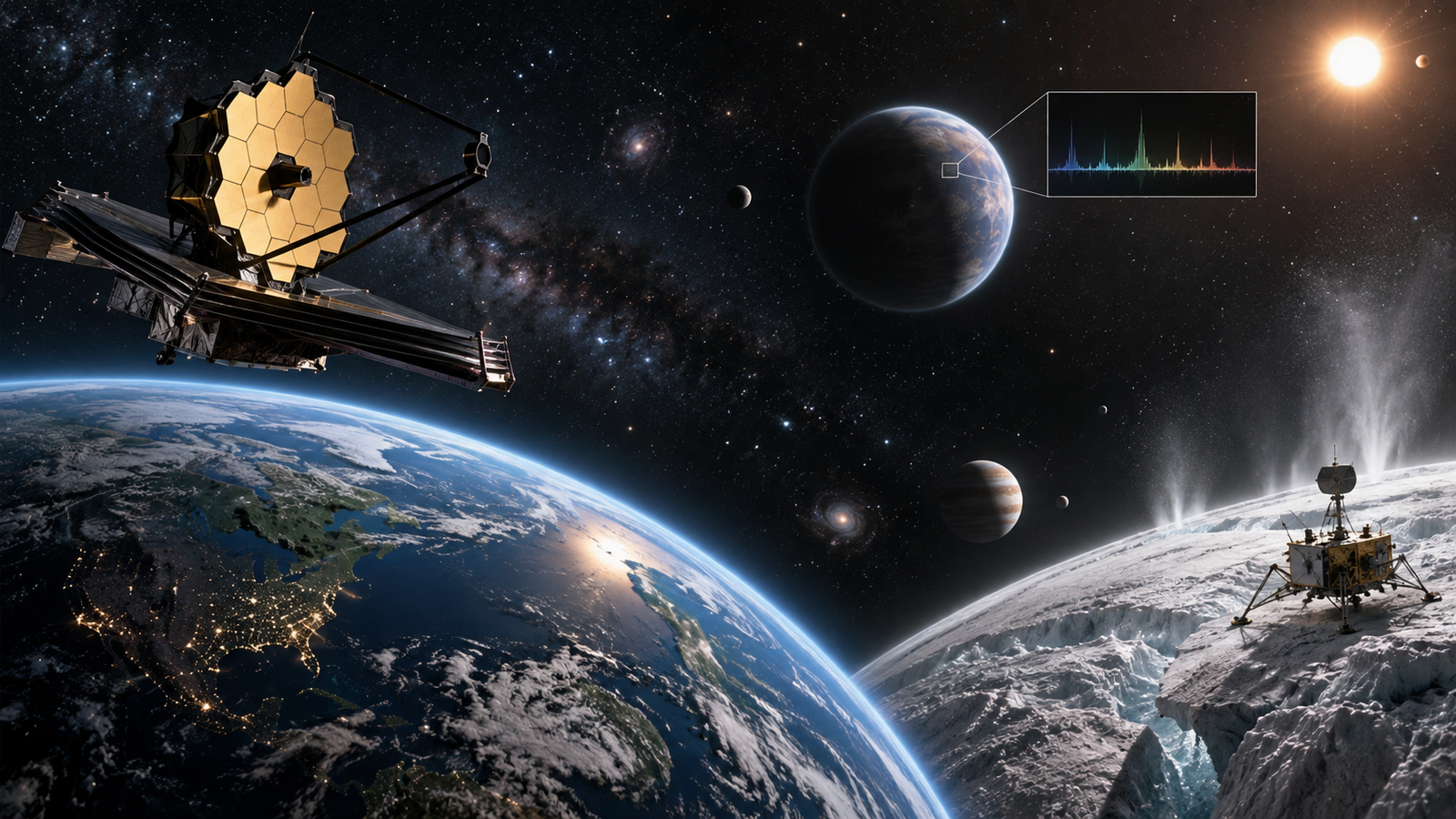
For thousands of years, humans have looked at the night sky and wondered whether anyone else might be looking back.
Today, that question can be investigated scientifically.
Astronomers can discover planets orbiting distant stars. They can study the chemistry of planetary atmospheres, investigate moons with oceans hidden beneath ice, examine environments that may once have supported life, and search for signals that could reveal technological activity.
Yet one fact remains unchanged:
Earth is still the only world where life has been confirmed.
Scientists have not found credible evidence that extraterrestrial life exists. At the same time, they have identified many environments beyond Earth that are scientifically worth investigating because some of their conditions could potentially support life.
So are we alone?
We do not know.
But we now have a much better idea of how to search for an answer.
What Do Scientists Mean by Extraterrestrial Life?
Extraterrestrial life simply means life that originated beyond Earth.
That definition is deliberately broad.
Scientists are not necessarily searching for intelligent beings or civilizations. The first confirmed discovery of extraterrestrial life, if it happens, could be something much simpler.
It might be a microorganism.
It might be preserved evidence of organisms that lived billions of years ago.
It could be a biological signature detected in the atmosphere of another planet.
Or it could be evidence of a technological civilization.
These possibilities require very different search strategies.
Microbial Life
Microbial life would be one of the simplest major targets.
A microorganism does not need cities, spacecraft, radio transmitters, or intelligence. It only needs to satisfy the biological requirements necessary for life to exist.
Finding even a single independent example of life would be extraordinary because it would demonstrate that life is not unique to Earth.
Complex and Intelligent Life
Life elsewhere could potentially become more complex, but scientists do not know how common complex life is.
Earth contains everything from single-celled organisms to highly complex ecosystems. Yet Earth itself existed for billions of years before humans appeared.
That matters because finding life would not automatically mean finding intelligence.
An inhabited world might contain only microbial organisms.
Technological Civilizations
A technological civilization creates another possibility.
Scientists can search for technosignatures, which are potential detectable effects of technology. These might include artificial radio or laser signals, unusual atmospheric chemicals, or other large-scale technological effects.
The question becomes very different:
Does something technologically active exist somewhere beyond Earth?
Why Is Earth Still the Only Confirmed Example?
Astrobiology has a fundamental limitation.
We have only one confirmed example of life.
Earth.
That gives scientists an enormous amount of information about terrestrial biology, but it also creates uncertainty. We do not know whether Earth’s biology represents a universal pattern or simply one possible form that life can take.
All known life uses carbon-based chemistry. Life as we know it also depends on liquid water, and terrestrial organisms rely on complex molecular systems.
But scientists have never examined an independent extraterrestrial organism.
That means researchers must distinguish carefully between two ideas:
What supports life on Earth and what life might be capable of elsewhere.
This distinction becomes especially important when scientists discuss potentially habitable worlds.
What Makes a World Potentially Habitable?
When scientists describe a planet or moon as potentially habitable, they are not saying that life has been found there.
They mean that some conditions may be suitable for life.
For life as we know it, scientists often consider three broad ingredients:
- Liquid water
- Appropriate chemical ingredients
- A source of energy
Europa, one of Jupiter’s moons, is an important example.
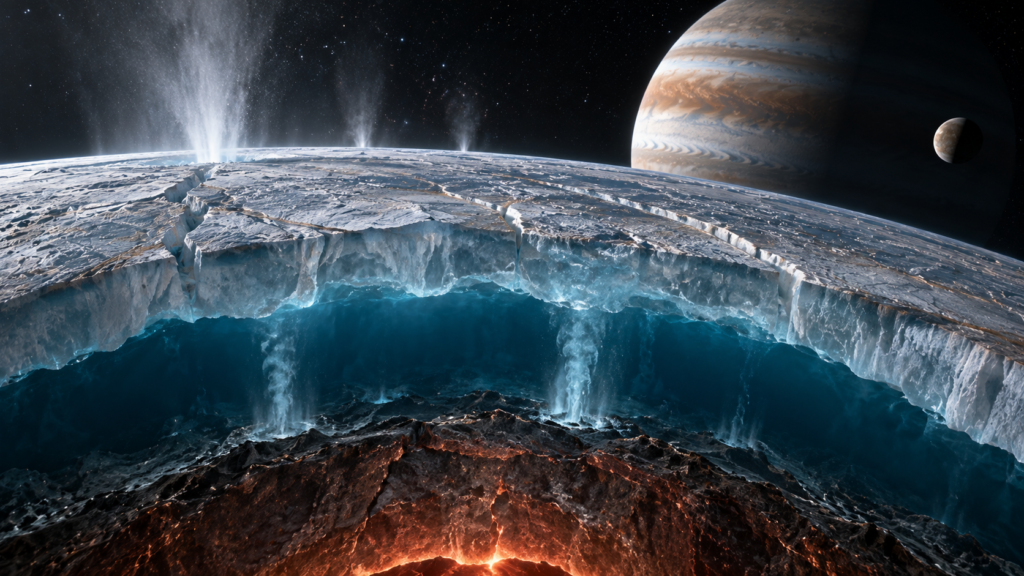
Evidence indicates that Europa has a salty ocean beneath its icy crust. Its interactions with Jupiter provide an internal source of heat, and scientists are interested in its chemistry and possible interactions between water and rock.
Enceladus, a moon of Saturn, is another important target.
The Cassini mission found evidence of a global subsurface ocean and detected material escaping into space through plumes. Those materials include water, organic compounds, salts, and molecular hydrogen.
These observations make Enceladus an especially interesting environment for studying potential habitability.
But the distinction is crucial:
The presence of ingredients that could support life is not a discovery of life.
Why Does Liquid Water Matter?
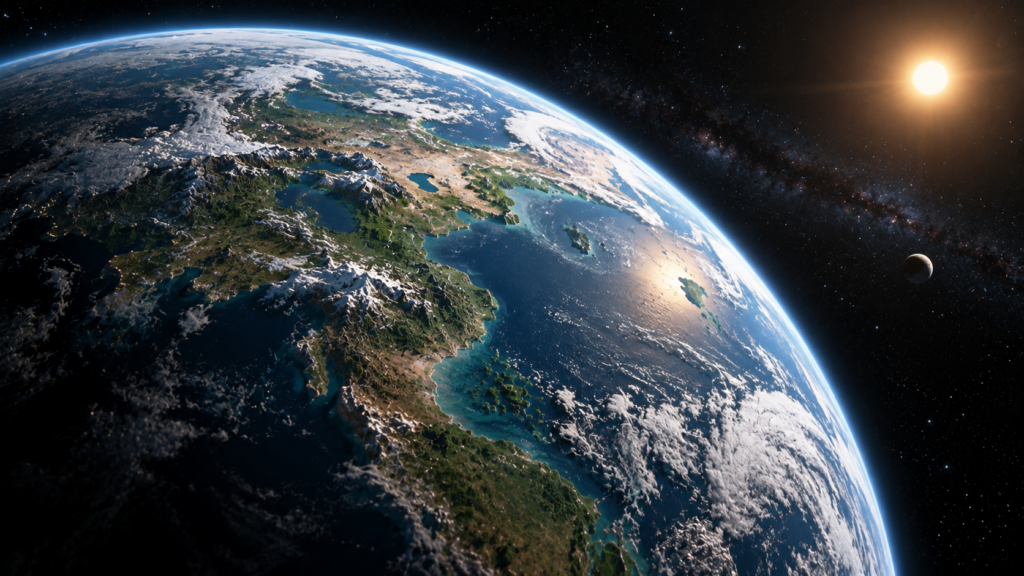
Water is important because all known life on Earth depends on it.
It acts as a solvent, allowing chemicals to move and participate in biochemical reactions. It also plays important roles in transporting materials within living systems.
That makes liquid water a natural starting point when scientists assess potential habitats.
But water alone proves very little.
A world can contain water without containing organisms.
Mars illustrates this clearly.
Ancient Mars had rivers, lakes, and other environments involving liquid water. Scientists are investigating whether some of those environments could once have supported life.
But evidence that water existed does not establish that life ever existed there.
The same principle applies to icy moons.
A potentially habitable environment is not necessarily an inhabited environment.
How Do Scientists Actually Search for Extraterrestrial Life?
There is no single alien detector.
Scientists use several complementary strategies.
Some involve direct exploration. Others depend on remote observations. Some search specifically for biology, while others search for evidence of technology.
Exploring Nearby Worlds
Mars is one of the most accessible targets.
Robotic spacecraft can examine rocks, study minerals, measure atmospheric chemistry, and investigate geological environments.
NASA’s Perseverance rover is collecting rock samples because carefully preserved geological material could contain evidence relevant to the question of ancient Martian life.
Other targets include Europa and Enceladus, where subsurface oceans make the moons especially interesting for astrobiology.
Studying Planetary Atmospheres
Distant exoplanets cannot currently be explored in the same way.
Instead, astronomers can study their light.
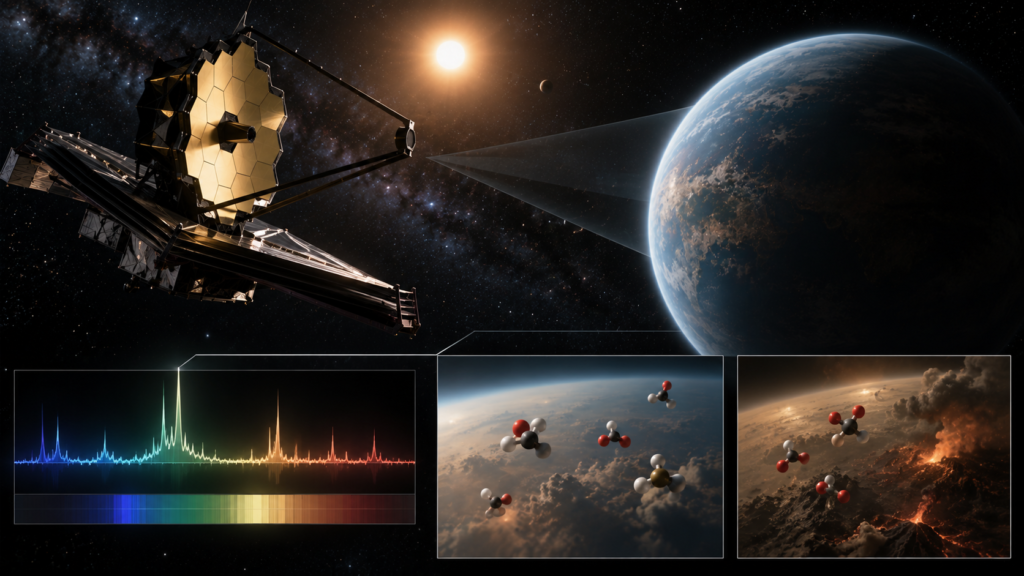
When a planet passes in front of its star, some starlight travels through the planet’s atmosphere. Different gases absorb different wavelengths of light.
By analyzing those patterns through spectroscopy, scientists can infer information about atmospheric molecules.
This provides a way to investigate worlds that are unimaginably far away.
Searching for Biosignatures
A biosignature is a feature that could provide evidence of life.
It might be a molecule, a combination of atmospheric gases, a mineral pattern, a microscopic structure, or another measurable feature associated with biological activity.
But a biosignature is not automatically proof.
The critical question is:
Could something other than life produce the same observation?
Why Are Biosignatures So Difficult to Interpret?
Imagine that astronomers detect oxygen in the atmosphere of a distant planet.
That would be interesting.
Earth has abundant atmospheric oxygen because biological activity has played a major role in producing and maintaining it. But oxygen is not automatically proof of extraterrestrial life.
Under some planetary conditions, non-biological processes can also produce oxygen.
These possibilities are known as false positives.
This is why scientists examine potential biosignatures in their planetary context.
They need to understand the planet’s atmosphere, temperature, chemistry, star, geological activity, and other relevant conditions.
A strong biosignature is therefore not simply a molecule that life can produce.
It is evidence that becomes difficult to explain through non-biological processes.
False Negatives Matter Too
There is another challenge.
False negatives.
A world might contain life without producing an obvious detectable biosignature.
Perhaps the organisms are extremely rare.
Perhaps they live beneath the surface.
Perhaps their biological activity is too weak to significantly alter the atmosphere.
Perhaps relevant molecules break down before they can be detected.
Or perhaps our instruments are simply not sensitive enough.
So failing to detect life does not necessarily demonstrate that life is absent.
The observation itself may be insufficient.
This is why life-detection research has to consider both possibilities: observations that look biological but have non-biological explanations, and biological activity that produces no obvious detectable signal.
Scientists Need Context, Not Just One Signal
Suppose a telescope detects methane on a distant planet.
Is that evidence of life?
Not by itself.
Methane can be produced by biological processes, but it can also arise through geological and chemical processes.
Now imagine scientists detect methane together with another atmospheric gas.
That could be more interesting.
Add information about the planet’s temperature, atmosphere, geological activity, water availability, and chemical environment, and the interpretation becomes more meaningful.
This is how scientists approach potential biosignatures.
They do not simply ask:
Did we detect molecule X?
They ask:
What explanation best accounts for everything we are observing?
That shift is fundamental to the scientific search for extraterrestrial life.
Why Are Europa and Enceladus So Interesting?
Some of the most promising environments are not planets at all.
They are moons.
Europa and Enceladus are icy worlds with evidence of subsurface oceans.
Europa’s ocean may contain an enormous amount of water, and scientists are interested in whether water, chemistry, energy, and sufficient time could create a potentially habitable environment.
Enceladus offers another advantage for investigation.
Its ocean material is expelled into space through plumes.
The Cassini spacecraft was able to fly through those plumes and analyze their composition.
Scientists found evidence of ingredients that could potentially support microbial metabolism.
But once again, the correct conclusion is about habitability, not confirmed life.
A place capable of supporting life is not necessarily a place containing life.
What About Mars?
Mars remains one of the most important places to investigate because its rocks preserve evidence of a very different ancient environment.
Billions of years ago, Mars had rivers, lakes, and a thicker atmosphere than it has today.
Some ancient environments may have been suitable for microbial life.
That means the scientific question is not simply:
Is Mars alive today?
It is also:
Did Mars ever support life in the past?
That question is difficult to answer.
Ancient biological traces can be destroyed or altered. Chemical signatures can have non-biological explanations. Geological processes can sometimes produce structures that resemble possible biological evidence.
A convincing discovery could therefore require detailed laboratory analysis of carefully selected samples.
That is one reason sample collection and potential sample return are so important to planetary science.
What Are Technosignatures?
The search for extraterrestrial life does not have to focus entirely on biology.
An advanced civilization could leave detectable technological traces.
Scientists call these technosignatures.
Possible examples include:
- Artificial radio signals
- Laser emissions
- Artificial atmospheric chemicals
- Unusual patterns of energy use
- Large engineered structures
A confirmed technological signal could potentially demonstrate the existence of extraterrestrial intelligence without scientists ever finding an alien organism.
But the standard of evidence would be extremely high.
A strange signal is not automatically an alien signal.
It could be interference, a natural astronomical phenomenon, human technology, an instrument problem, or an analytical error.
A credible technosignature would need to survive repeated observations and independent investigation.
What Is the Drake Equation?
In 1961, astronomer Frank Drake introduced an equation designed to organize the question of how many technologically detectable civilizations might exist in the Milky Way.
The equation considers factors such as:
- The rate at which stars form
- The fraction of stars with planets
- The number of potentially suitable planets
- The probability that life develops
- The probability that intelligent life develops
- The probability that technological civilizations emerge
- How long detectable civilizations remain detectable
It is often presented as though it can calculate the number of alien civilizations.
That interpretation goes too far.
Some of the equation’s most important terms remain deeply uncertain.
We now know much more about planets than scientists did in 1961. Thousands of exoplanets have been confirmed, and planetary systems appear to be common.
But we still do not know how frequently life begins, how frequently intelligence develops, or how long technological civilizations remain detectable.
The Drake equation is therefore most useful as a framework for organizing uncertainty.
It helps show where our knowledge ends and our assumptions begin.
Then There Is the Fermi Paradox
If the universe is so large and old, another question naturally follows:
Where is everybody?
This is the basic idea behind the Fermi paradox.
There are enormous numbers of stars. Many have planets. Some planets may have potentially suitable environments, and the universe has existed for billions of years.
If technological civilizations are common and long-lived, why have we not clearly detected one?
That is the puzzle.
Possible explanations include:
- Intelligent life may be extremely rare.
- Microbial life may be common while intelligence is not.
- Technological civilizations may not survive for very long.
- Interstellar communication may be difficult.
- Civilizations may use technologies we cannot detect.
- The distances between civilizations may simply be too large.
- Our search may still be extremely limited.
These are hypotheses.
The Fermi paradox does not establish that any particular explanation is correct. It highlights the tension between the enormous number of possible opportunities for life and our current lack of confirmed evidence.
What Would Count as Convincing Evidence?
This may be the most important question in the entire search.
Imagine that a telescope detects an unusual chemical pattern.
Interesting.
But not immediate proof of life.
Suppose a spacecraft finds organic molecules on another world.
Also interesting.
Still not proof.
Organic molecules can form without life.
Suppose a telescope detects oxygen.
Important.
Still not definitive.
Suppose scientists discover a possible microscopic structure inside a Martian rock.
Extremely interesting.
Still requiring careful analysis.
Scientific confidence becomes stronger when independent lines of evidence point toward the same explanation.
Researchers would want to know:
Is the observation real?
Can it be repeated?
Could contamination explain it?
Could geology or chemistry produce it?
Does the environment support the proposed biological process?
Are there multiple independent signs?
Can other instruments confirm the observation?
Can independent teams reproduce the analysis?
The stronger the evidence survives these tests, the stronger the case becomes.
Why Scientists Are So Careful

Finding extraterrestrial life would be one of the most important discoveries in human history.
That makes scientific caution essential.
Researchers must avoid turning an unusual observation into a discovery before alternative explanations have been tested.
The goal is not to find the most exciting explanation.
The goal is to find the explanation that best survives testing.
That is especially important in astrobiology because many observations can have more than one possible interpretation.
A convincing discovery would need evidence strong enough to withstand repeated measurement, alternative explanations, contamination concerns, independent analysis, and scientific scrutiny.
So, Are We Alone?
Right now, science cannot answer that question.
There is no confirmed extraterrestrial organism.
There is no confirmed extraterrestrial civilization.
There is no confirmed alien transmission.
There is no confirmed biosignature demonstrating that life exists beyond Earth.
But the search has not been empty.
We know that planets are common.
We know that some worlds have environments that could potentially support life.
We know that Mars once had environments where microbial life might have been possible.
We know that Europa and Enceladus have evidence of subsurface oceans.
We know that organic chemistry occurs beyond Earth.
And we have developed instruments capable of studying the atmospheres of worlds orbiting other stars.
The question has therefore become more precise.
It is no longer simply:
Could there be life somewhere else?
It is:
What observations would allow us to distinguish life from non-life?
That is a much more scientific question.
Why Social Connection Matters for Health
The search for extraterrestrial life is ultimately a search for evidence.
Researchers are not simply looking for something unusual. They are trying to determine whether observations are better explained by biology, chemistry, geology, technology, or some combination of these processes.
That requires patience.
It also requires accepting uncertainty.
The same principle explains why a potentially habitable world is not automatically an inhabited world, why a strange signal is not automatically an alien transmission, and why a possible biosignature is not automatically proof of biology.
Science becomes stronger when claims remain proportional to evidence.

Modern observatories give scientists new ways to investigate one of humanity’s oldest questions: whether life exists beyond Earth. (CAVELYRA Visual Archive)
The Search Is Only Beginning
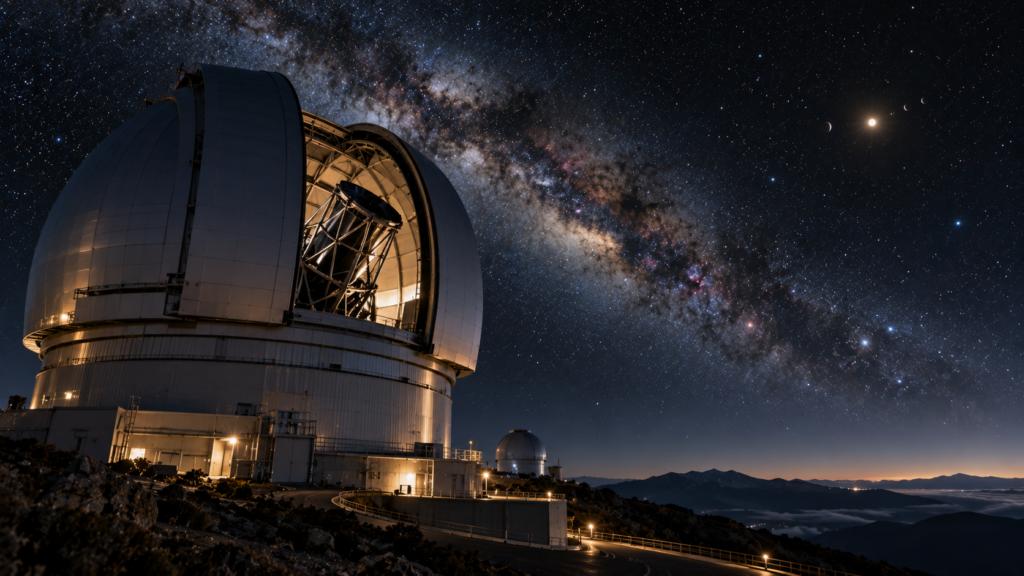
The universe is enormous, while our ability to explore it remains limited.
We cannot visit most potentially habitable worlds. We cannot directly sample the oceans beneath distant icy moons. We cannot yet examine the surfaces of most exoplanets.
Even powerful telescopes see distant worlds primarily through the light they emit or reflect.
Yet science has already transformed the search.
A few decades ago, scientists did not know whether planets around other stars were common.
Now we know they are.
We can identify potentially interesting worlds.
We can study planetary atmospheres.
We can investigate ancient environments on Mars.
We can analyze material released from an ocean world into space.
We can listen for technological signals.
And we can develop increasingly sophisticated methods for deciding whether an unusual observation is actually evidence of life.
That is the real story of the search for extraterrestrial life.
We have not found aliens.
We have found worlds, chemistry, environments, and signals worth investigating.
And perhaps the most important lesson is this:
A world that could support life is not proof of life.
A strange signal is not proof of intelligence.
A promising biosignature is not proof of biology.
But if multiple independent observations repeatedly point toward the same biological explanation, while strong non-biological explanations fail, the evidence could become extraordinary.
Until then, Earth remains the only confirmed world known to harbor life.
Whether it is the only one remains one of science’s greatest unanswered questions.
We are still searching.
And for the first time in human history, we have the instruments to search scientifically.
Related Reading
Key Takeaways
- Earth is still the only confirmed world known to contain life.
- Extraterrestrial life does not necessarily mean intelligent aliens. It could be microbial or preserved evidence of ancient organisms.
- Habitability is not the same as evidence of life. A world can have potentially suitable conditions without being inhabited.
- Liquid water is an important starting point because all known terrestrial life depends on it, but water alone does not prove life.
- Mars, Europa, and Enceladus are important targets because their environments provide scientifically interesting possibilities for past or present habitability.
- Biosignatures are possible signs of biological activity, but scientists must test whether non-biological processes could produce the same observations.
- False positives and false negatives both matter. Life can be mistaken for non-biological activity, and life can also exist without producing an obvious detectable signal.
- Technosignatures offer another route to discovery by searching for detectable effects of technological civilizations.
- The Drake equation organizes uncertainty about how many technologically detectable civilizations might exist rather than providing a known numerical answer.
- The search for extraterrestrial life is ultimately a search for evidence. Scientists need observations that survive repeated testing and alternative explanations.
Conclusion
We still do not know whether life exists beyond Earth.
But that uncertainty is not a failure of science.
It is the question that science is actively learning how to investigate.
Mars preserves evidence of ancient environments. Europa and Enceladus offer intriguing ocean worlds. Exoplanets give astronomers thousands of distant environments to study. Spectroscopy lets scientists examine atmospheric chemistry across immense distances. Technosignature searches provide another way to investigate the possibility of intelligent life.
None of these discoveries has confirmed extraterrestrial life.
That distinction matters.
The search becomes scientifically meaningful when researchers can separate what a world could support from what it actually contains, and what looks unusual from what the evidence can genuinely establish.
For now, Earth remains our only confirmed example.
The answer to whether we are alone is still unknown.
But the search is no longer just a question of imagination.
It is an experiment the universe has not finished answering.
Explore more from CAVELYRA Science Explained for clear explanations of the discoveries, questions, and ideas shaping our understanding of the universe.